Swan Lake

I saw you dance tonight
Through the first floor window
Your arms upraised in ballet stance
First the one and then the other

I knew it was you bywoman-tying-ponytail-vert
your hair tie piece of lace
you use to hold your keys.

There is this grace
when a woman
With the nicer sort of neck
And upper arms
ties a ribbon in her hair
Gathers tall thick brunette silk
A dance in miniature
flowing hands and fingers

And it’s done.

The act isswan-lake-odette-san-francisco-ballet
as beautiful
and effortless
as a swan
.
gliding on a lake

Chris Perley

Posted in Poems | Leave a comment

Full Moon on the Lamb’s Ear

The eternity that
only a child can know,
an interminable drive
through that wild
and stormy night,
on the Desert Road.
.
The window’s whistling –
never quite closed –
incessant whispering
thoughts, bright flashes
in the dark – and rumbles, deep –
disturbing desires to doze.
.
Papatuanuku alive
with laughing love,
telling tales to the little ones,
trying not to notice
in their sleep.
.
Moonlight on the silver sea
closer to Opotiki,
half awake, half asleep,
closer to our beds
.
Pohutukawa
tunnels of love and
welcome silhouettes,
the dancing Waioeka Gorge
sways and pirouettes.
.
The rhythm of a Vauxhall six
growling its way home,
the belonging of our sweet breaths
all contested limbs
together in the back seat,
alone.
.
Being lifted, limp
Protests, grizzles, love
.
And the full moon
on the lamb’s ear,
grey and ghostlike
by the door.

Chris Perley

Lamb's Ear

Posted in Poems | 4 Comments

Climate Change: from a Protest to a Movement

We dread the horror documentaries on climate change. “This is what is happening. If we don’t do something about it, these are the consequences.” It has the effect of stunning us. It’s better to put our head Head in the sandunder a rock. It’s better to believe that the big powerful interests actually care about our future. Let’s move on to other things and just have faith.

Naomi Klein’s documentary This Changes Everything, played a completely different tune. It was a film of hope: “What if Global Warming isn’t just a crisis.  What if it is the best chance yet to build a better world.  Change, or be changed.

We can make a difference. And no, we cannot trust the powerful interests, because they think in the blind alleys where short-term finance mugs wisdom.

Al Gore’s An Inconvenient Truth was of the horror variety. It went into what was happening, and the danger of threshold effects tipping our global system into some bleak beyond. Remember the frog heating up in the Frogs in hot waterbeaker, seemingly oblivious to its eventual fate until … Al Gore rescued him from the beaker. “It is important to rescue the frog,” he said, to the amusement and nervous relief of the audience, released from witnessing a cooked amphibian. They got the point though. We are the frog. We risk much by waiting for that point where our life support system collapses.

Naomi Klein starts her documentary stating how bored she is with struggling polar bears and receding glaciers. She didn’t mention frogs. Oil lobbyKlein knows this horror ground is covered. She knows that there is now no serious dispute about the warming climate, other than from the oil lobbies that continue to fund the deniers.

Klein focuses on response: what to do; where to focus. Klein’s genius is to do two things. First, she takes us deep into cause. Not just the immediate cause – the burning of fossil fuels and the unscrupulous power of corporations undermining democracy – but many layers deep into the way we in the ‘Modern’ West see the world. Four hundred years ago, much of the Alan Watts you come out of this worldWestern World lost its connection to place. We started seeing the world as a set of resources, something for us to dominate and control. We lost our humility, and saw ourselves as above the eventual banquet of consequences. Klein challenges the very core of what it is to be human. We are not disconnected. We belong. We stand together as a community, and within our land, or we perish.

Her second piece of genius was to take us to places and deeply embedded communities where there was an immediate threat. Their connection was obvious. Their threat was on the door step. There was no longer any room for apathy because the people all around them, their children, their elders, mordor-like-tar-sandswere very evidently the frog on the point of no return.

Immediacy. The land to which you belong being destroyed, sacred grounds desecrated, the ripping apart of the tar sand earth of the Crow Nation of Canada for the creation of Mordor and the gain of some far away corporate financier.

Klein takes us around the world; to a Greek community fighting mining interests, to a Montana ranch and the Cheyenne Nation fighting yet more oil interests in pursuit of a life within the land; implacable Indian protestors, channeling Gandhi, passively resisting the march of coal fired power plants destroying the commons upon which these local people depend.

The groundswell of dissent was from the bottom up. It was their communities and commons that was being lost because of a way some viewed our earth and our communities where extraction and profit dominated any ethos of care or justice.

There are those that say that marches and rallies do nothing. Yet every significant social change has started from small beginnings by people concerned and courageous enough to act on principle.

It seldom starts with many, but there is always some trigger that shifts the momentum from a narrow protest to a wider movement. People wake up from apathy and despair, and realise that they can change things, and the momentum grows.

Rosa Parks refused to give up her SelmaMontgomeryseat to a European in Montgomery, Alabama, was arrested, and the outrage at the injustice saw first the bus boycott, and then a growing movement of principled and decent people, until President Johnson was forced to act after the events of Selma.

Gandhi was another; the Berlin Dame Whina Cooperwall; the rise of Maori rights following Dame Whina Cooper’s 1975 land march.

Unjust conventions cannot hold when the people realise that they stand for what is right and have the power to change things.

We face a similar injustice with climate change: the clear threat of the loss of 8000 homes and 76 businesses in Napier alone within 50 years is the tip of the iceberg of consequences. We cannot wait 50 years to do nothing, because stopping climate change is like stopping a supertanker with a fleet of rowboats, requiring international coordination and commitment. It will take time.

The Paris talks of early December are critical, and standing up for right and the future of our world is the act of a citizen.  Around the world the Earth to Paris day of November 28th is delivering a message.  This is a test of the relevance of government; of the relevance of having the lobbying corporations in the rooms where policy is made.  Corporate smile.jpg

If we get the same old corporate-government speak, and the same platitudes to appease the people they disdain, while the extractors continue to extract for their selfish and short term gains, then that question will have been answered.

We can create a movement to change this world, or our Earth will change us.

Chris Perley

A version of this article was published in the Hawke’s Bay Today, 25th November 2015

Posted in Land Use, Thought Pieces, Wicked Problems | Tagged , , , , , , , , , , | 1 Comment

Things I’ve never seen

I believe in things I’ve never seen
I believe in Africa
I believe in Atoms
I believe in the Rings of Saturn

Call me irrational
Unscientific
Unprofessional

I believe in transcendence and beauty and love
I believe in the power of the people
I believe in good
I believe in the spirit of the land

I have not seen them
But I have felt them
And I know they are real

saturn_rings1.en.jpg

Posted in Poems | 2 Comments

The Government’s TPPA spin is not Working: We know it is a Corporate Deal for Their Rights Usurping Ours

My apologies for this rant.  I confess to being very worried about the rise of powers that would have no problem in their hearts with reducing our civil liberties; but worse, would entrench a view of the world that would destroy what it is to be human, to be of a community, and of a place.  I really don’t think they see what they do because they view the world through a paradigmatic lens of mechanical money transactions in an anti-real cyberspace model world of their own imaginings.  

There is no room for qualitative things like ‘democracy’ and ‘justice’ in their models, because that is all reflected in economic allocation through the market.  Never mind the deeper thoughts of Amartya Sen, Robert Putnam, E.F. Schumacher, Herman Daly, John Cobb, Leopold Kohr, Adam Smith, John Kenneth Galbraith.  Never mind the great moral and Political Economy thinkers.  Never mind the history of Let us now praise famous menneoliberal excess leading to destruction – the 1840s dispossessions, the 1890s manufactured famines of Asian colonies, the 1930s Great Depression, the constant financial mini-collapses of the last 30 years.

We have an economic order that sees: 1. large corporates and large finance as benign because they are – within the model – a reflection of their own particular ‘merit’ (like one of Adam Smith’s butchers in his village economy analogy), not their coercion or political influence, and; 2. governments as suspicious – which, by extension, means that democracy is suspicious, which by extension means that the ideas of the people are suspicious.  And so liberty is lost, to rapturous applause, incrementally, little by little, just as the infamous dictators prescribed.    

That anti-real view as espoused by economists of the Neoliberal ‘cult’ (and I will defend my claim it is a cult should anyone want a longer explanation) begat the horrors we now see unleashed.  It forgets that the anti-real model is not the real world within which we live and breathe, then proceeded to destroy systems of balance, justice and wider & longer meanings of what it is to live and be in a communal place.  It replaced those systems with their preferred and theoretical social institutions through political & media influence that treats people and our planet ‘as if’ it actually is a construct of infinite and otherwise meaningless ‘resources’.  

In unwittingly designing thisNeuchadnezzars dream destruction, the neoliberal cult is actively supported by the narrowest and meanest of corporate commercial minds who hugely benefit from the loss of meaning and the peoples’ wisdom.  Anyone versed in the history of the expropriation of commonwealth for private gain – followed by destruction – since the pre-classical empires of Asia-Minor will see the same patterns.  Collapse is the logical corollary.  Yet today the scale is different, the stakes are higher; not a mere local Empire collapse of Nebuchadnezzar (who at least dreamed of his destruction), but a potential planetary and cultural end-of-days Ragnarok.

You are destroying the sacred.
You have lost sense
Of what it is to be human,
To be a people,
A culture,
To be of and in a place.
You are destroying meaning
And purpose
And have replaced it
With a spreadsheet
Filled with false idols
Masked by dollar signs

To what end?

A recent TV pole revealed that only 34 percent of New Zealanders are in favour of the Trans-Pacific Partnership Agreement.  The Government is losing the battle.  They call it a ‘trade deal’.  The people see it as a deal to lock in Corporate rights at the people’s expense.We the Corporations

The government spin is so obvious it is cringeworthy. This is not about trade, it is about power and control by corporations for their own ends. It  is about profit, not achieved through normal Adam Smith village commerce, but through extraction, shifting the wealth of natural and tppa-ttip-tisasocial systems held in common by us all into their cashflows, with their tax deceit, and their coercion of small business and democratic systems everywhere.

More and more people see this government as a puppet for Big Corporates, with Big Corporate ethics and A big Corporate view of the world. We are clients, resources, measured in dollars. The New Zealand National Party has lost its compassionate conservative and democratic roots, and has been taken over by the wide-boy deal makers. Labour is still lost in the Neo-liberal cult, which let loose these Dogs of Commerce, and apparently cannot find a tunnel out of the abyss.

The TPPA is about Big Corporates Its our futuregrabbing even more of the Commonwealth. They want to set up their own court – not the International Court like the Hague where there are real judges and systems of appeal – but a Corporate Court run by their own types without anything like appeals. And THAT is supposed to tell a democratic country what its laws will be.

TPP-protest-new-york-002This is a big step toward totalitarian control by the most unethical, most short-sighted, most power-crazed, least far-sighted, least wise, most greedy, completely dys-connected degraders of our world – planet and community. Be outraged by these Corporations. Be outraged that these type of people – these people with their empty eyes – would dare to try to reduce our democracy for their own narrow ends.

That fact that they are in the negotiation room – not small local Guy Fawkesenterprises, but these Corporate mega-corrupters of the democratic process – says it all. We need to stop this – and if it does go ahead, simply ignore anything a Corporate Court tries to make us do. Gandhi Civil Disobedience is the next step. We will not lose in the long run. There are too many of us, and too few of them.

I confess, this enrages me. This is definitely a step toward a totalitarian system of government. Corporatism may one day be held in the same distain we have for Fascism. Lost libertyAnd the similarities are evident with hierarchy, control, propaganda, the grabbing of commonwealth, theft, power games, scapegoats, and the cult of the business suit as the great gods of government. The least wise, and they end up in a bunker tearing their hair out and not understanding how this Banquet of Consequences could possibly have happened in their deluded minds. We only know in hindsight the emptiness and pathetic ego-driven psyches of these types of people.

Chris Perley

Posted in Building Regional Economies, Thought Pieces | Tagged , | 6 Comments

The Purpose of Life: Assimilation into the Borg Collective?

I’m quoting this Hundertwasser idea (below) because I’m interested in human purpose and creativity.  I don’t think we’re meant to be deconstructed into cogs in the Corporate machine, obedient and defined by tasks, job descriptions HUNDERTWASSER_ART_CENTRE_MODEL_16X10and money.  That is Modernity gone mad. I think the corporate machine is an example of a rationalised insanity, not unlike the rationalisation of Moonies or the Jonestown cult, a form of Assimilation into the Borg Collective, and I think one day people will wake up and realise.

I have watched from the inside public departments shift from engaged, ethical, thinking, civil service spaces where mavericks and the odd brilliant eccentric could find a home, to a hierarchical managerial power game with petty types counting meaningless and distortionary beans to suit the meanest of minds, who were promptly promoted.

Citizens not customersAnd I wonder what is the effect of that extension of Corporate thinking and economic reduction of life to a dollar; what it actually does to not just the people who work in these places, but also our people, Te Tangata, the citizens, the public – oh, pardon me – the ‘clients’, the ‘customers’, the ‘consumers’ – mere objects upon which we act, defined by their cost or revenue generation, not their souls, their qualities, their values, their creativity.

hundertwasser-toilet-031 (1)
Friedreich Hundertwasser – the Austrian artist and designer of classics, including our own Kawakawa public toilets (the only Hundertwasser in the Southern Hemisphere) and of the proposed Whangarei Art Centre (which is a beautiful idea looking for funding) – had a view on at least one of the effects of this Corporate stifling of the human experience.  David Dale, in his lovely book Essential Places: a book about ideas and where they started, asked Hundertwasser why he thought the Austrian suicide rate was so high. Dale writes (p 81) ……

Conformity-e1429314899128

He said it’s because of the prevailing conformism of the populace and the determination of the State to regiment every aspect of life: “When you take away the impetus of creativity of every citizen, then people tend to think they are not needed, there’s no demand for their ideas, and they become apathetic. Most suicides come from apathy. ….. You don’t have to think.”

I know nothing about suicide, but I think that living without a purpose is, well, meaningless. That is tautological, surely. Purposelessness is purposeless. And if you reduce meaning to the accumulation of money, or power, then I would have to ask what meaning you place on the value of money, or power.

And please don’t try to convince me that such people “create value”.  A Highest purpose to inspirepoet creates value with the beauty and depth of imagery and metre; a person who makes the lives of others richer in meaning and joy creates value; those who inspire; those who lift the damaged soul; those who heal a landscape and makes it hum with all the richness of life and resilience create value; an artist who holds a mirror to the world, a philosopher the same, a great scientist that deepens both our understanding and our appreciation of this universe we live in creates value; those who heal people and soul and open our eyes to different ways of seeing; those who show us what tomorrow could be.

What life did you exchange for it

Some may create value and generate money. I have no problem with that. Some artists even make money!  But I see a lot of big Corporate activity that is essentially extractive and degrading, especially in my field of rural land use systems and provincial communities.  Rather than creating life, they exchange life for money.  The lives of others.  The life of landscapes.

I don’t see their point.  Why would you be part of that, even if you were on a few million a year?

Unless …. power and money are the only consolation for a glass ego?  Is that the alternative to suicidal thoughts?  Dominance?  Control?  The manic thrill of pillage?

Empty eyes.jpeg

A friend once told me his old school colleagues who had since retired to Wanaka after lives as Corporate lawyers and accountants had “empty eyes”.

What is the point of a life that ends with empty eyes.

Chris Perley

Thoughtscapes

Chris Perley is an affiliated researcher at Otago University’s Centre for Sustainability with a philosophy, governance, research, management and policy background in provincial economies, rural sociology and natural systems.

About Chris Perley

Donation to Thoughtscapes Blog

Donations are welcomed with my sincere thanks. You can simply click the multiples of $5 donations, then click on the Paypal or any of the Credit or Debit Card symbols. It also allows me to get rid of the pesky advertisements! And it’s a nice way to say thank you. So thank you 🙂

$5.00

Posted in Reimagining, Thought Pieces | Tagged , , , , , , , , , | 4 Comments

Becoming Native to a Place

I am searching for farm landscapes (farmscapes); researching & writing something about how to look at land as other than a utilitarian set of ‘resources’, a list of measurable ‘nouns’ to put on a truck with a weight and a dollar attached; meaning reduced to mere numbers. This is the technocratic curse.

Our environment is more defined by functional connections and dynamic flows, ‘verbs’ that emphasise the dancing and the singing of landscapes and the community within. I wanted something that illustrates Connections to community, and to land, and to spirit. And I found this. Zane Williams – Southwest Wisconsin. It will not resonate with all, and I would prefer a New Zealand example that is on a par with this image – a Grahame Sydney of Central Otago, all big sky and dry – but I quickly found this Williams, and felt the need to express.  The image is not the point.  The point is the representation of what it is to belong.Williams_panoramic_wi

Have those connections, be in a landscape, be in a socialscape, be in a soulscape (a thoughtscape), and you are whole. This is the lesson of Human Ecology and of Indigenous thought – and I include all the Europeans in Indigeneity, because we come from waves of Celtic and Germanic tribal connections and spirit/land/culture tales of folk.

We are ‘indigenous’ if we have those connections, and we build that sense of ‘Becoming Native to a Place‘, not when we have been here through the generations, but when we feel these connections. Carl Jung understood; “The earth has a soul.” It is only this current obsession with a 400 year-old so-called ‘Modern’ Disenchanted Age post-Bacon & Descartes trumpeting dualisms and hard analytical dichotomies that separated us – from each other, from the land, from spirit.

To the ‘Modern’ mind, it is not just land that is a ‘resource’, you are seen as a ‘resource’, a thing, worthless without a dollar attached.  Here evil begins.  Analysis can kill synthesis, tangential dreams and thoughts, intuition, deeper meaning, feeling, instinct, sense, wisdom – and then we lose the moral sense. We justify Gulags with models and finance.

And even then only some of us lose those connections; the ‘educated’ experts of the Modern Age – taught to murder to dissect as Wordsworth wrote, to see the world through Discounted Cashflow analysis or a simple disconnected mechanical task because the land is a factory and animals are units of production; to continue the Modern Plan A of Easter Island destruction writ large to our island Planet Earth by mining the Moon, then Mars – the extension of Mordor to the Universe, feeding Sauron and his henchmen.

It is with our dys-connection that the sickness begins. And the destruction. When you are whole inside yourself, to diminish the land, or the community, or the soul of things, is to diminish yourself.

The solution to our Terminal Age is not in technical fixes and a continuation of our Modern disconnect, it is in sensing our belonging, and diminishing the hard false logic of the technocrats.

Chris Perley

Thoughtscapes

Posted in Land Use, Thought Pieces | 3 Comments

Are we in the Endgame of the Age of the Zombie Neoliberal Cult and Corporate Influence

Let us document the changes, the shift in consciousness that is happening around the world, the signs of hope.

Mr Burns 1%The 1 percent (or is it the top 0.1 percent) – An interviewer of Russel Brand challenged him that the Occupy movement had achieved nothing to change the behaviour of the banks (or the fact that they still enjoy ‘reverse austerity’ at the expense of the people). Brand’s reply was that Occupy achieved something great – the rise in the people’s consciousness of the existence of an immoral and exploitative 1%.  They were no longer hidden behind the curtains.

What other memes are now out there? Add any I have missed if you want.

The idea of the undeserving poor and the undeserving rich with all the rhetoric and clichés being a mirror of the real situation: “They get too many handouts from the government, etc.”  Cliches spouted by those who describe the poor as ‘beneficiaries’, while the benefits flow to exactly their opposites.   The system makes the poor ‘worthless’, and liars-pokerit is the same system that makes the superrich ‘worthy’.  We know this now.  It is not ‘Trickle down’, it is ‘Gush up’.  And Piketty proved it.

The idea that Commerce banks are
essentially corrupt gamblers
 and the worst usurers of our long debt history – at the expense of individuals and whole countries – is now in our consciousness – but we lack the knowing – or is it the political will – to deal with it.

The idea of these Commerce banks making money from thin air and cyberspace and charging interest
Powers on the banksessentially at will, before lending it to those much poorer than themselves.  We know this now.  We find it absurd.  Money for nothing, and have a free ride in exploiting while you’re at it.

The idea of Corporate Corruption of the Political Process is stronger now than at any time in my memory. The US is leading the charge where it is beyond blatant. Lobby groups and Corporate funding of pet politicians (not bribery apparently – because they have a ‘consultant’s contract’ or some other legal device).  Ex-Corporate CEOs as heads of public service departments?  The polluter is in charge of checking the pollutants?  That sounds absurd.  How did that happen?  It is in our consciousness – but we lack the knowing – or could it be the political will? – to deal with it.

The idea of the Corruption of Climate Exxon liesChange debates by mega-corporate media manipulation (Exxon & Murdock in the last few weeks are just the tip) is in our consciousness. Their influence in the manipulation and management of perception is acknowledged, however many make excuses. They know. But we lack the knowing – will? – to deal with it.

Halliburtons armyThe idea that wars are beneficial to corporate beneficiaries, especially oil interests, is in our consciousness.  We recognise the power games and the smell of an agenda for especially US Corporate interests, and for the control of strategic lands and resources.  It seems too big to deal with, which is why when Putin appears on the scene the debate bursts forth.

The idea that Their Security is not Our Security, that we are being watched more, and that the interests of internal and external ‘security’ do not align with the people, but with those whose interest is in accumulating power, and – surviellance1rather than protect Democratic Principles – those very principles are at threat.  This is in the public consciousness.  There is ‘public’ concern and ‘official’ dismissal, and even a Prime Minister of a ‘democracy’ – the son of a European refugee no less – can say “If you have nothing to hide, you have nothing to fear” without any sense of irony.   But then, we talk about it.  How could he have said that?  Is it ignorance or design?  Who is this man?
PlanetaryBoundaries1The idea that the Planet – our Home – is Suffering from a commercial view of the world that says extract and use it up for personal gain at the expense of the land, the community and the future.  It is harder and harder to hide, but how they try.  It is a growing reality in the public consciousness, but we lack the knowing of how to deal with it.

The idea of attempts for Corporate Control and Monopolisation of Food through GMOs and “intellectual property rights” is in our consciousness. The people don’t trust Monsanto et al. and the growing majority of European Kissinger - control foodGMO bans, and the bastion of Indian rebellion against their practices, demonstrate that there is growing mobilisation to deal with that. Though neo-liberal Corporate shill colonial countries like New Zealand still have administrations that are working against the people and the land.

The idea that Values, Virtues and Duties to people and places outside
ourselves are far more important than So clothed in rationality that we fail to see the primalutilitarian dollars  and ‘instrumental rationality’
that shroud the cruelty and injustice for the benefit of a few, is more and more in the public consciousness. We can talk about values now, fairness, the right thing to do for our land and our community
without some economist showing us his Input:Output model and claiming it represents anything other than a fiction Instrumental rationalitywhose beneficiary is a Corporate controlled world, justifying Gulags. The values were always with the people, despite the attempts to lionise the vices of greed and selfishness by the Corporate elite.

And the idea that There are Alternatives – that there is a different and better world possible, and that those who speak for those alternatives are not “unelectable” – but Corbyn unelectable?rather have mobilised people – is rising so swiftly and strongly – Corbyn, Sanders, Trudeau.

We are even hearing versions of the word ‘social’ – social democrat, democratic socialist, socialist – without the dominant latter-day McCathyism claiming they represent State Communism; or that public health is somehow a socialist evil alongside welfare for the unfortunate and aged, education, infrastructure, early childhood support, housing, the care of public lands, public science, and systems of justice.

These are strongly Beter to be sick than a socialistemerging memes in the public consciousness.  I wonder if you can kill a meme, or has the pendulum swung too far.  Already the old clichés of “it will trickle down” or “the market will provide” or “the private sector does it better” or “there is no alternative” are more likely to invoke laughter than any nodding heads.

I can imagine smoke-filled back rooms in the Corporate offices where the least ethical of men (mostly) are discussing this rise and their response. The media is critical to that end. “Go forth and manage the perceptions!”  Hosking will become more arrogant and practice his smug.  Fox will claim a danger to all things decent.

They may know how to kill a meme, but have they gone too far?  Is it becoming too rich, a parody of itself: the news anchor whose shallow arrogance and smugness becomes the butt of jokes.  The Soviets got to a point in their false denials and misrepresentations that the people eventually viewed each denial as a lie, effectively an admission.  And people began to laugh.  The Colonel Blimp pomposity at some point became a foolish joker.  The politician cozying up to the sports star looks like a desperate undignified wannabe.

Have they gone too far? Are people now at the point where they see not just the problem and the doctored half truths, but also that there are solutions?

Mind-the-gap-zombie-economicsAre we living on the cusp of a major political upheaval? The Endgame, the End of Days for the ‘Age of the Neo-liberal Cult’? This Cult that treats our people and place as mere things whose only meaning is expressed as a $ in a model, supported by the Corporate Beneficiaries who fund this Cult and keep its undead zombie corpse alive when it should be long buried?

The Paris Climate talks, the Trans-Pacific ‘Partnership’ and Trans-Atlantic TTIP equivalent are building more consciousness. In these threats there is hope for a better world as the effectiveness of propaganda diminishes, revealing the hollow men.

Anything I have missed?

Chris Perley

Thoughtscapes

Posted in Building Regional Economies, Thought Pieces | Tagged , , , , , , | 3 Comments

The Trans-Pacific ‘Partnership’ and Our Environment

The very idea that the Trans-Pacific neoliberalism‘Partnership’ (TPP) is good for the environment (Craig Foss MP Hawke’s Bay Today 26th October) is arrant nonsense.  More than that, it is wilful distortion. While Mr Foss might have the privilege of knowing what clauses say what in this secret deal ‘of the oligarchy for the oligarchy’, he obviously
doesn’t understand the environment, let alone the economics and ethics relating to natural systems.

It’s more of the same “the market will provide” idiocy.  It is a wonder “trickle down” wasn’t TINA-there-is-no-alternative-phrase-attributed-to-Margaret-Thatcher-white-chalk-handwrting-and-color-Stock-Photo mentioned, or “there is no alternative”, or “in our [mythical] meritocracy, the large obviously have more merit” (in other words, “might is right”).

Mr Foss thinks that certification schemes will ensure
environmental protection. They won’t. That is because there are two types of commerce – the small-c local, ethical enterprises connected to place and community, and the big-C unethical and disconnected commerce (with owners and managers living on effectively another planet). Mr Foss has dealt mainly with the latter interplanetary variety, who wear smart Italian suits in London offices.  No plan B

It is the unethical and the disconnected big-C Commerce that the TPP most serves – after all, they are the ones around the table while the people are excluded.  The actions of the big-C boys will be to the detriment of the small-c local family enterprises.

Think Walmart versus the local clothing store.  One of the biggest cons of the age is to get small-c local enterprise to associate themselves with Walmartundifferentiated ‘business’, inclusive of the mega-corporates.  John Key is a master of that con.  Trying to analyse commerce without understanding power is like trying to analyse politics without considering money.  When you don’t make the distinction, it favours the big boys.

The local ‘small-c’ commerce generally contributes to our place; moral philosopher Adam Smith’s village economy. The latter big-C commerce generally extracts from place and privatises gain. They are the modern-day colonising powers. They form oligarchies and unethically influence government policies. They take while promising low-paying ‘jobs’ and ‘GDP growth’ (which goes to their Smith Beware commerceown pockets); the blankets and trinkets of 21st Century colonial life.  Adam Smith recognised the dangers of powerful commercial interests, and warned us against their influence.

Mr Foss’ claims that certification schemes indicate a positive of the TPP lump all commerce – robber baron and local entrepreneur – into the same box. Certification schemes like the Forestry Stewardship Council (FSC) were accepted by small-c companies who were ethically linked to their land and community, and who recognised that, because they were smaller, labelling was essential to encourage the market position of their produce. NewDominantLifeForm_CorporateDominanceThey focused on maintaining higher prices against the power of the big-C Mega-. However, the FSC was an unpopular ‘thin-end-of-the-wedge’ initiative to the Mega-Corporates who focus on low-cost bulk throughput systems and dominance of small-c enterprise by market share and coercion.

Mr Foss is also confused about what theSafe & Just system environment is. It is not just our biodiversity; it is our life-support system; our water systems that are being mined, our soil systems that are being degraded; the use and source of energy; our climate and carbon cycles; our nutrient cycles; our acidifying ocean; the services that are gifted to us.  Perhaps he is repeating George Bush Sr’s mistake of equating ‘the environment’ with a country club golf course.

He should research the Planetary Boundaries work available at the Stockholm Institute before he again suggests that a commercial deal, one of whose aims is to commoditise life within a Mega-Corporate trade system, will do any good for the environment. We are running close to many boundaries, and exceeding some, and the root cause of  much of it is short-term greed supported by powerful big-C interests. Exactly the type of people who have access to the TPP details while we, the people (including small-c local family enterprises), do not.

ResourcismMr Foss also doesn’t understand natural system economics. The environment is not a set of ‘resources’ (A word that involves; the symbolic enslavement of nature), it is our functioning life support system.  Think dynamic ‘verbs’ to keep flowing, not static ‘nouns’ to weigh, price and load on a lorry. That does not preclude commerce or community, but it does require that short-term greed and power be held in check.

I once spat out my coffee when a neo-liberal economist spoke with the conviction that only a cliché can provide: “the free market provides the best environmental solution.” It is truly amazing that they taught economists that Rain-forest-ad-1998rank rubbish. If you are of a financial and big-C Corporate mind, without connection or ethical concern for the future of your local place or your local community, then the financially ‘rational’ thing to do is to pillage and move on. Those educated in forest and soil management know this. Finance will trump ethics and our children’s future if we let it.

Linebaugh-Stop-ThiefThe ‘rational’ strategy, if short-term profit is your creed, is to take ownership of the public common for your own ends, privatising the gains to be made and socialise the costs, and to make deals with short-term commissions without a moral thought. This is the short road to personal wealth. It is that road that transforms natural value to liquid money, and transfers that money to a few. It does not create common-wealth, it involves the privatisation of that wealth.

If you have that short-term selfish mindset, then you always, always, liquidate natural systems that cycle slowly – like forests, soils, water and fisheries.  Neo-liberal economics doesn’t just tolerate that mindset, it champions it.

Destroy the complex forest and convert it to wasteland or a plantation, driftnet the ocean, hoodwink the Solomon Island chief out of his valuable forest for hollow promises of a soon-to-be-rotting jetty and some unsealed eroding tracks.

Children from the Lobi community sit on a recently felled tree. This tree was brought down as part of an eco-forestry programme. In the last ten years many foreign logging companies have moved into the Solomon Islands. The current level of official production of 830,000 cubic metres, mainly whole log exports, is running at nearly three times the sustainable level. With more than 60% of government revenue coming from tariffs on log exports, the country's economy seems locked into a spiral of resource depletion and unsustainable development.

Children from the Lobi community sit on a recently felled tree.  In the last ten years many foreign logging companies have moved into the Solomon Islands. The current level of official production of 830,000 cubic metres, mainly whole log exports, is running at nearly three times the sustainable level. With more than 60% of government revenue coming from tariffs on log exports, the country’s economy seems locked into a spiral of resource depletion and unsustainable development

Mr Foss seems blind to history and the implications of short-term personal greed by people who live far removed from the consequences of their actions. Mining of long-cycling natural systems (soils, fisheries, forests, wetlands, etc.) is our own New Zealand history, and it is accelerating today as the greedy and powerful robber barons have reasserted their political influence around the world. This practice was recorded as far back as the Epic of Gilgamesh (4100 BP) for heaven’s sake. Plato wrote about it (2450 BP). The smoky skies of South East Asia are testament to that continuing Big Commerce way.

So-called ‘trade’ deals like the TPP that focus on the protection of the profits of Mega-Corporations will not change that extractive thinking that commoditises life, including human life. It will only reinforce it.

The banality of evilThe logical consequence of this commoditisation trend is the rationalisation of the worst of crimes – the treatment people as ‘things’. Simply as a cost. Or a ‘resource’; soap perhaps. This has happened in our past, with cliché-spouting functionaries focusing on the banal scheduling on the ‘rational’ machine of trains and camps.

This government seems intent on looking after20151006 Map GMO cultivation opt out the big-C Corporates. If it was supportive of small-c local commerce it would be encouraging high-value enterprise instead of commodities. It would be wary of any big-C multinationals and their paid lobbyists. It would make illegal the buying of politicians.
It would follow the majority of European countries that have banned GMO trade in order to protect our environment and our economy.

If a government held democracy dear to its heart, it would not accept the right of Mega-he tangata A3 textCorporates to sue our democracy. It would protect the principles of democracy whereby any enterprise must operates within the laws as decided by we, the people.  It would never countenance the reverse – that we, the people, Te Tangata, would have to live according to the laws as defined by Mega-Corporates.

If we live by their approved laws, then that is not democracy; that is Oligarchy.  Beyond the edge of oligarchy lies totalitarianism and tyranny.

If a government understood power, people and place then it would, at the very, very least, make open all these TPP clauses and conditions to which some of the most unethical big-C Corporate entities on this planet have access.corporate-dominance21

The fact that this Government has failed to do any of these things is a disgrace.

Mr Foss, your claims of environmental gain are empty spin serving unworthy ends.

Chris Perley

An edited version of this opinion piece was published in the Hawke’s Bay Today, 30th October 2015.   

Foss TPP 1510

Posted in Building Regional Economies, Land Use | Tagged , , , , , , , , , , , , , , , , , , | 5 Comments

Choice: A Bigger Machine, or Democracy & Culture

What are the critical factors determining good local governance?  The recent amalgamation debate in Hawke’s Bay was certainly raised some issues, but the debate was narrow – Good governancefocusing on the idea that bigger is better.

The logic of the Local Government Commission, central government and local proponents of amalgamation was that scale is the critical factor.  Economics of Scale.  Here we go again. It doesn’t matter that the world is discovering that Economies of Scope are where the future is.  The scope of opportunity from culture, diversity, synergies, clusters, functioning landscapes and socialscapes that are not treated as machines defined by a few select numbers in a spreadsheet.

The primary logic of the amalgamation argument was that bigger would provide better coordination and presumed ‘efficiency’ of services; notwithstanding that ‘efficiency’ is highly subjective.  I can much more ‘efficiently’ destroy a stream with a bulldozer than a shovel.

So … it is relevant to ask, efficient for what?  Efficient for whom?  Just whose interests did the LG Commission – for their oh so obvious agenda – serve?  Some big boys?  A CEO totting up numbers to make some spurious output-box-ticky KPI look good?  Some idea of the world as machine?  As hierarchical factory?  As cogs and resources?

central decentralSo let’s get real about the downside.  With scale comes centralisation. With centralisation comes distance, a lack of knowing.  Aka, ignorance (because, guess what, knowledge isn’t held at the top, but throughout an organisation and the community from which big organisations are increasingly isolated).  Our ever-larger public departments are testament to that diminishing of knowledge and wisdom; Wellington group-think in the best of suits.

The other logic was that we would get better quality representatives by selecting from a bigger talent pool.  We could certainly do with an increase in quality, but we only need look to US politics to see that larger scale has resulted in money dictating our choice of representatives, not merit.

So both major arguments are, at the very least, moot.  But wait … there’s more.

Concerns regarding a loss of local representation were dealt with in a ‘clip-on’ way. We’ll give them community boards, with some limited powers, to appease the dissenters.

Is scale the panacea?  It is one of New Zealand’s obsessions, deeply entrenched in colonial thought.  We use the logic of ‘produce more, cheaper’.  And we do.  We stepped voluntarily on to Willard Cochrane’s Technology Treadmill after WWII, and turned our land into a factory.  Bulldozers and aerial topdressing increased production of bulk, real prices dropped, margins shrank, farmers got bigger or got out, ownership centralised, more technology gave temporary restraint, before the treadmill continued, downwards.

But the hard logic is obviously persuasive, and in New Zealand at least, pervasive.  The irony is that small & medium locally-owned farms and firms perform far better for the local society, economy and environment[1][2][3].   Economies of Scope, realised.  But that strategic mechanical thoughtresearch is marginalised by the cult of the bigger machine.

This unrealised potential is what comes from thinking in ‘resources’ and machines.  People become obedient cogs not thinkers who know and care.  The hierarchy with their ‘objective’ spreadsheets measure quantity and ignore quality to suit the engineer and the accountant.

And so we amalgamate and centralise in one region the once local meat and dairy processing cooperatives, merge the suppliers; focus on cost, not value, certainly not service, sameness not diversity, rigidity and formulaic procedures, not adaptive judgment relevant to a context.

feed me seymourBuild the bigger ‘continuous process’ mill where the unit cost of processing is expected to diminish by increasing economies of scale.  Reduce differentiation in the interests of the beast.  Throw the high-value pruned log down the chipper to appease its appetite for bulk;
the organic certified and low somatic cell count milk into the common vat to favour commodity over the chance of anything special; favour the bland bulk beer plant over the batch-brewed emersons-1200boutique.

And then we corporatise management structures and develop hierarchies to ensure that all the cogs play their discrete obedient roles in running the machine.

Kirkpatrick Sale wrote brilliantly about scale. He identified a number of negative effects of creating ever larger government organisations:

  • a distention of rules as the ponderous beast spouted more protocols of obedience;
  • built in contradictions because jealous silos don’t communicate;
  • waste as work is overlooked or overdone;
  • increased costs as more hierarchical layers are installed;
  • inequity as only the well resourced gain admittance; and
  • more corruptibility as the weighty and more powerful organisation is largely removed from public scrutiny, or from healthy internal dialogue and critique.

Chain of commandThen add a withered and centralised knowledge system, a focus on bland sameness of safe measures rather than reaching for the stars of excellence, less adaptability, less foresight, less community buy-in to decisions, and, with that, less effective delivery.

It is a curious observation on our age that we look inwards to the logic of the ‘hard’ definable numbers placed within a spreadsheet, and seldom outwards to the critical ‘soft’ cultural factors that underpin the good life and community: meaning, trust, initiative, ethics, quality, belonging, participation, diversity. Technocrats cannot see the culture for all their measured wheels.

In centralising and amalgamating, we could replace a committed people-centred organisation with a more command and control hierarchy, more especially if we promote the wrong people.

Diminished are open engagement teamwork-holding-handsand dialogue of ideas both between staff and with the community, esprit de corps, a sense of belonging and purpose, as well as innovation and adaptability.  And we become more distant from the community where so much wisdom and knowing resides.  That is not a thriving place for ideas and a focus on goals and an ever-shifting world.

Some people like it that way. The machine has a tempting mystique of certainty and control, far more predictable than raising a child.  If you like marching in step there is comfort, and if you are up the hierarchy, there is status.  Tyranny and totalitarianism is far more ‘efficient’ in some senses than democracy.  Elections are costly.  Local representation costs more.  Consultation is costly.  Listening to people takes time.

Command & ControlOur real ever-changing adaptive world is not, however, a predictable machine, and treating it so will not change that fact.  What it will do is create even more uncertainty and dull responses, because we will neither be looking for surprise, nor with the local sense and adaptability to act.

‘Bigger is better’ is a myth. We need to replace our obsession with machines and scale.  It is culture that is far more determining of outcome; not just the culture within organisations, but also the culture of our Theory-X-and-Theory-Y
communities and of our representatives.  Each supports the other.  If the policymakers and CEOs think hierarchically and mechanically, then they will create the mechanical monsters of their minds.  And then the community will disengage and lose its own sense of democracy, responsibility and participation.  Build democracy and decentralisation, not autocracy and hierarchy.

Scale alone will never deliver us a better local government.  A culture that welcomes discussion, new ideas, cooperation and initiative is far more critical.  That and building a shared vision with our communities and local enterprise.

Chris Perley

Chris Perley has a background in primary sector and regional strategy, policy, research, and operational management across forestry, agriculture, community, economy and the environment.  He is an affiliated research with Otago University’s Centre for Sustainability.


Donation to Thoughtscapes Blog

Donations are welcomed with my sincere thanks. You can simply click the multiples of $5 donations, then click on the Paypal or any of the Credit or Debit Card symbols. It also allows me to get rid of the pesky advertisements! And it’s a nice way to say thank you. So thank you 🙂

$5.00

References

[1]http://und.edu/org/ndrural/Community%20Effects%20of%20Industrialized%20Farming.pdf#st_refDomain=www.facebook.com&st_refQuery=/

[2] http://www.monbiot.com/2008/06/10/small-is-bountiful/

[3] https://bealocalist.org/economic-development/planet-protection/benefits-of-locally-owned-businesses

Posted in Building Regional Economies, Resilience Thinking, Thought Pieces | Tagged , , , , | 1 Comment

Morality & Strategy Trumped by Financial Expedience

Deep SustainabilityAfter reading the enthusiastic trumpeting of the sale of our water overseas in Saturday’s paper (17th Oct) I wondered when what is morally right got trumped by what is expedient to the financial minds.  Certainly it took a major turn for the worst when in New Zealand corporate thinking replaced democratic principles in 1984 (not the book, the actual year).  

Jobs is the justification, and I’m sure GDP would have been mentioned.fat-cat-with-cigar  These have been the arguments of the takers and exploiters for centuries.  They are the arguments expressed in the Dr Seuss’ Lorax.  Lots of jobs and money, never mind for whom.  Until there is no more for the local people who lived within their place, and someone sails for the horizon puffing on a satisfied cigar.

You can always make a lot of money by mining the land and the community, especially if you can get it for free.  It’s why we see our fisheries depleted, mass deforestation, aquifers drained, soils degraded, the winding down of labour conditions and communities.  A few will always benefit.    It is the whole damned history of colonisation.  And it is a history many economists don’t understand, and many financiers don’t even think about.

polany - conversion to moneyIt is because of this fact that the moral arguments should always come first, and it is up to our representatives to consider those concerns.  It is our water, our ‘common’.  We, the people, have the moral and ought to have the legal right to choose who we invite into our place, and on what conditions.  Those conditions relate to moral and strategic concerns.  Are we safeguarding our place for the benefit of our mokopuna (descendants)?  Are we creating and multiplying common wealth, or simply turning nature’s gifts into someone’s personal dollar?  Are we retaining that commonwealth, or continuing the colonisation process by leaking our natural and creative wealth to an outsider?

diagram_pathologies
Consider our people and our place for the long-term; not the false promises from men in suits whose smiling madness in pursuit of greed and short-term gain does not suggest either moral or strategic thought was much considered.

Chris Perley

Posted in Building Regional Economies, Resilience Thinking | Tagged , | 1 Comment

The TPPA and New Zealand’s Democracy

Presented in weekly radio spot on Hawke’s Bay local radio station Bay FM.  

The Trans Pacific Partnership Agreement (TPPA) negotiations are concluded, and have shifted to the next phase – ratification by parliaments.

Democracy-JeffersonThe government is spinning like a top telling us how wonderful it will be for New Zealand. Forget the figures of $2.7 billion. They are mere guesstimates, and carefully avoid the costs. The Government’s negotiated access to overseas dairy markets are continually trumpeted as some sort of economic panacea.  They are a delusion to anyone but those with a narrow vision that extends no farther than the commission or the closing of the ‘deal’.
They are a delusion because there is Swiss Dairyno way Japan or Canada want to kill their family farm dairy operations in the interests of industrial production from New Zealand. There are very good economic, environmental and social reasons for that. It’s the same reason the French won’t kill off their rural communities by allowing factory dairy products in, and see the dispossessed move to the slums of Lyon and vote for extremist parties in their despair.

We and the Anglo-American west are NZ Dairy Shedabout the only countries who think industrial agriculture is a sane approach, and I don’t know why – production of dross with an ever-larger factory, rather than creation of multiple co-values.  Other than State Communist collective farms, of course.  Now there’s a similarity in authoritarian hierarchical thinking worth examining.

And then there’re the increased costs for medicine and the impact on our local communities and businesses – forgotten in the haste to get a dairy deal that will never happen. Other governments are not that naïve.

So what’s it for, this so-called trade ‘partnership’.

Well, they are careful not to discuss that. Trade Minister Tim Grocer won’t mention the fact that only some five out of over 20 clauses deal with trade and the rest are about the investment rights of mega-corporations – including the ability to sue both our central and our local government – that’s you and me.

Here’s what Nobel prize economist Joseph Stiglitz says – “The reality is that this is an agreement to manage trade and investment relations – and to do so on behalf of each country’s most powerful business lobbies.”

Bryan Gould argues there is a need for an agreement on managing trade. He thinks – and I agree – that we should look very carefully at the activities of corporate investors across national boundaries to ensure they comply with our laws, protect our people and avoid damage to our environment.

The TPPA does the very opposite. It reverses our democracy. It extends their interests without having to bother to consider ours. We – the people – now have to be mindful of their corporate interests in making our laws – or else.

Or else they can sue. “How dare you reduce our corporate profits for mere public good.”

Government by merchants

It happened when Australia wanted plain packaging on cigarettes. It happened when Egypt wanted to improve labour laws.

If you believe in Adam Smith’s village – local enterprise with no powerful outside exploiters coming in the make our lives worse – then you should be against this ‘deal’.

This deal goes to the core of our democracy.  Prof Jane Kelsey issued a challenge to our government that needs to be answered:

Ang Sung on democracy“Who gave the Prime Minister and Trade Minister the right to sacrifice our rights to affordable medicine, to regulate foreign investment, to decide our own copyright laws, to set up new SOEs, and whatever else they have agreed to in this secret deal and present it to us as a fait accompli?”

This is far from over. The dealmakers haven’t disclosed the details – they should immediately – but when they do, expect outrage.  The US congress may be our greatest ally.

Posted in Building Regional Economies, Thought Pieces | Tagged , , , , , | 1 Comment

Ways of Seeing II: The Mechanical View and the Treadmill of Techno-Fixes

This is the second in a series.  I wanted to write about where we have come from in land use and conservation, what we are doing, and where we could be going: from Pre-modern (Pre-Industrial), To Modern (Industrial, or Productivist), to Late-Modern (Post-Industrial, Post-Productivist).  

The first discussed the Rise of the Mechanical View from the days of Bacon, Descartes and Newton.  The legacy of that view is that we are encouraged to view land in a particular way, not just something outside ourselves, but a highly simplified system that shuts down our options and solutions.  Since World War II the technocratic approach has led us to think at a symptom level rather than to go deep into our understanding of and belonging to land.

My father was a walking sartorial stereotype of the East Coast country boy going to town; aertex shirt and moleskin trousers, with a hat, a pipe, brogues or RM Williams slip-ons,

and sometimes the dog. Two of his favourite things were a laugh and a yarn.Agricultural Treadmill

There were funny stories, deep stories, and sometimes stories both funny and deep. One of my favourite concerned the way to look at land and farming. He said there were two ways to ‘see’ a farm: either look at just the immediate ‘thing’, the symptom, the proximate cause, the concern, and simply act upon that; or you go deeper, understand the root issue, the ultimate causes, the wider system, how the complexity of land and people, and stock and history combined to manifest this ‘thing’. Then you may act differently.

Deal with the deeper system, and the symptom needn’t happen at all.  Treat just the symptom, and you could set up a treadmill of bad, creating worse, creating god only knows what hell.

Dad didn’t mention any of that until later, and he didn’t use some of the words that I used like proximate and ultimate and symptom. First, he painted the picture of an East Coast summer, hot and heavy, where the stock found shade where they could. A lone tree in a paddock might be all that was left of the forest clearing of the past. I’ve seen sheep in summer lined up on the shade of telegraph pole.Shade sheep

Then he’d tell of the story of the summer rains that come. The ground is wet, steaming, it has an evocative scent, especially after the sun comes out, just as hot as before.  It is then that the stock seek the same shade.  And because it is muddy and moist, and because there are concentrations of animals, it is a site that encourages germs and infection. Stock die. Problem.

cattle-shadeMy father, with a twinkle in his eye, would ask, “So what do you do?” And I would reply the way I know he expects, “spread the shade and plant more trees.” And he would play the contrary, hamming it up, “No!  You cut the tree down!” laugh, and take another sip of beer. Then discuss the parable. Not his words, but in essence, either you can think of place as a system of complex interactive relationships and rippling linkages of cause & effect, or as a simple machine defined by a minimum of controllable variables. Either create a system of functions (think verbs) that self-organises into a low input and resilient whole where all the potential of place is realised, or force the farm into machine of parts (think nouns), obedient and fragile, where the potential of place is subjugated by an obsession with grass.

There is a flinty edge to my father’s laugh, because the analogy of cutting the tree down as the techno-fix is what many, if not most, people do.  It is always the most simple and immediate ‘solution’ that attracts.  It is easy to justify, and a choice made from deeper thinking is likely to involve long explanation, and suspicion by the ‘practical man’ that you may just be that worst of all types – a ‘shiny arse’.  To some, if a cattle beast is chewing its cud in the shade, it is not ‘working’, eating grass to make money. If there is barley grass and nettle growing under the one tree, and it is a site for disease, then obviously the tree is the problem.

And it is not just the supposedly ‘simple’ hillbilly or country bumpkin that sometimes acts this way; so-called sophisticated professionals do it as well. One could argue it was the professional technocratic classes who drove that narrow view of land in post World War II New Zealand.  More on that next in this series.

Only the mountainAldo Leopold’s essay Think Like a Mountain is one classic that sums up our propensity to see things in a narrow frame, when the wider ‘mountain’ view
is the necessary perspective for any wise act.

Vandana Shiva referred to this simple disconnected technical view in her Monocultures of the Mind.  The story she tells of the effect of the Green Revolution on the complex socio-ecological systems of Asian paddy-village life is another classic. The traditional system involves many different Monocultures of the Mindvarieties of plants – both rice and others – to provide resilience against the uncertainties of climate and a better quality of diet.  Uncertainty is the ruling paradigm, and reverence, diversity, resilience and ‘minimising-the-minimum’ is the traditional approach, because failure means famine and death.  In addition to the paddy rice, koi carp and ducks provide protein and keep the bugs and the mosquito larvae down, so both health and yield are improved. Vegetables from crop rotation, wild plants, and wild animals (including amphibians) supplement the diet. Seed is saved and replanted. The system is not highly reliant on cash, and much of the system involves common pool resources.

This is a self-organised, low input, resilient socio-ecological system.

And then a technocrat appears who claims to be about to increase yields massively using diploid and haploid grains that are mules – a small point with huge implications. TechnocratPeople are persuaded by the ‘specialist’ ‘expert’ technocrats in white coats, because they do not imagine that one new input into the system will impact on the resilience of their socio-ecological system, which has been working for up to 2000 years (in parts of China – 1000 years in Bali).

Ceteris paribus is the assumption – all else will stay the same.  Which, when you think of life as a system rather than a machine, it never does.
Other things always change.  When you implement an act or introduce a new thing, you never do just that one thing because elements or agents in a system nearly always have multiple connections  and therefore multiple functions.

Clearing a wetland or a forest doesn’t just

Ceteris paribus

Except, that whatever you hope for in the model, you can’t keep real world variables constant, let alone predict all outcomes

create more pasture (you could write a book on the other consequences).  Cutting down a tree doesn’t just stop stock from congregating under it (another book).  Changing from multiple fertile rice strains to one higher yielding mule strain does not just increase grain supply (lots of books).

If you take a systems view, assumptions of Ceteris paribus are a nonsense.  The consequences of any act roll out across multiple and long chains of cause and effect from ultimate cause, to proximate cause, to symptom effect.  But in the Green Revolution paddy-village example, with each new symptom the approach was not to go back and look at the integrity of the wider, deeper paddy-village socio-ecological system, but to treat the new symptom …. which creates yet another system effect, another symptom …. whose treatment causes yet another symptom, and another, and another.

terraced-rice-paddiesIt goes like this.  We have to buy the grain, and cannot save it for next year, so need to develop a line of credit. The grain is indeed a heavy yielder, which means that crop rotations are not sufficient to maintain fertility. No problems; the solution for that symptom is to add fertiliser. But the effect of that is that the carp are not as happy, and so we have more mosquitoes. The techno-fix is an insecticide … on credit. But that means the ducks are not doing so well anymore, but that is ok because the pesticide is dealing with the pests even thought the predator-prey balance is seriously out of whack so we need to buy yet more pesticide because pest numbers have never been so high. But the amphibian wild food is suffering and our free protein from koi, ducks and amphibians is therefore seriously depleted. Never mind, on more credit we can buy protein.  ducks-in-the-rice-paddyWith all this building credit, we need to shift our farming focus from resilience and sufficiency whatever the weather pattern, to repaying the creditor, or else we lose our land.  And so we increase the planting of grain for market sale by stopping crop rotations.  But that crop-rotation provided soil improvement as well as vegetables, and now they are both diminished, which means the ‘solution’ is for one, yet more fertiliser, and for the other is buying our greens …. on more credit.

Gross Domestic product is booming of course, and the creditor – usually the largest landowner in the village – is foreclosing on the debt of those smaller farmers who got into debt once again to buy more seed grain on the hope (and prayer) that next year the grain price will be higher so they can repay the crippling debt. But unfortunately – just as happened to the US Dustbowl farmers of the 1930s – the high grain production has led to a surplus and a lower price.  Sale, despair, suicide, the exit from the land to the slums of the city, there to provide labour for the sweatshops.  I am only touching on some of the system effects here.  Think of the potential downstream ecological, resource depletion, psychological, sociological and political effects.

So now the larger landowner or bank is a lot bigger, while the socio-ecological system has collapsed, though the GDP is a thing of praise (and gets all the headlines because the corporate suppliers and chief beneficiaries of all the new bright shiny GDP churn out the press releases and talk to the politicians to keep the treadmill going).  And the GDP is set to get even bigger with the rise in yet more cash to deal with the pollution and social fallout.

This is now a mechanical exercise in agronomy, with humans set apart from the biosphere and culture potentially destroyed, with an increased demand for finite artificial inputs and credit, with little resilience. The industrial model applied to a place to which people once belonged.

Welcome to just one example of the Techno-fix Treadmill that many professionals like to call ‘progress’ or ‘development’.  In land use it is linked strongly into increased production, decreasing real price, and pressures to decrease costs still further to the detriment of rural community and our land.  the_technological_treadmill_1958_0It is exacerbated by the fraught nature of the beast going ever faster, a gerbil on a wheel.  Margins are squeezed, prices are down, the bank is on the phone, costs are up, and there is all too much psychological pressure to think creatively or deeply, and therefore we just act.  We cut the tree down.  We apply more fertiliser and hope.  We fight for the irrigation scheme without considering the implications.

This techno-fix treadmill is not wisdom. Every step is an apparently rational act, but blind to system, to meaning, to belonging, to ultimate end point, and therefore nothing short of postcolonial_imagea rational pursuit of insane ends. But all of it is completely justifiable to those with faith in technology as the solution.  More irrigation, land clearing, swamp draining, fertiliser applying, drug producing, with all the accompanying displacement and dehumanisation.

Within a mechanical view of life, the wit of science, technology, economics and finance dictate the making of the world into a dystopian place without soul.  A systems view of life puts the ken of local knowledge, belonging, values, practical wisdom and a sense of the whole at the centre of how we make policy and choices in this world.  Science, technology, economics and finance are good tactical servants, but appalling strategic masters.

We need the wisdom to Think like a Mountain when we consider our land use futures.  We need to get beneath the surface of things, dig deep into the system, into the intuitive, the knowing that we have when we are in and of a place, and belong.  And have more faith in the wisdom of place.


Chris Perley
Thoughtscapes

Chris Perley is an affiliated researcher at Otago University’s Centre for Sustainability with a governance, research, management and policy background in provincial economies, rural sociology and land use strategy.

Donation to Thoughtscapes Blog

Donations are welcomed with my sincere thanks. You can simply click the multiples of $5 donations, then click on the Paypal or any of the Credit or Debit Card symbols. It also allows me to get rid of the pesky advertisements! And it’s a nice way to say thank you. So thank you 🙂

$5.00

Posted in Land Use, Ways of Seeing | Tagged , | 3 Comments

Summarising the Neo-Liberal Agenda – A Letter to Treasury

Reading Adam SmithDear Treasury neo-liberals, and mega-corporate backers of Ayn Rand et al. in various university neo-liberal seminaries.

My Adam Smith quote of the day.

“The proposal of any new law or regulation which comes from [businessmen], ought always to be listened to with great precaution, and ought never to be adopted till after having been long and carefully examined, not only with the most scrupulous, but with the most suspicious attention. It comes from an order of men, whose interest is never exactly the same with that of the public, who have generally an interest to deceive and even to oppress the public, and who accordingly have, upon many occasions, both deceived and oppressed it.” –

Adam Smith, An Inquiry into the Nature and Cause of the Wealth of Nations, vol. 1, pt. xi, p.10 (at the conclusion of the chapter)(1776)

There are so many others; I may write to you again.

Kids had jobsI haven’t heard you mention these thoughts any time since the 1980s. So I’m a little confused about the idea you put forward that the ‘free’ market is benevolent, made up as you say it is by ‘an infinite number of equally-powerless firms’ which rise and fall on merit. Did you mean ‘free to exploit’ when you keep using the word ‘freedom’?

Hmmm, anyway, the idea of trusting life to large corporates doesn’t seem to be what Smith the Moral Philosopher, and your chosen prophet of neo-liberalism, suggests. Am I reading him wrong? Out of context perhaps? “What he really meant was ….” sort of thing?

Government by merchants

So who are you working for again? The people, right?

That’s why you are so into the following ….

GE; privatisation; forget climate change because the Market (hail) “will provide”, and that Market (Glory to His name) self-regulates a perfectly predictable mechanical world with infinite ‘resources’, which obviously aren’t running out because if they were then the Market would have indicated by a price – and oil prices have fallen so obviously we’re fine. And then there’s deregulation of social & environmental protection; user pays; praise self-interest; boo co-operation and community; cheer greed and power (and smart suits); objectify people and land.

postcolonial_imageAnd – my favourite – let’s re-open a new path to colonisation (control the world’s land & resources, use their cheap labour – and take all the dosh back to the ‘home’ country – or, in our current age, to the Hamptons or 5th Avenue)

Given that I live in a colonial country with our very own history of this wonderful and benevolent age, I feel nostalgic. It’s just like old times. Except we don’t have the Top 1% NYpageantry of Governors, Redcoats and Gunboats. But who needs imperial powers when you can do it all with mega-corporations nowadays – although those awful Chinese and Indians seem to have a bit of a grudge and won’t let it happen to them again. After all, according to your highly realistic theory, we all live in the same international scale meritorious village, where power doesn’t exist, nor history either, so come right in and buy all our land and argue away for corporate welfare deals and the right to exploit, while making our people pay for it. They’re only ‘resources’ after all. Grist for the mill.

Land ownershipWhat next? Oh yes, corporatise science – Rothmans always did it better anyway. Tell departments what to say in their ‘independent advice’, in a way that is presentable to the public – we’re not fooling them, we’re educating them. Make sure we emphasis the quantitative sciences, engineering & commerce rather than the Humanities, because that might give the ‘people resources’ (which some people refer to as ‘humans’) the ability to contextualise and think outside the spreadsheet and the dollars.

Then vilify the poor; let corporates run our prisons with all the incentives to increase recidivism. Let a couple of large corporates control all the Command & Controlmedia in the country. More efficient, obviously. Restructure the public sector along corporate lines – with CEOs and obedient hierarchical staff where those who voice a different thought will be marked as  trouble. Promote the loyal box-tickers who have no problem scheduling trains wherever they may go … and the sociopaths of course. Take the ‘managing the perceptions’ by spin to a completely new level. A good thing that people are all knowing and rational, because otherwise that might be seen as manipulative.

Keep ‘em coming. I’m convinced.

Oh, almost forgot, lose any shred of Noblesse Oblige; select wide-boy, deal-making commission salespeople as politicians, who are, of course, widely known for their great depth, breadth, and long-term cultured view of life. Qualities of the true Statesperson. Raise vital issues like a new ‘flag’ (aka corporate logo NZ Inc.), and chum up to the All Blacks without any shred of dignity. People will know that you really, really, really like and identify with those great guys in the team …. unlike the opposition. Circuses still work apparently; shame about the bread.

Taking all Vile Maxim

Lastly, let’s start a media campaign that says Bernie Sanders and Jeremy Corbyn are radical lunatics with weird ideas –

a tinge of the ironic, that last. I almost laughed

– and obviously rag-head loving communists bent on the destruction of life, liberty and the common good.

Posted in Thought Pieces | Tagged , , , , , | 2 Comments

Irrigation in New Zealand and yet more Propaganda

The following was submitted to regional papers in response to an opinion piece written by Andrew Curtis from Irrigation NZ in early September 2015.

Irrigation NZ’s Andrew Curtis’s comments (3rd Sept 2015) about land use and irrigation – as well as the disparaging comments about the ‘extremists’ who dare to suggest that industrial agriculture is not our best future – suggests that some minds are firmly made up.

Our rural communities deserve much better than what is being dished up by the proponents of intensive corporate-style irrigation schemes.

There is a whole library of books and a database of research on the history of degradation and the destructive effects of intensive and industrial farming systems on local ownership, farm size, local employment, our community and the local economy.  The corporates win.  Everything else loses.  But the proponents of the industrial commodity model will use words like community, reliability, value, resilience, jobs, GDP, drought, and anything else that will pluck the heart chords of struggling farming communities,

Central Plains Irrigation

.. with images that suggest something is as benign as using a watering can on some peonies.  Image and perception is everything.  Image is a thing to be ‘managed’, like facts.

irrigation_header

The research and history reveal a deeper story that image management would rather be kept hidden.  The literature includes the history of the effects on our soils, water, functional ecosystems and civilisation itself going back to the Sumerians and the Epic of Gilgamesh. Even Plato wrote about it with his famous references to Greece’s lost Arcadia through certain land use practices. Are these the people Andrew Curtis describes as “extremists,” or part of the “the radical green lobby that are just anti-change”? Or perhaps we acknowledge the trends and are thinking about better solutions before our own vested interests.

Arcadia

Arcadia – a radical green agenda a caption

There are also shelves of books on the failure of the 1950s-style centralised irrigation systems that Andrew Curtis espouses. He must be aware of this fact, as he must be aware of the links to historic and current colonisation and international food commodity networks.

There are whole branches of research on Agri-Food Systems and the Political Ecology of continuing industrialisation where the big get bigger, privatise the commons, socialise the costs through pollution and the decay of villages and hamlets, and generally treat people and place as mere commodity measured by yield and dollars alone.

cotton picking exploitation

Andrew Curtis also knows that the appeal is for a higher value, more diversified rural landscape, the employment of more local people, owned by local people, and processed locally. And so he promises that future, with all the fanfare and exuberance of a good commission salesperson.

The real promise and potential of that high value future is no more than hollow cant when promoted by commodity-thinking industrialists. Theirs is not the way to get there. Theirs is the very opposite path – to degrading the local space for the benefit of the absentee. It is no more than the honeyed words of Euripides’ Orestes, dealing in false promises of the good life, ending in woe.

The unsettling of America

The claims of industrial agriculture advocates such as Irrigation NZ are so at odds with the international evidence.  With the industrial bigger-is-better approach, we get the famous ‘unsettling’ of the settler communities. Intensively managed industrial landscapes producing commodities end up with a focus on cost-cutting, not premium price.

That results in at least four things:

  • A focus on scale of both ownership and production (more homogeneity, not more diversity, witnessed with the latest NZ dairy boom);
  • A trend to centralise and corporatise ownership and processing out of the local area;
  • A reduction in social fabric, people employed as well as their working conditions (an extensive review of 51 studies on the social effects of industrial agriculture on rural communities can be found here); and
  • A continued long-run decline in real prices because commodities are always positioned in strong buyers’ markets, and consequently the buyers simply negotiated each small cost-efficiency away with a lower price offer.

Real Commodity

And then there is a fifth effect. Once profit margins are yet again inevitably cut to the bone, there are increasingly desperate calls for the right to ‘socialise the cost efficiencies’ by shifting the costs to either community or the future. We have done this repeatedly by either lobbying for the right to degrade the ‘common’ – the community’s rivers and landscapes within which we live and recreate – or by degrading their own land and substituting the loss of soil function with increasing applications of soluble fertiliser inputs … and calls for new irrigation schemes.

Industrial Irrigation

That is New Zealand’s land use history, with all the dinosaur colonial appeals to ‘feed the world’ cheap food as if our future heaven is some vast industrial landscape with the cost structure of Bangladesh. The proponents of the Ruataniwha dam are either knowingly or unknowingly proponents of a volume-over-value agricultural model that is badly failing.

Glover wrote about it in The Magpies.

The farm’s still there. Mortgage corporations
couldn’t give it away
and Quardle oodle ardle wardle doodle
The magpies say.

The previous NZ Parliamentary Commissioner for the Environment Morgan Williams highlighted the environmental effects, and the need for a redesign of our ‘working’ landscapes, and our thinking, back in 2004 with the Growing for Good report.

If the PCE and others are considered ‘extremists’ or ‘radical greenies’ for suggesting there has to be a rethink away from intensive commodity-producing land use, then so be it.

False promises

Andrew Curtis knows, or should know, about the difference between the false promises of intensive large-scale agriculture and the real outcomes to people and place. After all, the detrimental social, economy and environmental outcomes that are the result of thinking that ‘good’ farming practice is to grow ever cheaper and higher yields of undifferentiated stuff, is already upon us. It has been seriously harming our provinces and rural communities for some time. But still the industrialists show the aces in the pack that they say will be dealt out to the farmers and the rural communities, and because there is always optimism and hope for better, the promise of those aces is readily accepted by some.

False promises economy

Promising aces while holding a pack of deuces, is a time-honoured propaganda technique called ‘card stacking’. Mr Curtis and other proponents of the Ruataniwha Dam do this constantly – more GDP (for whom?), more jobs (what, where and for whom?), unsubstantiated promises of a ‘better’ river (really?), a vibrant community.

Snake oil

Mr Curtis knows there is debate out there, and dismissing it as ‘extremist’ is frankly arrogant … and rather extremist. Of course, he and many others have a personal stake in the industrial approach, as do the financiers as well as corporate and political backers of big irrigation schemes. Large schemes create a deal of interest, with ownership prospects to corporations, as well as media kudos, headlines and promotion to politicians and CEOs.

We deserve a lot better from those who claim to be speaking in our interests. We deserve, at least, a commitment to our rural homelands over the next corporate deal promoted with false promises; we deserve a lot more honesty, and we deserve less name-calling.

Chris Perley

Chris Perley is a Hawke’s Bay consultant with a background in land use practice, advisory services, strategy, policy making and research.

Posted in Land Use | Tagged , , , , , , , | 2 Comments

Propaganda and the Rhetoric of the Ruataniwha Dam

“Political language… is designed to make lies sound truthful and murder respectable, and to give an appearance of solidity to pure wind.” George Orwell

I was taught propaganda at school. Our English master, Mr Brown, liked words. He had an inspirational way of making us pause in admiration at the bon mot. He once stopped boys in the quad by calling some poor litterer a Philistine mixed up with other adjectives, verbs and the occasional noun.

Malcolm X the media

When I read things coming out of the Hawke’s Bay Regional Council advocating the wonders of the Ruataniwha Dam– the latest by Andrew Newman (18th August) – I think of Mr Brown. We were taught how you can if you wish construct a rhetorical argument to deliver a twisted message. We all do it to some extent because we are emotional beings, but knowing the techniques allowed us to better critique any bias.

Watch-for-7-Types-of-Propaganda2-e1425938094844

The most basic propaganda is to use words that are loaded in either a positive or a pejorative way; adverbs and adjectives particularly. Words and phrases like ‘major boost’, ‘deepen its economic resilience’, ‘improve water quality’, ‘strengthen the social fabric’, ‘a better Tukituki’, and ‘for the benefit of the region and the nation.’

Patriotic that last. I wanted to put my hand on my breast and swear allegiance. Who could possibly be against?

The satirist John Stewart from The Daily Show warned in his last broadcast a few weeks ago to watch out for such bovine excrement; he used the appallingly named US ‘Patriot Act’ as an example.

The enemy is bullshit

A more sophisticated propaganda technique is called the Sin of Omission. This is more powerful that the Sin of Commission – a bare-faced lie – because with an Omission there is often a partially-redeeming document or half-truth to fall back on.  You just conveniently forget the bit that makes you look bad.

For instance, it is true that in 70 years the dam if constructed will be “transferred into the hands of the Regional Council,” after “all the investors walk away.”  Well, half true. Yes, the ‘asset’ will be transferred, but by that stage the dam may well be filled with shingle, and we the public – our children’s children – will be charged with decommissioning the dam, at much greater cost than construction by some estimates.

It’s called ‘privatising the gain and socialising the cost’ and it is the oldest game in the book.  But we’ll call it a gift to the people instead, a return of an ‘asset’.

Another statement with a tiny shred of truth is “resilience in a world where the climate is drying and warming.”  The threat of more frequent and more severe droughts of course.  But then there is the full story.  Drought relief was never a feature of this scheme, but it is continually trotted out to create some warm fuzzy feeling. Facts: there are 25 to 28 thousand hectares proposed in the scheme with about 160 farms. The plains areas to be irrigated already has some access to ground water. Hawke’s Bay has 1.42 million hectares, mostly hill country, and it is the southern hill country that is most exposed to drought, not the plains. We have continually pointed out that their drought argument is a nonsense, yet they continue to use it because it resonates.Argument from Authority

Then there is the Argument from Authority; a report perhaps with number estimates based on a number of assumptions that are neither discussed nor open to critique. Speculative figures of let’s say $200 million in GDP, 2000 jobs in servicing and processing, a rate of return of X. Anyone who has had anything to do with models knows their severe limitations, particularly when there is apparently no understanding of primary sector trends, and whether the scheme will involve a structural shift away from such trends, or simply accelerate them.

I am talking here about the trends of reducing commodity prices, more farm amalgamations to achieve cost reductions, more absentee owners, processing centralised to a few large plants outside the region, less people employed per farm, the increase in migrant labourers who repatriate much of their earnings, and all the loss of local supporting population, spend and servicing that multiplies from the primary sector base.

commoditization-1-728

None of these structural problems are addressed in any of the HBRIC reports. Large corporate-designed dams will not shift those trends, they will only make them worse. But the ‘expert’ reports generate numbers, so let us publish them to applause and fanfare.

What we won’t hear is any discussion about the effect of high capitalisation and risk related to farm investment encouraging family farms to realise their free capital gains by selling. The buyers will follow the trend of being large absentee owners who will not spend either their profits or much of their operational expenditure locally. Something like three times the regional money spend and employment is generated by local firms compared with syndicated firms coming in from outside.

competitive_strategies

Ruataniwha Dam thinking locks us into the lower left quadrant, and the dominant buyer takes the cost savings in a lower price … and so we cut costs again … and again …

All we need do is look to the US agribusiness trends in the mid-west to see it. It is well documented in both fiction and non-fiction, and involves a local social, environmental and economic decline, with the gains made elsewhere. It is effectively a new type of colonisation, where the locals end up as the colonised, by the new Philistines. And with it, more commoditisation and homogenisation of our land, our people and our economy.

It actually creates far less resilience, the opposite of Andrew Newman’s claims.

Perhaps the most incredible and bare-faced conjecture is that there will be a ‘better’ river and a stronger ‘social fabric’. This represents either naïve blind hope that technology will protect us from pollution, or wilful disinformation by those whose short-term interests and egos are far more important than creating a better Hawke’s Bay in the long-term.

Chris Perley

Thoughtscapes:  Chris Perley has a field experience, management, policy, consulting and research background in land use, rural economies, environments and communities, and is an affiliated researcher at Otago University’s Centre for Sustainability.

Published in Hawke’s Bay Today 29th August 2015

Planetary boundaries

Posted in Land Use | Tagged , , , , , , , , , , | 6 Comments

Ways of Seeing I: Paradigms of Progress – the Rise of the Machine

Preamble.  

This is the beginning of a series.  I wanted to write about where we have come from in land use and conservation, what we are doing, and where we could be going: from Pre-modern (Pre-Industrial), To Modern (Industrial, or Productivist), to Late-Modern (Post-Industrial, Post-Productivist).  

I started out thinking that we could just write about what we did and are doing, but it goes deeper than that.  It starts with how we see the world, the things in it and our relationship to it.  It starts with what we think land is, and food is, and people are, and what is ‘right’.  It starts with identifying, discussion, and challenging deeply held philosophical views that we are not normally ‘educated’ to consider.  Philosophy is like that. It is there – it is always there – but many ‘educated’ people – especially in science and those who play in the world of quanta and ‘fact’ – dare not go there because it represents a search into that which is beyond physics and quanta.

It starts with the Scientific Revolution of the 17th Century.

==============================================================

Isaac Newton was a meticulous man, if a little odd. All unconventional people are odd from Worldviews & Realitythe perspective of the conventional, from what we consider ‘normal’. It is normal to see things collectively in a particular way, to live within a ‘world view’, a paradigm, a Weltanschauung.  I live in the ‘Modern’ West.  Arguing for a Maori world view, or an Eastern view, or an eco-centric view, or for the ideas of Aldo Leopold rather than Milton Friedman, and … well … in earlier days you might have been burnt.  At least some changes have been good.

If you don’t accept your culture’s paradigm, you’re odd. Only hindsight names the main protagonists brilliant and genius. Newton was so odd that he poked things in his eyes to record the difference in the way he saw things. Einstein's eyeThe eyes were a filter between the world and his mind, so he reasoned it was best to understand how they work. You can imagine the discomfort. Meticulous …. and odd.

Then he went on to challenge many of the ideas we considered ‘normal’ pre the Enlightenment and the Modern era, and demonstrated that there was a different way of seeing. Before Newton, the physics of a heliocentric solar system didn’t exist. Aristotelian physics described an earth-centred physics, with Ptolemaic astronomy replete with epicycles and perfect circles …. continually added to and refined to account for each real-world anomaly.

After we realised that Newton wasn’t odd so much as brilliant, we got a brand new Normal.  We then saw everything as the mechanical System of the World with the reductionism of Bacon and Descartes overlain with Newtonian formulaic laws of description. The universe is a machine; just cut it up and find the mathematical description.

The small problem of God was done away with by assuming first that God prescribed the rules, and then we just rid of God altogether. For the new normal science, it was now odd to think of God. Meaning was in quanta. Romantic poets make nice sounds, but they’re a bit odd.

Mechanical Universe

And then it spread. Physics envy became part of that new normal, extending to economy, human behaviour, and anything else you could dissect and model. And if you couldn’t reduce it to a number or a Likert scale of 1 to 5, then does it really matter?

The new normal extended into ‘Scientific Management’, treating people – or rather ‘labour’ and ‘consumers’ – into mechanical constructs, dis-integrating complex and living wholes into ‘allocating resources’.

Scientific Management

Mechanical equates to factory; factory to industry; industry to measures of dollars and weights; measures to the immorality of treating land, community and people as mere things, immorality to the accumulation of centralised power and ultimate destruction – perpetuated by both corporate capitalist and state communist. Dis-integrate and allocate. Standardise, Uniformity, Quantify and Analyse.

People as robots

A new set of values emerges. The allure of predictability led to the quest for standardisation the better to mass produce and measure, for control, for centralisation, for hierarchy, for instruction and obedience, for order rather than democracy, for Orwellian Newspeak, for an ideal of marching through a life rather than dancing. The allure is especially strong for those who fear not being in control, fear the Trickster, fear the mob, fear a world where reverence to something outside of your knowing is, well, metaphysics! Shudder.

However …

… it doesn’t work outside obvious machines. The mechanical reducible deterministic predictable view applies to some hard systems – getting to the moon and back for example – but not to those that are ‘soft’, complex and adaptive.  People, communities, economies, ecosystems, health, education, landscapes; construct them as machines at your peril.

Collapse of hierachy

We are seeing now the growing fragility of a global environmental, social and economic system undermined by mechanical thinking. But hey, it’s what we think of as normal, so we’ll just keep refining the model. A little bit like Ptolemaic astronomy that, because this is what we do, and we’ll just add more perfect circles to the models trying to justify our conventional thinking, and we’ll call it Progress.  And we better throw some more standardisation, control, uniformity, order, centralisation, media messaging, technofixes and industrial ‘development’ in there as well.

There is another way of seeing the world.

That view has been emerging from the failures of the modern mechanical view for over a hundred years. The three great ideas of the 20th century signalled the new order – Einstein’s Theory of Relativity suggesting Newton wasn’t quite right, Heisenberg’s Uncertainty Principle, and Complexity Theory with all its talk of self-organisation, attractor points, emergence, adaptability, non-linear relationships and feedbacks, and unpredictable thresholds.

Within disciplines, ecologists now talk about patch dynamics rather than climax ecology, evolution and genetics is shifting with epigenetics and very odd almost-Lamarckian happenings, ecological economists are challenging the unquestioned axioms of neo-classical economics, universities are now researching complex integrated socio-ecological systems, the ‘functional integrity’ and ‘resilience’ of those systems rather than ‘resource sufficiency’ (thoough the machinists are now using ‘resilience’ when they advocate building the next mega-machine because they … just … cannot … think … outside that box).

ComplexityWordle-Transparent

But these are very odd and threatening ideas to the hierarchies of order whose very position is dependent upon maintaining the axioms of our current Normal … and their positions.

With the rise of a particularly fundamentalist mechanical view of economics; of the order and power hungry modern day robber barons in their dark suits; of the governments they increasingly control; and of their corporate media and marketers taught to manufacture consent (with their appeals to freedom and patriotism when they mean the opposite) – we are held in a suspended intellectual space where the machines rule. This suits – neither people nor the planet – but them.

Food Inc SuitsFood Inc Tag Mahal

There are other ways of seeing this world.

I think I’ll start with land use, because the mechanical world view is why we treat our land like factories, homogeneous no matter the potential of place, why our primary sector ‘strategy’ is essentially an agribusiness engineering throughput approach

(more, more, cheaper, we need a bigger plant, commoditise, industrialise, more inputs, more chemicals, less people, right to pollute, aren’t those biological types, permaculturalists, and tree planters odd),

and why the whole thing is failing economically, socially and environmentally.

Countryside

Chris Perley
Thoughtscapes

Chris Perley is an affiliated researcher at Otago University’s Centre for Sustainability with a governance, research, management and policy background in provincial economies, rural sociology and land use strategy.

Donation to Thoughtscapes Blog

Donations are welcomed with my sincere thanks. You can simply click the multiples of $5 donations, then click on the Paypal or any of the Credit or Debit Card symbols. It also allows me to get rid of the pesky advertisements! And it’s a nice way to say thank you. So thank you 🙂

$5.00

Posted in Land Use, Resilience Thinking, Socio-ecological Systems, Ways of Seeing | Tagged , , , | 8 Comments

Regional Development – Thinking Short & Narrow or Long and Broad

Wairarapa MP Alistair Scott’s opinion piece regarding the environmental record of New Zealand’s National led government (Hawke’s Bay Today 26th July 2015) is so full of errors, misrepresentations and clichés that it is difficult to know where to start.

At its core, it is clear that Mr Scott’s thinking is locked within an industrial and commodity approach to our region; its people, its land and its economy. On the face of it, his argument for ‘balance’ gets a nod. Balance is a word like ‘efficient’, or ‘sustainable’ – all motherhood and apple pie.

But what lurks beneath is a view of the world that sees land use as ‘industry’; and land and people as ‘resources’. Substitution, allocation and choice are the thinking; and therefore there is a clear choice to be made between our economy and our environment; a trade-off wrapped up in the spin doctoring clichés of ‘balance’.

Pit mining

If you do not see the potential for synergies between your people, your environment and your profit, then you tear them apart and call it progress. You do not build legacies and synergies – the cultural and environmental lodestones that keep us whole – but undermine them. Anything that may happen in the long-term like climate change are discounted or ignored in favour of the deal on the table – the reduction in the cost of the labour resource, the negotiated right to pollute, the new large industrial box championed as ‘development’. You tell people you are doing well, when in fact you are degrading their future.

This deal-making thinking caused past civilisations to fall. The Sumerians gave us writing, cities, irrigation, bread for the cities … and deserts. The clearing of the hill country forests, the subsequent aridity, floods, erosion and sedimentation of canals, the salt build up in the soil – all eventually led to the collapse of food production and the whole civilisation. But these environmental realities move as slow long-term feedbacks, well beyond the reach of markets. Even seeing, let alone seriously considering them, requires breadth, thinking out in generations and across ecological cycles, and a government with a vision that doesn’t just say leave it to the markets.

Collapse-of-civilisation-in-the-feature-film.-Planet-of-the-Apes

The markets are good at focusing on the relatively short-term feedbacks of supply, demand and finances of grain and bread production as well as immediate technical solutions like dredging silt and digging more canals. Commercial contracts. Technofixes. Fiddling while Rome burns, very slowly.

What we do not want to see in our political leaders is any indication that they can only think in the space of the grain markets or techno-fix. More than that, we really do not need any latter-day Ozymandias telling us to look upon their great works, while driving us into a future where… “round the decay of that colossal wreck, boundless and bare, the lone and level sands stretch far away.

Ozymandias

Short-term and narrow thinking is bad enough, but add irreverence toward the greater global forces within which we live, and we risk catastrophe.

Such thinking is also a nonsense because it closes our eyes to what could be. New Zealand’s colonial approach of growing more, ever cheaper in order to feed Britain was at least bearable until Britain entered the European Community in 1973. But the continuation of that commodity production thinking is now completely bewildering. We see the evidence of that today within the dairy, forestry, wool and meat sectors.

It’s a broken strategy 40 years past its used-by date, but the industrialists cannot think themselves out of it. And so we still hear calls to producing more, ever cheaper, and to invest in more technology that doesn’t shift the game off commodities – in fact the opposite with GE – and other industrial solutions like large scale corporate-structured irrigation.

Iowa Farm

It is particularly bad thinking for regions. Our future is not in degrading our lands and communities to make Auckland or New York richer in the short-term.

The alternative is not to think in trade-offs but in building land use and social systems that complement a high value and vibrant economy, selling to those who willingly pay for sustainable, high quality, safe produce. There is both research and examples around the world of better social justice, mitigation of climate change, a fully functioning environment and a vibrant economy. It doesn’t have to be an inevitable road to Mordor and latter-day serfdom.

How landscapes work

Besides rethinking land use, we can focus on encouraging start-ups, emphasising locally owned small & medium enterprises, and applauding continual differentiation across and down value chains. Development thinkers like Manfred Max-Neef and Jane Jacobs all advocate this local people-led and environment-led approach.

marche.d.aubeterre

By arguing that all is well with our current environmental and economic strategies, Mr Scott does not demonstrate vision, but more of the same failing model. Meanwhile, our own version of the buildup of Sumerian sediment and salt – including but not limited to climate change – continues.

France Terroir

This is not an issue solved by being blind to continued degradation, justified as ‘balance’. We need, and can, address them with multiple positive outcomes; but we won’t get there with clichés and spin.

Chris Perley

Posted in Building Regional Economies, Land Use, Resilience Thinking, Socio-ecological Systems, Thought Pieces | Tagged , , , , | 3 Comments

Satirist Jon Stewart Bows Out – Oh the Humanity!

1+1=5Jon Stewart from the Daily Show has gone. Jon Stewart

Satire is a way of speaking truth to power, and also to highlight and question the values of our society – racism, attitudes to money, etc. Instead we get reality TV that reinforcing the most questionable values. The tolerance of satire is an indication of how healthy is our democracy. We’re not as tolerant anymore, or those in power at least. Even our authoritarian ex NZ Prime Minister Robert Muldoon accepted it, at least its right to be there.

Rushdie satire In our more commercial and ‘managing the perceptions’ age where marketing the spin is everything, satire has declined. Should we be worried? Carroll O’Connor from All in the Family argued there was not enough of it before he died in 2001 (on the Donny & Marie show – go figure). It’s arguably a lot worse now. In New Zealand we used to have A Week of It, and McPhail & Gadsby, and the satirical sitcoms of those writers as well as Roger Hall.  We lost John Clarke to Australia, where he now plays an important role in shining a mirror on all the half truths and distorted spin of those that would happily deceive us.  He’s on the ABC.  I don’t know why a corporate-owned network doesn’t have him.  You’ll have to ask them.

At least we had John Stewart, although NZ Sky pulled it a few years ago – I have no idea why. I really don’t believe the public mind is at all served by large corporate media. It is a myth that they are only concerned about the ratings. The Campbell Live debacle put that myth to rest. Reading about Rupert Murdock, his attacks on the BBC and public broadcasting generally, his UK Sky deals and News of the World is chilling. His links to and power over UK politicians is chilling. His messaging is Brave New World chilling. Goebbels chilling. Murdock is just one.  And he owns Fox, which ought to shine a light on what might have happened, is happening, in the UK. In his novel Dominion, C J Sansom puts forward the idea that no one person or organisation should control more than 10% of the country’s media. And we need a ring-fenced public broadcasting system.

Voltaire

The loss of critique and questioning is very much aligned with the rise of an economic and commercial ideology that sees the world through a lens of money rather than life.  Without satire, with an ever-growing corporate control of messaging and both national and international policy making, this perverted power & avarice purpose of humanity is not even raised, let alone questioned and openly critiqued.

Easter Island

It is not just our democracy that is at risk. If a political, commercial or economic commentator has no regard for the history:

  • of the rise and fall and rise of human purpose and philosophical thought;
  • of social, economic & environmental exploitation in all its forms – colonisation, privatisation of commons, short-term greed for power & position, socialisation of costs, feudalism, corporatism – the forces that rationalise it and allow it, and exploitation’s inevitable consequences;
  • of the ‘cult of entitlement’ and consequent blindness that grew with some religious orders, the Stuart and Bourbon absolute monarchs, the aristocracy of Versailles, and the robber baron bankers and corporates of yesterday and, again, today;

then the very future of our communities and planet is put at risk.

Ozymandias

I’ll miss you John Stewart. One final thought.  The Guardian is managed through a company, formerly a trust, with the purpose of editorial independence and maintaining financial health to ensure it cannot be taken over by a competitor.  For some reason, the Guardian is often referred to as ‘left wing’.  That seems to be an epithet that is associated with not so much ‘left wing’ views (whatever they are), but with critique of today’s powerful.  By that definition, all critique is ‘left wing’, which is simply another way that the powerful diminish the value of critique – by labelling it with a name around which they build a pejorative meaning: ‘Liberal’; ‘Left-wing’; ‘Academic’; ‘not-practical’; ‘shiny-arse’.  Ad hominems, fallacious. Chris Perley

Posted in Thought Pieces | Tagged , , , , , , , , , , , , | 1 Comment

Two Dystopias: “Voltaire’s Bastards” and “Paris in the Twentieth Century”

Strange how we speculate on future dystopias, while we are living in one. The great writers shine the truth on it. The subtle and covert power games of Brave New World have won over the overt oppression of 1984.

Posted in Thought Pieces | 1 Comment

Some Water Myths – and a Few Science Myths as well

The following was published in the Hawke’s Bay Today 4th July 2015.

I was surprised at the title of Dr Jacqueline Rowarth’s 30th June talk to an audience of the Hawke’s Bay Rural Business Network: “Water – urban myth and rural reality.” The title did not suggest an open examination of all the non-scientific values that underlie all our lives and thinking. You’re a bunch of dreamers; but we have the facts. But which facts?

Urban myth rural reality

No one lives by facts alone, especially where those facts are bounded by our ideas and choices; we choose these ones, but not those ones. There are always values and ideas underpinning our choices, you might say the myths we live by; for instance that water is a ‘resource’ rather than something with far deeper meaning, and that anything flowing out to sea is a ‘waste’. And then we measure what we think is important from within that worldview, and call it objective data, facts, reality. That is the whole point of classics such as Frankenstein and Dr Strangelove. Beware the narrow technocrat who has no wider vision or the wisdom to know what is important and what is not.

All observation is theory-laden Thoery & Observation

So to present a black and white polemic as if one side has a grip on supposedly-objective reality, and the other side deals in myth, is a complete nonsense. It smacks of ‘scientism’, where science shifts from being a useful servant to answer the wise questions of society, to a master, even a cult. Worse in this case, a master with a corporate industrial land use agenda. Then we are presented with their facts wrapped up in their rhetoric presented by their PR machine, trumpeting ‘science’ as if that means wisdom.

Good to outcome - Phronesis

Aristotle would be rolling in his grave. He wrote brilliantly about how mere data and technology are useful servants to the greater intellectual virtues of knowing what is ethical and good, and the ability to make a wise judgment in a particular context requiring breadth and foresight (‘Phronesis’ or practical wisdom).

phronesis_logo_small

We ought to side with Aristotle over anyone presenting a narrow view. And that is the supreme irony; our reality is steeped in values, our myths. What values underlie the idea that we should produce ever more undifferentiated products such as milk powder? What values decide we should ignore others’ ‘reality’ of land degradation, our economic trends, climate change and rural community decline?

frankenstein_monster  Dr Strangelove

Leading the debate just with data rather than a sense of what is important and wise in life leads consistently to Frankenstein failings. You can quickly get the trumping of what is good by what is expedient or mathematical. The injustice of the lynch mob can follow – a few powerful people may be very happy (let happiness be our chosen measure) to hang the innocent man, which outweighs his lonely voice of unhappy dissent (or the soon-to-be-lynched river perhaps, who cannot even cry out its sadness). But all the happiness data is there to justify ‘their reality’ that we ought to lynch him – despite his innocence, despite the principles of justice which can be conveniently termed ‘your myths’.

Understanding and questioning your own worldview and values is critical to understanding. By not acknowledging their own values, spokespeople for a commodity view of life do an incredible disservice to good science, and continue to justify degradation and the lynching of our future.

TheMismeasureOfMan1

To use selected data to justify the unjustifiable also does an incredible disservice to where the conversation ought to focus – within the realm of our shared values, vision, the meaning of our land and our connection to it, our future generations. Discussing our hopes and dreams and key principles of how we treat land and life is the first step to deciding what regional development and land use strategy is best. Data can inform parts of that strategy, but is not equipped to direct it.

Vision to action

The positioning of urban and rural does another disservice to that necessary discussion by positioning people as either for you or against you. That does nothing to further a shared vision for all people of Hawke’s Bay. We all want a better world for our children, and how we bring together what moral principles and goals we choose to guide us requires that we work together without the nonsense of rural-urban splits and power games.

We can only hope that in the future the Hawke’s Bay Rural Business Network will encourage the wider discussion about where we are trending and the role of industrial commodity thinking in those trends. This is a point we ought to be discussing; not rationalising business-as-usual behaviour and the degradation of our lands and rivers. The precious myth that growing ever-more, ever-cheaper food at the expense of the environment is somehow a good thing continues to destroy the economic and social potential we have in this place, while exacerbating the risk of catastrophe. Questioning our commodity strategy is vital; and understanding that our economic, social and environmental goals are co-dependent, a point the silo-thinking reductionists will never get, locked as they are in their myth that the advancement of one requires the degradation of another.

Phronesis

We all know there is another way of looking at this picture of water, land and people. Many of us – rural and urban alike – do not want to see our rivers lynched just because some powerful interests see life that way, and provide selected data as justification. That is not wisdom.

Posted in Land Use, Thought Pieces | Tagged , , , , , , , , , , , , , , , , , , , , , | 2 Comments

Reframing our Water as a Commons

This article was published in the Hawke’s Bay Today following the Hawke’s Bay Regional Council’s (HBRC) decision to allow an overseas water bottling plant to take water from the high quality aquifer that lies beneath the cities of Hasting and Napier.  Within New Zealand law there is no single ‘owner’ of this ‘resource’, in part because indigenous Maori are opposed to making something that is essential to our being into a mere economic ‘resource’.  Ko au te whenua, Ko te whenua ko au (I am the land, and the land is me).  This is not a view shared only by Maori.  It is a view of most if not all indigenous thinking, including the thinking of the European tribes before the Scientific Revolution and the rise of a world where dis-integration and analysis of parts became the order of the day.

This wisdom is now alien to most of our policy makers and politicians.  The world is much simpler when reduced to things outside ourselves.  Simpler still when Cartesian dichotomies split people from place and a number then placed on each.  Simpler still when the voice of economics ‘allocating resources’ is the dominant and dubious creed; the paradigm of the power elite.  Yet it is these very philosophies of how we relate as people to our place that are arguably the most important and challenging thoughts for a future that is sustainable.  When administrations think only within a ‘resource’ and ‘market’ view of those things that are integral to being and community, then they completely miss the point of what it is to be.  All their technocratic measurements and allocations are about what it is to have, the irony being that it is that creed of possession for self that will eventually make paupers of us all, even those who starve last.  We need a return to ‘commons’ thinking where land is integral to us, and we to land; and where accumulation of power and possession at the expense of community is no virtue.


commons-cloud

There is a clumsy academic term termed ‘cognitive dissonance’. It describes a human trait of irrationality, of a continued fixation upon some treasured idea, perhaps taught at a university or similar seminary experience. This is the way it is. This is what we do. This is the way we do things. The underlying assumptions need never be sought out and acknowledged, never mind questioned. Obedience to current thinking is all. The humility to question and learn is not a desired trait.

When people with a more philosophical bent challenge the cherished worldview, or present evidence to show that the ideas upon which we have based our approach to life is wrong, then the only decent thing to do is to retreat into ignoring the challenge, or disdain, or defense and attack. Those attacked are treated as ‘outsiders’, being ‘against us’ because they are not ‘for us’.

These are also the classic phases of a paradigm shift … before the worldview shifts.

    Protect our commons

We need a change of worldview about so much of what we do in Hawke’s Bay: the way we frame ‘development’ as ‘resource-centred’ rather than ‘people-centred’; our ideas of land use as simple industrial production rather than the creation, enhancement and retention of diversity and value within our ‘bioregion’; our prehistoric views on irrigation as a mechanical construct rather than a wider landscape system.

And the way we look at the water that is under our feet, which we give away to outsiders because ‘no one owns it’, and ‘we work in this legislative environment’, and ‘this is simply the market at work’. All lines of spin we have heard over the last month or so.

Which is all complete nonsense.

Our water – yes, ‘our’ water – is a ‘common’, a ‘common pool resource’ by another clumsy name. It is like our air, our airwaves, the genetics of life. The privatisation of the commons is an historic trend whereby the powerful grab the common good for their gain and the peoples’ loss. It is characteristic of invasion, of feudalism and serfdom, of the many enclosures acts that forced people off their own lands into penury in the slums of Manchester (or Otara), of colonisation, and of privatisation to corporations. It is the same thing, called by many different names. It is a serious and highly significant current and historic issue, with negative legacies that are prevalent around the world. And those privatisations and dispossessions continue.

Three_Forks_Commons

Economics 101 argues it is for the better of all to privatise the commons because all commons end in ‘tragedy’. The work of Elinor Ostrom, David Bollier, Peter Linebaugh and others have demolished that myth, but those learnings have yet to dent the faith and cognitive dissonance of neo-liberal economists.

Two billion people today still live within commons strongly governed by protocols. Commons are re-emerging as a system of governance in defiance of the privitisation agendas of the last 30 years.

A common is functional and workable when it is managed by a community with a set of social protocols. It is not workable as a free-for-all. We have the community, we have the representatives of that community in our elected councilors, and it is the responsibility of those representatives to ‘see’ our water as more than a first-come-first-served ‘resource’ for the taking, and to develop the necessary set of social protocols.

Steal back the commons

It is not the responsibility of officials to turn to legislation and act as blind functionaries, any more than they should if an alien species came in to claim our air. It is our air, not theirs. It is for us to govern that allocation and harvest in the interests of the community, not leave it to ‘the market’ or ‘there are no laws’ or function upon the inference that there is no basis to act other than laissez faire. We, the community, decide. If we cannot decide, then something is seriously wrong with our protocols and they need to be changed.

12keyassets Ogallala Common

It is irrelevant that there may be enough water to share. What is relevant is that any sharing is a community and governance issue, before it becomes an issue for our administrators. It is highly disturbing when these officials claim the rhetoric of the market for a common pool resource.

Thinking of our water as a managed common gives a completely different model of human morality, behaviour and aspiration, going far beyond the benighted models taught in Economics 101.

What the Regional Council has done in giving access to water bottling by an outside party as a carte blanche illustrates a way of seeing and thinking about community and place that discounts what is important, for what is simply expedient. It has demonstrated, in the words of Robert Sullivan, the “striking characteristic of human civilization [in] its tendency to discount what is most essential to sustaining its long term existence.”

There really is need for more internal thinking and discussion within our government organisations. Robotic obedience may serve someone, but that someone is not our community.

Chris Perley

Posted in Land Use, Socio-ecological Systems, Thought Pieces, Wicked Problems | Tagged , , , , , , , , , , , , , | 8 Comments

Seeing the World System of Weeds – Or – Do Androids dream of Intelligent Sheep? A Compleat Ramble

An anecdote about our research focus on ‘weeds’.  I was a little mischievously provocative about our ‘weed’ research at Otago University.  I remembered an Aldo Leopold article in one of my books of his essays (no, I can’t be bothered going and finding it – I think I lent it to someone anyway, so please give it back whoever you are) which was politely scathing of the agriculture professors of the 30s or 40s calling chicory and plantain ‘weeds’ when they had such great qualities for the wider system.  This is ramble about needing to think in that wider system view ….. or else.

Robot sheep

17 May 2006

Relating to the topic on ‘why biodiversity for farmers?’ I was listening to the National Radio farm news programme. CSIRO in West Aussie are doing some work with sheep grazing. Sheep are apparently intelligent enough to selectively graze particular pasture species for medicinal requirements. They mentioned the implications for reduction in artificial medicines and sustainable agriculture. Right up Marion’s agro-ecological alley.

They mentioned that work in the past had apparently shown that sheep will selectively graze for nutritional requirements. It is well known that certain plants (otherwise known as “weeds” – sorry, couldn’t resist) have different nutritional properties. “Remember to eat your spinach,” etc. Same goes for medicinal properties – plants are still v. important sources of drugs. Not rocket science, but odd that we don’t encourage the floristic diversity of pastures because of our – I think – dumb focus on limited variables (production, metabolisable energy, and utilisation)

Cattle are very selective grazers, as are horses and goats, but also not-so-dumb sheep apparently.

The story highlights two alternative approaches:

  1. Mechanistic focus on pasture ‘production’ as Kg dry matter (DM/ha/annum), pasture ‘quality’ as measured (quantitatively!!!) by metabolisable energy (ME)/kg, and pasture utilisation (so you graze low to ensure lots of high ME leaf and less dead grass & stalk (& never mind that lower utilisation is linked to organic matter build up through root extension/death/decay and surface litter build-up). Problems of nutrition and health are dealt with by adding supplements – fertiliser, nutritional supplements such as licks, & oral/external/intravenous medicine. System effects on soil, stream, biodiversity are not considered. Or if your increased compaction and reduced OM leads to more ‘problems’, you treat the symptom by some added input of energy (more fert, mechanical/aeration processes, etc.). A factory approach. “Scientific management,” a la Frederick Taylor on steroids.
  1. Systems focus on designing a self-organised ‘system’ to provide multiple benefits, reduce costs, risks, improve performance, etc. which ticks over by and of itself without the need for more, and more, ….. and more, ………… and even MORE energy and ‘techno-fix inputs to keep the dam thing viable (see Mechanical focus above) – with the additional recognition that it is not a closed system like a machine, so appreciate that wider system effects come in from outside to ‘shock’ the system – disease, climatic events, market shocks, etc. – (so build in robustness/resilience/adaptability through farm structure/within-patch composition/between-patch landscape pattern/management processes, etc.), as well as implications for system effects sourced from inside on soils, streams, biodiversity etc, which in the long term can come back to bite.

Think Vandana Shiva’s brilliant dichotomy of a paddy system in Monocultures of the Mind – so we start with a self organised system of diverse species (to cope with the variability of monsoon patterns), ducks and koi for grubs, protein (& mosquitos = malaria, dengue fever etc. – see – ‘system effects’), wild food, both protein & vegetable, resilience, non-reliance on cash.  And then a ‘wise’ (humph) technocrat comes along and promises to quadruple grain production with their diploid rice, which has to be purchased, whose seeds are mules, which needs more fertiliser inputs, and some sprays for this, and … whoops, the koi have died, and the ducks are sickly … so we need to deal with the grubs they were eating with more pesticides … and then there’s the dengue fever (where did that come from?), and now I’m in debt to the big farmer down the road, who wants my farm as collateral, and two years later he owns it and I commit suicide.

The self organised, low input resilient system is destroyed by monocultural thinking, but never despair, because we don’t measure any of that other stuff because we are agronomic researchers (piffle to your ducks, dengue fever and suicides) and we increased grain production, so there.  A feel a scientific, objective, completely value-free journal article coming on, with numbers of course.  Then everybody in the Ministry will read it, and look bewildered if you so much as whisper ‘complex adaptive system’.
I think it would be a simply marvellous idea to run our whole world this way, don’t you?

That about explains where the hell western land use systems – well ‘socio-ecological systems’ really – are ‘seen’ by the technocrats.

Anecdote aside. So here’s another one (yes, and I know because I have been told this since a freshman that stories are SOooo much poorer than numbers, so forgive me, please).  When a student at Lincoln (God, that was horrible; I felt I was having a frontal lobotomy performed daily) – one or two years ago (hmmm) – we went and saw a very interesting dairy farm near Ashburton. Had border dyke irrigation, and crappy Lismore stony silt loam soils (“crappy” is, of course, a technical term). The farmer had no dogs, incidentally, which resulted in wonderfully calm friendly cows that came up and nuzzled we students. He maintained he got better performance through the lack of stress, but he didn’t show us the numbers.  Sigh, when will these people learn that numbers are everything.  Where would love be without numbers?

I do remember his interest in ‘weeds’. Then he first arrived on the property, he noticed that the cows were selecting grazing some of the ‘weeds’ that has established on the drier ridges of the border dykes (little ridge lines a little less that a foot high and 18 inches wide (that contain the flood water down a channel in the paddock). Stocksbill, yarrow, plantain, etc. Can’t remember the particular species, but specifically interested in the broadleaves (as opposed to gramineae). Broadleaves (except clover, and even they are under fire) ought, of course, to be sprayed with MCPA & MCPB to ensure a ‘pure’, ‘high quality’, ‘high production’ sward (more on these definitions inon).

He asked a professor friend about the attributes of the broadleaves selected and was told they were high in some trace elements (iron as I recall).

Now it gets interesting. What would our normal response be to this news? Naturally, you go for option 1 above. That’s how everyone is taught. You do a soil test for micronutrients and do a dressing of all the low ones, ….. right? I mean, if yarrow will take it up, then just nuke the broadleaves, plant more ryegrass & clover (higher ‘production’ and ‘quality’ see), and Bob’s your uncle; solved. And no ‘weeds’.  Except certain plants selectively take up different micros, but hey, who’s counting that when there’s all this sexy kg/dm yield and ‘quality’ (measured quantitatively of course) to research.

Which brings us to definitions of ‘quality’. NZ agricultural focuses on one property of pasture – metabolisable energy. Well, OK, palatability as well, but less so – and, before the Motonui urea plant – ability to fix N. What about the other ‘qualities’ represented by a greater micro-pattern diversity within farm ‘patches’ that are – in effect – free lunches (like photosynthesis) whose loss requires some artificial input – usually involving more energy, so more cost & less resilience in the event of a shock like running out of oil?  Viz:

  • Ability to select for certain micronutrients
  • Ability to provide medicinal properties
  • Ability to feed at different levels in the soil profile (deep rooters – mainly broadleaves – also important for soil structure & water infiltration/percolation – through OM buildup à improved structure, as well as creating macropores)
  • Robustness/responsiveness under certain conditions – drought, flood?, temperature extremes, etc. (So pleased that it is still so easy to just put that pesky climate change completely OUT of our minds …
  • Links to soil micro-organisms – key fungi, decomposition/detoxification guilds
  • Links to macro-invertebrates – ensuring wide season of feed availability to beneficial insects – pollinators, lacewings, hoverflies, labybirds, lovely butterflies – and – I suppose – ‘rats with wings’ that feed on them.

Not to mention the effect of industrial agriculture driving diversity (and options) out of the wider land use system. And – speculation – a tendency to emphasising finance (a more cash-dependent economy) that drives people down a financial efficiency path, so scale wins, which means homogenous pattern wins, so farm macro-pattern diversity declines (the woody elements, wetlands, water bodies, rank field margins, etc.), with still more declines in beneficial biodiversity that – if present – would represent – directly or indirectly – a net value gain to the farmer.  So the farmer loses, but the technocrats must be right, because they have white coats and went to Lincoln.  But people are not trained to see that value. The paradigm doesn’t allow it – universities, agricultural research institutes, government policy, industrial product suppliers through their advertisements, the agricultural media, the young farmers clubs and farmers union (Feds) – are all dominated by the mechanistic, scientific management approach to farming. Cut things into silos, isolate, simplify, homogenise, focus on the material rather than the sociological/psychological, the fixed & measurable rather than the contingent & qualitative, analyse but don’t synthesis, presume closed-system entities are autonomous and whose measurements (however temporary or contingent on non-linearity and weird shifts in relationships) are all part of our noble pursuit of universal Newtonian social and natural laws are the path to enlightenment, rather than understanding the deeply contextual connections, which are not readily ‘knowable’ over space and time if you aren’t located within the system yourself.

Queue another anecdote by way of an example of ‘knowing’ a complex adaptive system.  Place a ball on a tee.  Set robot up with all the Newtonian formulae; include air pressure, distance and direction to goal posts, windage, height of goal.  puch button so robot kisks ball.  Record it sailing over the bar, Allan Hewson-like (I just say that to stir up the South Islanders).  Put ball back on tee.  Repeat.  Now we – the technocrats can claim we ‘know’.  We can predict the next kick, the next path, the next result.

But then …. let’s replace the ball with a small dog.  A chihuahua perhaps (I have nothing against these fine animals.  Paris Hilton cannot always be wrong.  And besides it’s a thought experiment and no animals were actually harmed in the writing of this anecdote).  Right, so we set the fine animal on the tee, position the robot, and push the button.  The fine animal sails over the bar.  We smile.  Then, because replication is, like, GOD, we repeat the process.  The fine animal is placed on the tee, but …. something is wrong …. it … has changed …. it is not being as cooperative as the ball.

So they replace the dog with a ball in their models and write another paper in a peer-reviewed high impact factor journal, and remember that saying about not acting with Dogs or children.

Which brings us back to children.  It terms of who ‘knows’ or can predict fairly readily what the hell the chihuahua will do the second time, will not be the outside technocrat.  It will be the small child who has know Miffy the chihuahua since it was a small rat-like puppy.  You have to be within the complex adaptive system to ‘know’ the system.  Parents know their children.  Think of that movie The Anthropologist from Mars with the voiceover explaining the significance of the wife passing the peas to her mate – it is obviously about fertility.

Anyway, it demonstrates – I hope – how absolutely critical is getting the philosophy right – or t least close – when to comes to determining policy and strategy.  Which is why we employ so many poorly-read economists to provide us with the font of policy of course.

Back to farm diversity ……. slightly more boring, also more immediate.   The implications of within-patch diversity decline is hitting Europe – most visibly in bird & butterfly losses (the charismatic fauna). But what else is happening to their system?

“Between 1947 & 1980, Britain had lost 95% of its lowland herb-rich grasslands, 80% of chalk & limestone grasslands, 60% of lowland heaths, 45 % of limestone pavements, 50 % of natural woodlands, 50 % of lowland marshes and fens, >60% of lowland raised bogs, and 1/3rd of all upland grasslands, heaths & mires. A large proportion of what remained has been severely damaged by the abandonment of traditional management practices such as extensive grazing and hay mowing. One third of all lowland rivers had been altered by drainage schemes and ‘improvement’.”

Martin, J. 2000. The development of modern agriculture: British farming since 1931. p 173

Note ‘herb-rich’ means ‘weed-rich’.

What the hell are we doing not shifting to a systemic view of land and community?  When will the scourge of mechanical thinking stop – when it tips us completely over?  If you want a root cause to focus on, focus on that.  Kill so-called ‘modernity’, then neo-liberalism will die with it.  And so will symptom-focused, new-problem-making techno-fixes.  And scientific industrial management which views everything as a reducible ‘resource’ through their monocultural lens.

Sheep are, indeed, very intelligent.   They get that you cannot classify perfectly functional elements of the system as ‘weeds’.

Btw, a ‘systems focus’ doesn’t mean organics. Industrial organics is rife, whereas there are plenty of ‘conventional’ (i.e. non-organic-labelled) farmers tend to that systems end of the spectrum. But who’s on the trending path – the mechanics or the systems thinkers?   And why?

Chris Perley

Posted in Land Use, Resilience Thinking, Socio-ecological Systems, Thought Pieces, Wicked Problems | Tagged , , , , , , , , , | 4 Comments

Future Goals and Options in NZ Land Management – A Transdisciplinary View

A brief argument from some years ago to rethink land use in New Zealand

“If we go through a list of some of the main problematiques that are defining the new Century, such as water, forced migrations, poverty, environmental crises, violence, terrorism, neo-imperialism, destruction of social fabric, we must conclude that none of them can be adequately tackled from the sphere of specific individual disciplines. They clearly represent transdisciplinary challenges[1].

To Max-Neef’s quote you could also add that the solutions for one place don’t necessarily apply in another. The world is complex, adaptive (especially where people are concerned), indeterministic (any particular state cannot be necessarily reduced to underlying laws or rules), highly connected, and contingent on time, place and history. Which is why land is so interesting.

Reconciling the environmental, the social, the cultural, the economic

Goals in land management should not relate just to the biophysical. If you accept that community is a part of land, and that economy is part of that community, then as there are ‘holonarchical’ links within the biological system, so there are links that integrate people and their present and future wellbeing with the biophysical aspects of land.

The two strategic alternatives for this wider view of land demonstrate the strong links between environment, society and economy. Drawn simplistically and unashamedly polemically, the choice, as metaphor, is either (Refer Figure 1):

  • (Nebraska Inc. – large scale, specialised, cheap, corporate): a segregated mechanical model of land (single-function spatially allocated plantations – with offset preserves – producing product focused on scale, homogeneity, high inputs, commodity, compromise of other local extant values; cultural and environmental), or;
  • (Tuscany, integrated, multifunctional, environmental diversity providing economic options, high value market position, and free ecological services) an integrated systemic model of land that views resilient community, environmental functions and economy as integrated and mutually reinforcing. Tourism, fine wild food, artisans, fine beverages and cuisine, and culture are emergent properties of an integrated and functional wider system.

The Least cost, High-energy use, Low value Commodity Strategy

The Nebraska Inc. (Mordor?) alternative is energy intensive, and is profitable while energy costs are low and product prices are high. It tends to be highly capitalised and demanding of a return on investment to service debt. If energy or compliance costs associated with maintaining environmental and social standards rise, interest rates rise, or product prices fall, these systems can be highly vulnerable.  We have seen these dynamics happen a number of times in New Zealand, most recently the drop in milk solid prices of 2014-2015.  This industrial land use model tends to concentrate and centralise ownership outside of the local, to marginalise both the environment and social values, to homogenise landscapes, to simplify the complexities of life to agronomic formulae, and rely upon technofixes and off-farm inputs to compensate for the loss of free ecological gifts.

Over-production leads to its own positive feedback of price reduction, with highly capitalised and specialist structures being less flexible to changes in the market or community (social) demands (often associated with environmental standards). The response is often to produce even more as the only option available to get out of poor liquidity, when the market signals are actually to produce less.  This increase in yield is often encouraged by policy, science, purchasing processors and suppliers of inputs.  This dynamic was famously evident in the 1930s US Dustbowl where low price lead to increased rather than decreased production which lead to land degradation an eventual environmental, social and economic collapse through a vicious and highly linked positive feedback.  President Herbert Hoover even encouraged the increased production, and by implication the degradation of land, as patriotic.

In the face of declining prices the other option to maintaining margins is to reduce costs through:

  • incremental (and sometimes radical) innovation,
  • increasing scale and specialisation even more,
  • deferring costs into the future through land degradation, or
  • externalising costs to the public.

A number of these options include reducing yet more future options and natural capital, including the ecological ‘gifts’ (some term ‘services’) that provide free functions (e.g. pollination, soil productivity and resilience, detoxification, biological pest control, etc.). The loss of these ecological gifts leads to yet greater demands for artificial inputs. In the face of changing market and community pressures, the result can be a ‘race to the bottom’. The ‘commodity’ status of much of the production is particularly vulnerable to any efficiency gains in cost (even those costs transferred to society or deferred into the future) being negotiated away by the more powerful buyers.  So the pursuit of wider margins by either reducing standards or through producing more poorly-positioned product leads to a greater chance that margins will be squeezed again in the future. These are the symptoms of a lock-in-trap.  They emphasise that price position is a far more important focus than production, or the self-serving industrial and political rhetoric of ‘feeding the world’.

The option of radically shifting to a strong price-making (rather than price taking) market position may not be readily available within an industrial landscape because the very prerequisite for that strong market position often relates to food differentiation, food quality, the care of and state of the environment, and the very community values that have been eroded in the pursuit of production at least cost. One of the solutions to reducing costs in an energy-expensive future – building free ecosystem gifts – requires diversity and smaller scale rather than large scale homogeneity, and the degradation and loss of those gifts takes time, local expertise, and yet more investment to restore.

This industrial system is not resilient in a future world where costs and prices fluctuate, more especially where their high dependency upon energy risks future price rises in the face of oil peaks.  Its lack of resilience suggests it is not the best option for the future economy, community or environment of a region.

It is important to note that this industrial model – as the natural antithesis to preserves –  is implicitly endorsed by some environmental interests focused on preserves and universal regulation as the answers to the environmental problems, rather than a rethink of environmental, land use and social policy.  Both the productivist industrial and the hard preservation world-views are philosophically ‘modern’ in their framing.  They demonstrate a reducible mechanical view rather than an integrated complex adaptive system view.  In effect, the preservation ideal endorses the model of the productivists, and then argues about where the fence ought to be between each of their single-function realms.

The alternative to this model is a socially, economically and environmentally integrated system, relying on building social, economic and environmental ‘capacities’ and synergistic linkages (win-wins) within a region.

The ‘Agro-Ecological’, Integrated, Multi-Functional, Ecosystem-gifts, Positioned-product, High Value Strategy

The alternative model to ‘Nebraska Inc.’ is a challenge to the colonial focus on cheap production and specialisation, and to thinking within a reduced mechanical frame of reference. This model effectively views the environment both as:

  • A cost reducer through ecological services, particularly of energy, and
  • Integral to a ‘price-making’ market position through the narrative surrounding the environment, the landscape, and the community associated with any products and services from the land.

A major report to the UN General Assembly in 2011 by Olivier de Schutter emphasised the need to shift from industrial agribusiness models to localised agro-ecological methods because of the superiority of this system for rural communities, climate change, environmental benefits, and gross production.  De Schutter has since emphasised the need to address how food systems are shaped by political and economic power, and how the needed shift in emphasis is effectively stymied by powerful lobbies.

These agro-ecological systems still represent an ‘intensive use of land’ in the sense that output per unit area can still remain high, with gross production matching or exceeding energy-intensive systems provided that all outputs are measured[2]. The intensity relates to using knowledge to optimise self-organising functions and value within a system (knowledge intensity) rather than substituting free ecological gifts for cheap energy (energy intensity).

There are a number of key principles to integrated high value systems:

  • Positive (husbandry) practices to diversify across landscape and within patches & get off vicious cycle of reliance on off-farm inputs – woodlands, trees, wetlands, integrated practices, building soil C, managing for water retention, within & among-patch heterogeneity, utilising meso-site properties to create properties for the whole – e.g. well-located shelter can provides risk mitigation for stock, climate amelioration, longer growing seasons through warmth, reduced evapotranspiration, increased grass production, reduced stock maintenance levels and feed demands, soil conservation, shade, water quality improvement, biodiversity, fodder, and amenity – multiple functions from a single element with environmental, social and economic benefits;
  • Substitution of farm-generated or locally available inputs for outside inputs;
  • Values feed off each other – e.g. the use of wetlands and woodlands creates amenity, economic opportunity (pheasant shooting?), environmental positives, and cost reduction;
  • The importance of values (including institutions, social capital[3] and capacities) and knowledge systems (incorporating local knowledge and information systems from different sources).

Integral to the development of high value systems is a social dimension to policy making and implementation (refer Peterson work).

One Example – Key Environmental Considerations for Hawke’s Bay

An example of a multiple-function approach relates to drought within the Hawke’s Bay landscape. Hawke’s Bay is summer dry and projected to get more floods and droughts with a similar rainfall total. Heavy rain events with high evapotranspiration loss (as occurs in Hawke’s Bay spring and summer through solar and wind effects) can lead to ineffective retention of rainfall. This is exacerbated by a history of trying to drain land, even affecting flood damage and soil loss, rather than retaining water within the wider land and waterbody system. There are strong links between improving the landscape functionality of water and the landscape functionality of soils, biodiversity, carbon, and energy use (see holonarchical[4] Figure 2 below).

The potential within landscapes is not only not being realised by our colonial emphasis on gross production and industrial agronomy, it is being actively eroded.  That represents an economic, social and environmental loss, alongside a marked increase in vulnerability and loss of resilience to uncertainty.  Tactics have trumped strategy.

I do not know how the shift will occur, but the need for that change is vital.

Chris Perley

[1] Max-Neef 2005 Foundations of Transdisciplinarity. Ecological Economics 53 (2005) 5– 16

[2] The enclosures of the British commons are often associated with claims that production increased. Production of certain transportable products such as grains did increase, but more recent evidence argues that that increase was more than offset by the loss of other goods and services utilised by local communities (firewood, fodder for house cows or poultry, wild game, edible flora, etc.). These goods and services were not measured in previous analyses. The enclosures acts were, however, connected with the concentration of ownership of rural land, and the shift of people to towns providing the labour necessary for the industrial revolution.

[3] The work of Robert Putnam showed that social capital is essential to economic performance, and that economic policies that lead to reduced social capital lead to poorer economic performance. Social capital includes: trust, participation, innovation, foresight, the capacity to foresee, adapt, and change, learning & knowledge systems, motivation, energy, sense of permanence, aspiration, inspiration, cooperation, and confidence.

[4] A complex system is not understandable by reducing it to parts. Many of the properties of wider systems are explained by their associations and connections, and may include ‘emergent’ properties (such as ‘life’ or ‘consciousness’ or ‘society’ or ‘resilience’) that are not derived from any inherent property of any one of collective of its parts, but represent adapted self-organisation. Therefore, to understand and achieve certain goals, we need a systems view that looks both down to the parts within any one discipline, and across the separate holons (subsystems) that make up the greater whole. ‘Holons’ and ‘holarchy’ are concepts developed by Arthur Koestler to challenge the thinking inherent in the concept of a hierarchy; specifically that a part is merely a sub-assembly, fragmentary and incomplete, and with its rightful place in the ascending orders of importance and complexity. Rather than use the more usual anti-reductionist notion of Holism, which Koestler argued is as one-sided as atomism, he invokes Janus, whose two faces look in opposite directions, to describe a part as both a whole looking toward and influencing its parts, and as a part looking toward and influencing the whole. An individual is a holon, both a part and a whole. Koestler, A. (1967). The ghost in the machine. New York, The MacMillan Company.

Figure 1: Where does New Zealand sit? Which way are we trending? Where do we want to be? (from Angelstam et al.)

Angelstam Figure

Figure 2: Environmental Functionality in a Drought & Flood Prone Environment – Transdisciplinary Holonarchy

Landscape Holon

Swaffield Landscapes

Posted in Land Use, Resilience Thinking, Thought Pieces, Wicked Problems | Tagged , , , | 1 Comment

Managing Complexity and Uncertainty in Natural and Socio-Ecological Systems

I wrote most of this as an internal document for a Regional Council in 2009 when it was apparent that both the internal management style and the approach to the wider natural systems and communities was not conducive to long term success.  Updated a tad.  Some very good people, but I’d argue that the greatest barriers to achievement are not any problems with ‘human resources’ (oh, how I hate that term – it sets up the various mechanical structures I write about here) but rather the barrier, or conduit to success, relates to the concepts that predominate in our collective heads; or –  in George Lakoff’s term – The Metaphors we Live by.  We tend to function in Zone A, when we should actually be functioning in Zone C.

If uncertainty calls for learning and adjustment, the need for adaptive management seems indisputable. The elements of adaptive management—monitoring, feedback, capacity to learn from past mistakes, and incentives to experiment with new adaptations—are rather obvious, though by no means simple to achieve (Ascher 2001).

Attempts to manage complex, dynamic, adaptive environmental systems as if they are regular and controllable has often lead to perverse outcomes and failure. This is especially the case where the approach is to structure a top-down, command-and-control, standardised, reductive, rigid, and universal solution extending to forests, fisheries, soil, water, whole landscapes, and their associated communities. This failure of regulation supported by what are presumed to be universal facts has been referred to as “The pathology of resource management”.

The essential problem arises from a number of assumptions:

  1. That a system is universally simple, linear, non-adaptive and predictable when many (if not most) parts of it are complex, non-linear, adaptive and unpredictable across space and time,
  2. That the issues can be defined wholly in the biophysical sense, without regard to cultural values, behaviours and adaptation (people are just another cog),
  3. That decision making is more about information and data than regionalised or localised judgement; the latter requiring an ability to connect the dots and judge within a given context,
  4. That knowledge is certain and held ‘up’ the hierarchy, with the learning and knowledge of local people largely irrelevant (they are there to be instructed, not having knowledge and judgement of their own, and having suspect motives)

The problem of dealing with complex environments by science, policy and management has lead to an increase in the search for alternative approaches. The established approaches of regulation (A) and incentivising “rational choice” through incentive structures (B) remain applicable in many contexts. To these are added approaches that increase the capacity to deal with complexity by systems of knowing, learning, adapting, buffering, and responding within environments that change in space and time (C). The diagram below is an adaptation of the work of G.D. Peterson.

image003

Approaches to managing natural & social systems with varying degrees of complexity. X-axis Increasing uncertainty, irregularity & unpredictability. Y-Axis Increasing complexity and uncontrollability

With distance from the certain and controllable to uncertain and uncontrollable, a shift in approach is required.  At their extremes, they represent two broad paradigms for conceptualising simple rule-driven hard systems (the physics of a billiard table) contrasted with complex adaptive soft systems (such as raising a child or solving global hunger).

They also represent two broad paradigms of conceptualising ‘sustainability’.  Within sustainability constructs, we shift from A. the more ordered ‘resource sufficiency‘ idea of sustainability (where the world is analogous to a mechanical sausage factory of inputs and outputs whose control guarantees sufficiency), to C. the ‘functional integrity‘ idea of sustainability where the more ‘organic’ system is subject to complex interrelationships that are constantly shifting and adapting).  B is an intermediate – ‘complicated’ systems such as getting a rocket to the moon and back, which, while complicated, also follow standard Newtonian physical laws.

Concepts of ‘scientific management’ of ‘resources’ clearly relate to ‘resource sufficiency’ approaches to natural systems (these natural systems are termed ‘resources’ with human elements marginalised or removed).  Arguably industrial forestry and agriculture (hard resourcism) are under the impression that certainty and controllability are the ruling conditions.   Their use of financial analysis to set strategy rather than to refine tactics within a strategy is highly indicative of faith in future certainty.  Arguably hardline preservation as the only conservation strategy (all human activity removed, except hiking) is the antithesis of industrial land use, working within the same conceptual framework.  Another example is the centralised military ideas of logistical warfare on the Western Front of World War I (Field Marshall Haig the best exemplar).

Applying such conceptual frameworks where the subject is indeed simple and controllable is not problematic.  The ‘pathology of resource management’ occurs where the subject is presumed to be certain and controllable, but is not (The Somme and various corporate failings being salutary lessons).

Concepts of ‘resilience theory’ and Elinor Ostrom’s management of the commons relate more to the ‘functional integrity’ concepts of how socio-ecological systems work.  The system is complex and uncertain, and acknowledgment of uncertainty, as well as inclusive of the values and adaptability of integrated social and natural systems (socio-ecological systems) are keys to maintaining the integrity of the system, even as it changes.

The philosophy of the two paradigms is further outlined in the table below.

Attributes of systemic and mechanistic approaches to see the natural & social world

Attribute

Mechanistic/Analytical

Systemic/Integrative
Philosophy Narrow & targeted

Disproof by experiment

Teleological/Deterministic

Broad & exploratory

Multiple lines of converging evidence

Indeterministic/Probabilistic

Perceived organisation Biotic interactions

Fixed environment

Single scale

Focus on components/entities

Biophysical interactions

Self-organisation

Multiple scales with cross-scale interactions

Focus on processes/relationships

Causation Single and separable Multiple and only partially separable
Uncertainty Eliminate (reject) uncertainty Incorporate (accept) uncertainty
Human-Nature relationship Culture separates Homo sapiens from nature – defiles and destroys ‘pristine’ nature Homo sapiens part of and embedded within Nature
Decision making From authority down Incorporating local knowledge

Partly sourced from Holling 1988 and Callicott et al. 1999

Without getting these philosophical concepts right, we are in danger of not just not achieving our potential, but of tipping ourselves over the edge with our hubris and our faith in certainty.  Where, one might ask, is the Western world’s appreciation of the tricksters of old polytheistic religion?

Placate the gods, or something bad may happen.  Which today would be better paraphrased as “Expect uncertainty and prepare for it, or something will bite back.”

Bibliography

Agrawal, A., 2005. Environmentality: technologies of government and the making of subjects. Durham: Duke University Press.

Ascher, W., 2001. Coping with Complexity and Organizational Interests in Natural Resource Management. Ecosystems. 4: 742–757

Callicott, J. B., L. B. Crowder, & K. Mumford. 1999. Current normative concepts in conservation. Conservation Biology 13(1):22-35

Funtowicz, S.O. & J.R. Ravetz, 1993. Science for the Post-Normal Age. Futures 25 (7): 735–755.

Grove, T. L. & C. A. Edwards., 1993. Do we need a new developmental paradigm? Agriculture, Ecosystems and Environment, 46, 135-145

Holling, C. S. & G. K. Meffe, 1996. Command and Control and the Pathology of Natural Resource Management. Conservation Biology, 10, 328-337.

Holling, C. S. 1998. Two cultures of ecology. Conservation Ecology [online] 2(2): 4. Available from http://www.consecol.org/vol2/iss2/art4

Peterson, G.D., Cumming, G.S., & S.R. Carpenter, 2003. Scenario Planning: a Tool for Conservation in an Uncertain World. Conservation Biology. 17(2): 358–366

Peterson, G.D., Carpenter, S. R. & W. A. Brock, 2003. Uncertainty and the Management of Multistate Ecosystems: an Apparently Rational Route to Collapse. Ecology 84(6): 1403–1411

Peterson G. D. 2004. Ecological Management, Control, Uncertainty, and Understanding. In Ecosystem Ecology

Plumwood, V. 2002. Environmental Culture: the ecological crisis of reason. Routledge.

Ralston Saul, J. 1992. Voltaire’s Bastards: The dictatorship of reason in the west. London: Sinclair Stevenson.

Ravetz, J.R. 2007. Post-Normal Science and the complexity of transitions towards sustainability. Ecological Complexity 3

Scott, J. C. 1998., Seeing like a state: how certain schemes to improve the human condition have failed. New Haven: Yale University Press.

Shiva, V. 1993. Monocultures of the mind: perspective on biodiversity and biotechnology. New Delhi: Natraj Publishers.

Thompson, P.B. 2007.  Agricultural sustainability: what it is and what it is not.  Int. J of Agricultural Sustainability 5(1): 5-16

Tognetti, S.S. 1999. Science in a double-bind: Gregory Bateson and the origins of post-normal science. Futures 31: 689–703

Posted in Building Regional Economies, Resilience Thinking, Socio-ecological Systems, Thought Pieces | Tagged , , , , , , , , , , | Leave a comment

Building Land Systems for Drought-Flood Resilience

kaweka-drought-1.jpg

Kaweka drought: Chris Gregory

A few notes from a morning rant

“Although rainwater harvest has been accomplished by humans in virtually every drought prone region of the world for millennia, our society seems to have collective amnesia about the utility, efficiency, sustainability and beauty of these time-honoured practices.”

Gary Paul Nabhan

  US drought Early 2015US-Drought-Monitor-Map1

The tendency of the technocrat is to only look for solutions within their paradigm. Drought and floods are but one example. The response to the mega-drought currently hitting California and its neighbouring states is a case in point. Senior water scientist Jay Famiglietti has caused a stir in California by highlighting the extreme drought situation they face, and the lack of systemic thinking to resolve this problem.

He criticized Californian officials for their lack of long-term planning for how to cope with this drought, and future droughts, beyond “staying in emergency mode and praying for rain.”

When we were focusing on droughts in Hawke’s Bay (New Zealand) in 2009/10, the approach from most technocrats was similar: think within the box, wait for rain, destock, and argue for the need for large-scale irrigation schemes (subsidised, and the water ‘commons’ enclosed to those with the biggest bucks – no issues there?). Most of the researchers, policy people & consultants only spoke that language – i.e. there is nothing we can do to our land systems because it is a fixed factory of mechanical parts (a version of hydroponics – just add soluble chemical & water).

We came in to the discussion talking about building ‘self-organised’ functions within the landscape (for drought and flood resilience – and much more, including economic, social & environmental positives). We asked the question, “What is a drought?” We argued that it is not just the lack of rain, because you can have 25mm of rain in a day, and if all but 1mm flows off, and evapotranspiration is running at 3mm/day, then you have a drought by the afternoon. A drought is to an extent dependent on the health of the land. As is the flood. We discussed some ideas and principles to avoid this:

  • Reduce overland-flow and stream-flow peaks;
  • Infiltrate the rain thru healthy soils (ours tend not to be due to reduced organic matter and compaction);
  • Build water holding capacity in soils (we have lost much of the soil mantle above bedrock – up to a metre in some cases – and organic matter [OM], so WHC tends to be declining);
  • Reduce evapotranspiration rates thru higher vegetation covers, both herbaceous and woodland systems (we have progressively lost covers and farm foresters and those who put back wetlands are often considered a little fringe);
  • Diversity pasture composition with deep rooting species for water access and to build deep OM (we tend to monoculture short-rooting spp with declining depths of dark soil horizons containing organic matter);
  • Hold water in decentralised on-farm wetlands/ponds or local systems, as well as your soils;

And there is more you can do in the landscape to build even more synergies above and beyond creating a sponge for water detention:

  • Build diversity & functionality of ‘patches’ within a farmscape (pasture systems, woodlands, wetlands, etc.);
  • Build linkages between patches;
  • Build diversity and functionality within patches;
  • Read about the degradation & restoration of systems documented by Eric Collier, Fred Pearce, Brian Fagan, Steven Mithen, Brad Lancaster, Gary Paul Nabhan etc.;
  • Work on Brad Lancaster’s principles (see appendix);
  • Research how the drought/flood hill country systems around the world have treated water in their landscapes for literally 1000s of years from the Hopi, the Mediterranean, the deserts, the monsoon lands, the sub-Saharan desert edge communities of Africa, etc.;
  • Look at the incredible stuff coming out of new paradigms of policy, research and practice: agro-ecology; eco-agriculture; socio-ecological systems; participatory knowledge systems, traditional ecological knowledge – many of which represent a fundamental shift from mechanical deterministic ‘modernity’ hard systems single-disciple frameworks of thinking, to integrated, complex adaptive systems transdisciplinary frameworks of thinking;

In essence, think in integrated land use systems, not parts – more particularly not hard mechanical parts. Build sponges that hold water within the landscape and retain potential energy. Avoid hard plate landscapes, and the rapid realisation of kinetic energy with accelerated run-off, like the plague. The streams and aquatic ecosystems improve, the valuable soil, nutrients and organic matter are kept on the land or trapped in the wetlands, the springs revive, those creeks that flow permanently increase. Downstream irrigators and communities benefit.

But we have to think in a systems way, not a mechanical way. And we have to avoid the propensity we have to create more and more problems because we believe the ‘normal’ (within the paradigm) science & technology focused on symptoms will create the solutions. And then the new techno-fix creates new problems.

This is what we do: think of complex issues and associated ‘wicked problems’ as ‘tame problems’ with simple solutions. When they don’t seem to work, we run around more and more desperately within our own paradigm, and when that doesn’t work, claim it’s out of our hands.

And we create more problems by exacerbating the dysfunctional system. Less sponge, more plate. More defining land and water by priced and owned ‘resource’, less as qualitative ‘function’ owned by no-one, or by all. Corporates are even lobbying to make it illegal for people to build sponge-like systems in places like Colorado and Utah (Joel Salatin takes this thinking to task as mechanical and senseless in any other paradigm than short-term control of a valuable limited resource – i.e. corporate wealth)

The farmers loved what we had to say. Many of the consultants also became enthusiastic. But the idea of the “big dam to save us all” together with the large-scale, industrial, homogeneous “agribusiness to feed the world” is still the dominant, corporate & public technocrat paradigm.

And so, we continue to seek even more industrialism and mechanical large-scale centralised ‘solutions’. Exacerbating fragility, increasing production of climate change gases, reducing supply chain lengths with the focus on cheap commodity, increasing finite energy-dependency, reducing rural equity and social wellbeing, centralising governance & control, colonising regions, causing environmental harm, and degrading regional economies as profits and spend is centralised out of regions.

swale-fish-scaleNever mind that other land use systems actually mitigate climate change, are more equitable to rural communities, more sustainable and resilient to floods and droughts, and actually produce more[1].

Swale & BermI’ve always liked the approach of asking the question ‘why?’ five times in order to get to the root cause of any problem.  Perhaps we should go further.  With every such approach you eventually end up at the level of philosophy.  And that is where many of the problems – and solutions – lie.  How do we ‘see’ the world?  What ethics – utilitarian; duty; virtue?  What metaphysical worldview? Cartesian mechanical determinism; reducible & quantifiable?  Or do we incorporate the three great discoveries of the 20th Century – Relativity, Quantum physics & Complexity theory?  Do we believe in a reducible and predictable ‘modernity’, or a complex adaptive contingent world where objectivity is but a dream.  What idea of knowledge and knowing do we hold – what Epistemology – hierarchical knowledge, or a system where all can learn and teach and where Aristotle’s Phronesis (practical wisdom/judgment) is more important than mere ‘facts’, however subjectively chosen and ordered on the page?  Cosmology – where we dare not tread?

What is failing us is I think our worldview: the metaphysics of modernity – all reducible machines and universal laws – the hierarchical epistemology of centralised law-givers from technocrats and their teachers – the ethics of utilitarianism with its dollars, spreadsheets, and convenient rationalisation of the unjust and the unworkable – and a soulless mechanical cosmology which validates making invisible the meaning of life and consciousness.

Sort those, and perhaps we may learn to solve some of our very wicked problems.

Appendix

Principles for Rainwater Harvest

From: Brad Lancaster 2013

Rainwater Harvesting for Dryland and Beyond: Volume 1, 2nd Edition: Guiding Principles to Welcome Rain into Your Life and Landscape, Rainsource Press

  1. Begin with long & thoughtful observation:
  • Solutions are place-based and contingent on local context. Use all your senses to see where the water flows and how. What is working, what is not? Build on what works.
  1. Start at the Top of your watershed and work your way down:
  • Capturing the energy higher up where there is less velocity & volume (keep it as potential energy), for easier capture & gravity fed distribution to more places within the land system (release kinetic energy slowly).
  1. Start Small & Simple:
  • Work at the human scale so you can build and repair anything (more adaptive and resilient).
  • Many small strategies are more effective when the aim is to infiltrate water into the soil.
  1. Spread and Infiltrate the Flow of Water:
  • Avoid run-off, but encourage water to ‘walk around’ the land, infiltrate
  • Slow it, spread it, sink it.
  1. Always Plan an Overflow Route:
  • And manage that overflow as a resource
  1. Maximise Living & Vegetative Groundcover:
  • So the water creates more vegetation and soils improve their infiltration and water holding capacity
  1. Maximise Beneficial Relationships & Efficiency by ‘Stacking Functions’ (Multifunctionality):
  • Do more than hold water, access paths, recreation, harvestable food and fuel, shade, shelter, clean stock water, environment & aesthetics
  1. Continually Reassess Your Systems:
  • Continual improvement and feedback – the adaptive management cycle – observe, adapt, reapplying the principles above.

Chris Perley

Thoughtscapes

[1] Cf the agro-ecology research & reports centred around UN Rapporteur Olivier de Schutter

Posted in Land Use, Resilience Thinking, Wicked Problems | Tagged , , , , , , , | 12 Comments

Two strategic directions for Land Use in New Zealand: Where do we stand?

I wrote this what seems light years ago.  I think it was 2007 or 2008.

This is very rough, a mind dump.  It was done quickly, and is more to do with me getting thoughts out of my mind and into some more coherent structure. There are some opening remarks, an attempt at fleshing out the differences between the paradigms that can guide us, and some closing comments. I’ve only included a few references. I’ve said and written about bits of it before, some in much greater depth than here. But it presents an argument, my argument, for what is the essence of ‘the problem’ associated with land use in New Zealand. Forgive the language. I’ve used Late-Modern rather than Post-Modern because the latter conjures up ideas that there is no ‘real’ world, so it’s all just narrative. I’d argue there is, in fact, a real world, just not the one envisaged by the Modern mechanical mind.

Introduction – Modern or Late-Modern?

This started as an analytical exercise in defining options for forestry strategy, and, with that, forest policy. Not everyone within forestry is happy with the shift to an ever narrower and ever more short-term view of forests. Breadth and a long-term view were both once considered integral to an appreciation of forests, and, it follows, from their management. But the narrower agendas have progressively built their power bases; particularly those that define forestry, and for that matter, all land use, through ‘resourcist’ ideas that forests, farms and fisheries represent agronomic crops, or, worse, manifestations of capital.

The antithesis is the power base of peopleless preservation, where people and wider values are again marginalised in pursuit of a purity that is not real. Agricultural trends continue in the same direction as forestry. I would strongly argue that both preservation and what amounts to an industrial view of land are very much part of the same structuralist, Modern view of the world. These modern trends are general, and there are particular examples where individuals and communities have argued for an alternative approach, even in New Zealand, where the capacity for the simplification of land is far greater than in older societies in Asia and Europe. There, people cannot be marginalised so readily, at least in a sense of challenging their right to belong within the land (notwithstanding the existence of military/authoritarian regimes and their removal of people through various modes of ‘cleansings’); something that both industrialists do, and preservationists like John Muir have advocated.

The questions that relate to land use strategy and policy cannot be differentiated from wider land use policy. Hence, this wee piece suggests we take a look at all land use, and the underlying assumptions and trends that do, I think along with Wendell Berry, represent “a crisis of culture” (Berry 1977). It is not ‘fact’ that limits us, and prevents us from a form of mutually assured destruction, so much as wider aspects of knowledge (knowledge is not just about ‘fact’, challenging as that heretical idea may be), a philosophical sense of how things relate, and what are likely consequences. Thinking our way out of it requires us to dig deeper than just the biophysical, yet the disciplines that deal in the biophysical and the financial still largely dictate the policy path, whether that be in a socially-segregated ecology, or a socially- and environmentally-segregated agronomy and economics. They all subscribe to a modern view of the world, and that is the view that, at least in the ‘West’, predominates. Albert Schweitzer (Schweitzer 1957) argued that any lasting civilisation requires a worldview (Weltanschauung) that encompasses a wider philosophy than mere fact and faith in universal mechanical law. We all have a worldview, and the one that currently predominates may be the problem.

Figure 1 below gives a particular perspective on where our landscape may be, and where it is heading. The left hand status represents land uses administered within narrow objectives, emphasising output of biophysical resource and area of reserve, many presuming that focusing on increasing the number of whatever narrow item you treat in isolation from the function of the whole will correspond to a measure of ‘success’. Yet the actual functionality of such a landscape where homogeneity is increased, and landscape hydrology and soil quality is compromised, may be lost. Landscape quality matters, and seeing the world through a narrow lens where proponents visualise the land they administer as all of one thing or another does nothing to maintain the functionality upon which society and economy depend.

Figure 1: Where does New Zealand sit? Which way are we trending?

Post-Modern turn

Modified from Angelstan et al. 2005

On the right hand side is an integrated landscape. It does not mean that there are no patches of forest, pasture or reserve. There is always, in a structural or compositional sense, an ‘allocation’ of land to one type of patch relative to another. The properties of land and the processes that flow across land do, if not determine, at least greatly influence the position of a wetland, or a shrubland dominated by cold-tolerant fuchsia, or wet-tolerant manuka, or disturbance-tolerant pasture.

The point is that such an integrated landscape is not functionally-bounded. You don’t have a situation where an artificial boundary defines where the processes associated with people suddenly cease; any more than we can reign in hydrology, or soil building, shifting, and ‘gift’ (not utilitarian ‘service’)  functions, or the flights of birds, or carbon flux and flows, or even economic functions. Yet thinking as though landscape function is delineated by landscape structure is something we so often do. As if only the within-patch centripetal processes matter, so we ignore the centrifugal processes that come back in the form of feedbacks to influence any patch. But such a functionally allocative process gives the illusion (delusion?) of being ‘tidy’. It simplifies the issues. And it leads to problems, many of which the filing clerk minds cannot visualise. Most important of all, it is anti-real; that is, it is something in our minds rather than how things actually are.

There are a number of examples indicating that this left-side modern segregationist approach is predominant in New Zealand, whether that be the rise in intensive land use with increasingly large-scale ownership structures, or the focus on reserves as “where the environment is dealt with”; over there, outside, the other, dichotomous, bounded, separate, a place of which we are not a part.

Synthesising the evidence in the Ministry for the Environment’s State of the Environment report (an excellent series since stopped by the present 2008-2017 government) should not simply be a repository of quantitative ‘fact’; it represents the opportunity for a higher form of knowledge; the ability to answer questions like “What is important?”, “What is happening?”, “Why is it happening?”, “What are the likely consequences?”, and “What should be done about it?”; all of which requires the ability to connect, interpret, and judge. If we limit ourselves to ‘facts’, as if they are independent of meaning and value, we might as well spend our lives measuring the grains of sand on 90 mile beach.  Ministry thinkers need the ability and courage to connect, because if we cannot connect, then you cannot think.

Our Ministry of Agriculture and Forestry tends to treat land and policy issues in isolation, without any broad sweeping framework, certainly not an integrated one (MAF has been renamed the Ministry of Primary Industries – defining a whole environmental & economic landscape and socialscape as an ‘industry’ is indicative of the values and bounded thinking we are facing).  The forestry policy relating to carbon is an obvious a case in point. If ever there was one policy that could achieve a number of positives in the wider landscape, it is the active encouragement of integrated land covers (woodlands, wetlands, pastures, etc.) as patches within the landscape, building the soil and diversity within those patches. The beneficial functions are not just environmental, but economic and social.  Agro-ecological thinking is well developed, though the productivist paradigm is still the research programme that is funded in New Zealand.  Better profit, risk, diversity, high-value opportunity, business and social resilience, productivity (input/output, energy demand, less contribution to climate change, better soil function, drought & flood resilience, water quality, terrestrial & aquatic biodiversity, aesthetics, recreation & mahinga kai (food gathering), and ……. gross production.

But if our Ministry is only thinking about gross production within what is essentially a mechanical hydroponic concept of land use, then I fear they can only ‘see’ a segregated, competitive concept of land use, where homogeneous agriculture, blanket single species forestry, and peopleless preserves compete over where to place the fence.

The promise is in doing away with the fences, especially the fences in the minds. That would represent a late-modern policy turn, a change in focus to integration and maintaining qualitative capacity and function rather than quantitative output or area. Aspects of this challenge are presented below.

Paradigm’s Lost & Found

When we start digging deep into why we choose a particular path, or how you choose to define and bound the object of any analysis, then we are faced with two choices. We can either agree with and succumb to the modern appeal to segregate and view individual parts of a wider whole through some increasingly narrow lens, until, in Galileo’s creed, you get to things that are irreducible; or we can do what Dewey argued, and seek a late-modern path to reintegrate whatever part we seek to examine with the wider influences and meanings that it itself affects, and that affects it in turn.

To make that choice is to delve into the philosophical; beyond the physics, into the metaphysics. It is a place where science cannot go, and because that is the case, these deep questions are often ignored in a society that for whatever reason has given ‘science’ a position on a pedestal, as representing our currently fashionable view of higher ‘reason’, as if it, and its companion technology, can indicate where we ought to go, and what we ought to do. I would argue that allowing the ‘facts’ – disputable as most of them are because they are derived from interpretations, questions, and methods defined by a context – to define strategic & policy direction is to put the cart before the horse. In the words of Sylvio Funtowitz:

“To use the traditional scientific method to deal with issues where facts are uncertain, stakes are high, values in dispute and decisions urgent is to be like the drunkard who lost his keys. Although he had misplaced them elsewhere, he looked for them under the street light because it was the only place where he was able to see. The problem is that the key is not there, we don’t even know if there is a key, and the light of the lamppost is getting weaker” (Silvio O. Funtowicz, quoted in Tognetti, S. S. 1999)

Since modern science, technology and commerce almost by definition look at the world through a narrow lens, then the policies and practices that replicate that approach become self fulfilling; that is, the solution is to segregate and marginalise and consider only the apparently regular and quantitative. The numbers on a spreadsheet are assumed the status of a latter-day objective oracle, as is often the case with forest policy controlled by both corporate financiers and Treasury economists. If there is any ‘fact’ it is that such an approach can delude because the quality of the data is dependent upon the ideas and the questions that are asked. It may be a fact that a given increase in fertiliser under given conditions produces a given change in production. But if the additional effects and corollaries are ignored, whether because they are qualitative, or because they behave too variably for statistics, then any decision based on a selected narrow fact is as, or more, value-laden than a decision based on an inside observer’s long-term observation.

Often the relevance of questions asked by technocrats is determined by what can be counted, rather than what really counts. The irregular, the contingent, the complex, the qualitative, the particulars of time and place, wider corollaries and feedbacks, are all so often ignored because they fall outside the mechanical ideal. Yet this focus on brute fact, what Alfred North Whitehead (Whitehead 1925) referred to as “anti-intellectual”, is given the status of ‘professionalism’ and technical excellence, when it is neither. It is either incapable of, or fears, asking the deeper questions. It is a mindset that seeks to find solutions using the same methods and assumptions that created them. In that it makes no reference to these underlying ideas that drive our assumptions, our questions, our interpretations, our policies, and our practices, it is, ultimately, shallow.

We can continue to ride this runaway train, or we can do what is inherently wiser, and saner. First, allow a wider judgment to direct a strategic path, and only then allow that context to define the questions and methods of what people mistakenly assume are the more ‘objective’ disciplines of science, technology and commerce. The process is adaptive, so information creates continual strategic adjustment, but the moment ascendancy is given to the narrow and the quantitative, the art essential to effective outcomes is reduced. Like John Ralston Saul and Val Plumwood (Ralston Saul 1992, Plumwood 2002), I’d argue that the left-side modernity in the graph above has lost the art, and with it the wisdom, to define workable strategies for complex things like land and communities.

That deeper examination of the roots of our position is relevant because each of the two paradigmatic choices is based on one of two distinct philosophical traditions;

  • one defined with the paradigm of modernity where the brute facts associated with supposedly discrete parts together with regular, structured, mechanical processes (laws) determine what ‘is’ in the ascending scales above (physics explains chemistry, which explains DNA, which explains life, consciousness & individuals, which explains behaviour, which explains culture and society [unless you deny their existence of course], which explains history, and the predictable future. This obsession with a mechanically-structural, deterministic, reducible ontology is the basic premise to ‘positivist’ scientism); and
  • the other late-modern emerging tradition that challenges what they think is an oversimplified mechanical and hierarchical approach, and hold instead to a more complex and irregular ontology where wholes confer properties to parts as much as the other way around (individual people influencing society, and society influencing individuals), where highly localised complexity, emergence (like ‘life’ or consciousness, or a ‘new’ biophysical system), adaptation, indeterminism, and thresholds mean that the mechanical certainty is a myth shrouded in desires for certainty, authority and control. Many of these effects are via feedbacks through domains that are actually interconnected, even though the modernists might work within their cells and presume – in their ironic search for ‘objectivity’ whilst marinating in unexamined values and beliefs – that they can be treated in isolation.

The debate is particularly relevant where we are dealing with policies and practices that have the ability to generate considerable harm or benefit to people, and to the environment within which society (and its subset, economy) is embedded. We live, after all, on a planet whose environmental history is both highly influenced by humans, and notoriously irregular when considered in evolutionary or geological, or even cultural, time. The debate is therefore nothing less than a debate concerning ‘sustainability’; of environment, of society, of economy. We have the power to destroy, and it these ideas of how things are organised, how they relate, what is relevant, and who ‘knows’, that are most influential.

The former modern analytical view seeks to understand the world through incommunicative compartmentalisation and a narrow lens. One of its corollaries is a dysfunctional, segregated landscape (left hand side of Figure 1). The latter late-modern view believes that the modern approach is fine where something is largely simple and mechanical (the physics of a billiard table), but where something is complex, such as landscapes and societies (which are themselves unable to be segregated, and which economies sit within, rather than outside as some governing force), then it leads to more problems than solutions. One of the corollaries of shifting to a late-modern view is the building of social and ecological capacities and qualities within a more integrated landscape (right hand side of Figure 1).

The table below is an attempt to look at the particular assumptions and approaches of the Modern and Late-Modern paradigms, aligned as left=modern and right=late-modern to give some symmetry to Figure 1 above.

Modern Late-Modern
Enlightenment (Question or defend dogma) Accept new Dogmas of mechanical determinism as a replacement for scholasticism and religion. Newton provided the new mechanical model. This became the basis for the new dogma – that universal, quantitative formulae (mathematical laws) could be developed for all phenomena, including those relating to complex social, normative, conscious, and highly adaptive systems whose complexity is beyond the gravitational relationship of planets. Believes that such systems can be visualised as complicated mechanical systems (see contrast with complex adaptive system to right). Questions all dogmas, and looks upon belief in a Newtonian mechanical world as inherently questionable. Social and biological systems are especially complex and adaptive, particularly if you include the realm of consciousness, mind, motivation, purpose, and ‘indigenous’ cosmology. A ‘complicated mechanical system’ is producing a spacecraft and getting it into space and back – Newton dominates. A ‘Complex Adaptive System’ is raising a child. Judgment of particulars dominates. A deterministic formulaic approach is likely to lead to unforeseen consequences, even thresholds over which the system cascades to undesirable states.
Gradually the new Dogmas of the Enlightenment swamp the Ethos of the Enlightenment – to question all assumptions, few if any of which can be considered axiomatic. The Ethos of the Enlightenment is maintained – question & doubt dogma – without a reference point of Newtonian Dogmas.
Ontology (what things there are; how they relate) Modern, mechanical, deterministic, knowable analytically Late-modern, complex adaptive system, indeterministic, unknowable through just analysis
Forestry & farming are ‘industries’, bounded by, usually, commercial consideration, focusing on the gross production of wood, crop. Forestry & farming are ‘sectors’ (a holon), inclusive of environmental, community, and economic considerations including productivity, risk, and profit.
Environmental, social, and economic functions are visualised as bounded by structures of fields, forests, conservation areas. Environmental, social, and economic functions are not bounded by human boundaries on land, but flow across them, and are impacted by all land ‘uses’, including conservation.
Conservation is dealt with ‘over the fence’, not within the ‘industrial’ lands. It is the analytical antithesis of industry, representing different emphases within the same framework of belief. ‘Conservation’ is integral to long-term social and economic function. It is included in the synthesis of land and rural community. It is not something apart from land use practice, but encompassed by it.
Land can be conceptualised simplistically, and can therefore be run by people who think short term (months or years) and narrowly.


Cost ‘efficiency’ through Economies of Scale of one thing.

Land is highly complex, and can only be appreciated and managed well in the long term (decades) by those who can see linkages – e.g. between a management practice geared to economic return, and a social or environmental effect that can feed back to in turn affect the original goal of economic return. Such feedbacks represent consequences, often qualitative, variable, and conditional, predictable by experience and with an awareness of how ‘soft’ complex adaptive systems can shift.

Economies of Scope –> Cost efficiency + diversity + revenue increase + market position + social-ecological outcomes + emergence

Single Function = ‘efficient’: Trees/farming/conservation are all managed with narrow objectives. The prime function of forests is production of wood, or capital. Potential synergies with environment and community not relevant unless markets affected, even though such synergies can provide opportunities. You only see what you’re looking for. Potentials not envisaged, let alone realised. Single Function = ‘inefficient’ – not realising potential of place: Trees/farming/conservation all provide multiple functions, with potential positives & negatives relating to soil, biodiversity, hydrology, energy substitution, climate amelioration, atmospheric carbon, recreation, aesthetics, and economy. Potential synergies exist with environment, rural community, and rural economy.
Dichotomies galore: culture–nature, subject–object, fact–value, environment–economy, indigenous–exotic. Assumed mutually exclusive. Dichotomies highly questioned: culture-nature, fact-value etc. not necessarily mutually exclusive. If you think they are, so policy will determine them to be. Often best outcomes and capacities achieved by thinking of connected system (e.g. a fact-value holon) as the relevant unit of consideration, rather than their separation.
Future can be predicted once we get the laws sorted. Assume people act mechanically (behaviourism), based upon simple motivations like selfishness etc. (Homo economicus). Assume that regularities predominate and override irregularities. Building predictability and certainty is the ruling paradigm upon which we 1. identify relevant & important issues; (I.e. ontological and epistemological views on the world underpin all considerations of choice of questions, methods, and interpretation of all disciplines, especially those that are least likely to acknowledge them – those that tend to the positive and the quantitative,with prescribed methods.); 2. develop goals; 3. develop policies; & 4. choose & implement management practices. Uncertainty and surprise events are inevitable because of: complexity; the irregularity of conditional and contingent localised effects; normative responses from sentient beings (i.e. animals & humans respond to their environment in different ways from machines – they have emotion, likes, dislikes, and a moral sense – so one experience can lead to new reactions when the experiment is repeated – contrary to the tenets of positivist science); emergent properties, and; thresholds over which the system can cascade through positive reinforcing feedbacks. There is complexity and unpredictability even associated with deterministic systems (cf Lorenz’s experiment with limited variables and changes in initial conditions). Add the indeterminism of consciousness (especially people) and effects that are not necessarily dependent on any one ‘cause’, then unpredictability and uncertainty is the ruling paradigm upon which we base the 1. identification of relevant & important issues; 2. goals; 3. policies; & 4. management practices.
Therefore, policy and management focuses on analytical approaches that break the ‘machine’ up, with the aim of optimising performance of a single goal under conditions that are considered to be stable. E.g. production of yield, often even emphasised beyond the point where the effects on profit and risk are adverse, let alone the negative effects on environment and community. The narrowest and most short-sighted of foci can even lead to mining the future viability of an enterprise simply to keep afloat in the short term (e.g. some failed forestry corporates run by financial interests, some farms ever more dependent on inputs to substitute for soil quality loss, etc.). Failure is reinforced by public relief without questioning the root philosophical causes. Therefore, policy & management focuses on goals of maintaining the ability of a socio-ecological system to continue providing values and functions (i.e. functional integrity) in the face of uncertain (‘what ifs’). E.g. What if energy prices rise? What if there is no longer access to funds? What if trade relationships change? Can we (a farming enterprise, a forest grower, a processor, a conservation department) 1. Foresee, 2. Buffer, 3. Adapt, 4. Shape a functional future.
Epistemology & Decision criteria Dominance of Science & Technology Dominance of Judgment & Philosophical enquiry
Those who best ‘know’ and can make ‘good’ policy are those that are divorced from broader issues, or local particulars and operational matters (and can therefore be ‘unbiased’ and outside a thing – ‘objectivity’). Those who best ‘know’ and can make ‘good’ policy are those that are not divorced from broader issues, or local particulars and operational matters (and are therefore influenced by and appreciate the connections that come only from being inside a thing – ‘subjectivity’).
‘Judgment’ is objective and technical, as the world is ordered mechanically from a few relevant laws. It can therefore be taught in a classroom as a set of relevant facts, formulae, & methods (to ‘test’ and ‘discover’ new descriptive deterministic laws). Judgment comes from personal knowledge of complexity and the contingency of pattern over space and time. It cannot be taught, but requires experience. Judgment goes beyond the biophysical to the ethical and the philosophical; corollary: contingency, consequence, causation, complexity all require a focus on the particulars of place and time, and a continual adaptive learning.
Quantitative finance & yield calculations using fashionably high (and irrational) discount rates direct decisions. Focus on the now, short term and narrow; make no connection & deny responsibility for unforeseen consequences which are treated as force majeure. Cost Benefit Analysis is seen as ‘objective’ and nature is defined as a set of resources and ‘services’ which can be quantified. Qualitative strategic focus directs decisions, before quantitative finance & yield, using discount rates that don’t make it rational to bankrupt the next generations. Focus on the future, and on the breadth of connections through which occur the feedbacks and unforeseen consequences – including the social, the environmental, the variable, the conditional, the particular.  Unforeseen consequences are buffered by recognition of uncertainty.  CBA is seen as ‘subjective’ and natural systems cannot be defined as sets of ‘resources’ which can all be quantified.
Sustainability Sustainability is defined as ‘Resource Sufficiency’ (Paul B. Thompson). Cult of ‘efficiency of input/output’ and analytical allocation. Quantitative focus on biophysical yields, areas & outputs, assumed to be produced by building a rigid perpetual motion machine without consideration of surprise and uncertainty. Faith in predictability & certainty; therefore structural configuration & control. Peterson’s Schema located on the axes closest to the most certain & controllable position.  Quantitative indicators such as units/ha, areas in reserve, maximum sustainable yield (MSY). Corollary of structural landscape allocation/segregation, simplification, homogeneity, energy-intensification, specialisation & narrow focus. Corollary of biodiversity loss, opportunity and option loss, increased risk and increased reliance on external inputs to maintain outputs, environmental & social loss etc.  Lose-lose-lose. Defined as ‘Functional Integrity’ (incorporating such frameworks as ‘resilience theory’ because the imperative is to be resilient to surprise, not engineer a delusion of ‘certainty’). Cult of ‘effective outcomes’ and synthetic integration. Focus on biophysical, and social and economic functional integrity; capacities to foresee, absorb shock (resilience), adapt, and shape a new future. Collapse is possible, and short-term analytical narrowness increases its probability. Social aspects are as, or more, important than the biophysical. You cannot differentiate between nature, culture and economy.  Productive output is a subset and consequence of maintaining functionality. A focus on resource output alone can harm its functional underpinnings in the long-term, and across space.
Maxims Analyse: Think of a very few quantitative things in isolation, and maximise it. Synthesise: Think of many qualitative and quantitative things, connect them, and optimise.
No meaning without measurement. Measurement can obscure meaning and value.
Think numbers first. Think values first.
Judgment is inferior to quantitative analysis. Judgment is superior to quantitative analysis.
Ignore the qualitative. Ignore the qualitative at your peril.
Reduce land and people to ‘resources’; minimise resource costs. Land and people have hidden values; make them flourish.
Everything involves a tradeoff – more environment means less money. Not everything involves trade-offs; you can have better environment, community and economy by seeing connections and qualitative potentials.
The opportunity is in the accounts and the quantitative decision support systems. The opportunities are in realising the values
Think like an bookkeeper or filing clerk – fixed, regular, determined prediction, ‘accountable’. Think like a mountain (Aldo Leopold) – interconnected, irregular, understand relationships, threshold surprise.
Governance/Management Structures Top down – Totalitarian/Aristocratic (those at the top are best equipped to ‘lead’) – PRESCRIPTIVE Combines top down with bottom up – democratic (requires many skill sets, with local knowledge and capacities such as very quick learning and adaptive key qualities for effectiveness) – ADAPTIVE.
Analogy: General Haig predetermining the battle from well before and outside (nice and objective, and nicely mechanically determined). Analogy: the German storm troopers of 1918; motivated, devolved responsibility, expert, probing, adapting, cooperating, constantly observing, connecting, synthesising & changing – influenced by central policy and in turn influencing central policy.
Goals, policies, standards, indicators, methods/practices are all relatively immutable, as befits the predetermined machine. Focus is on prescription of methods/practices. Goals, policies, standards, indicators, & methods/practices are more and more flexible and adaptive as we move from the goals to the operational end. Focus is on adaptive practices geared to the particulars of place and time, with monitoring and continual learning and questioning.
Monitoring of ‘outputs’ (short term achievements/tasks) and hard quantitative system components.  Monitoring of outcomes & soft systems qualitative capacities such as social participation less emphasised because those in power ‘know’ that their machine will work. Social often marginalised or excluded, as is economy & environment for the single focus ‘conservation’ & ‘commerce’ organisations. Monitoring ‘outcomes’ (desired ends) and soft system capacities essential to learning & adapting. Connecting across breadth of issues essential to foreseeing opportunities and threats, as well as adapting and shaping response. You marginalise wider social, environmental or economic issues at your peril, because that’s from where the ‘unforeseen’ consequences come.
If knowledge is considered within a mechanical construct, then technical tasks or activity-based rules are emphasised, with instruction and obedience down the hierarchy.  Those that ‘know’ are assumed to be in central positions up the hierarchy, and with the ‘objectivity’ of living in a central location. Encourages authoritative bureaucracy, inflexibility, superciliousness, and hubris. ‘Knowledge’ is contingent on particulars and complexities of time and place, so those that ‘know’ require and understanding of the local level in immediate time (not tomorrow, or next year). Encouraging participation, partnership, and humility.
Planning, organisation & control are key functions of ‘management’. I.e. ‘administration’, ‘authority and bureaucratic ethos (whose natural tendency is to say “no”) dominates over leadership. ‘Consultation’ tends to the ‘non-participation’ and ‘tokenism’ categories in Arnstein’s ladder of participation. Planning, organisation & control are secondary to leadership, responsibility and initiative demonstrated throughout the ‘levels’ (or perhaps ‘holons’) of any ‘organisation’. Leadership is humble and participatory, not dictatorial (dictatorship is ‘authority’ not ‘leadership’). The focus on such social capacities requires trust, esprit de corps, genuine partnership (cf Arnstein’s ladder of participation), and effective two-way communication & learning.
Land Use & Landscape Factory & hydroponics is the model.  Continued input to maintain organisation.  Homogeneous vegetative land covers; segregated areas of relatively pure plantation, pasture, and conservation areas. Agro-ecology and mutually supporting low artificial energy inputs is the model.  Self-organisation.  Patterned and integrated landscape and a land use that utilises the varying qualities of sites down to very small areas – e.g. farm gullies, natural wetland and stream margin, silva-pastoral, single trees, hedgerows.
Processing & Supply Chain Relationships Low value primary commodity leads to short or non-existent local supply chains.  Focus on cost efficiency, necessitating scale, uniformity, continuous production, centralisation, trend to outside conglomerate and corporate ownership and the treatment of people as ‘resources’ defined in dollar terms. All resources, suppliers, distributors and customers are defined quantitatively as aspects of this ‘industry’ enterprise to exploit. Higher value primary produce leads to longer, local scale, more locally-owned processing. Increased scope for secondary processing and development of models where creativity and design sophistication is included.  Focus on value realisation (getting more out of less by releasing the hidden potential) by appreciating the qualities, properties, and especially connections of all things making up an enterprise (from suppliers, through the processing sites, to markets). People are defined by their qualities, not their dollar ‘cost’. Product inputs are defined by qualitative potential as much as quantity. Gaining value requires realising the potential mutual gains with suppliers, distributors, staff, and customers. To achieve that requires the building of relationships and ‘social capital’ since those that can best see potential are those close to various parts of the network/system (cf Edward Deming’s ideas he transported to Japan from the 1950s – soft qualities associated with hard quantities and productivity). Cooperation requires trust, engagement/participation, a learning culture, the ability to connect and understand the whole supply chain, responsiveness, morale, flair, initiative, esprit de corps, etc. – all qualities that cannot be reduced to a dollar. And even if they could, they cannot be analysed using those quantitative units.
Overall Effect Continued marginalisation of returns leading to a continued desire to cut costs further, to exploit people and land more, to demand the right to pollute, to politicise for ‘development’ rather than sustainability.  Ever shorter-term and narrower thinking emphasised and rewarded, thereby reducing the capacities for resilience – foresight, buffering through capacities, adaptability, cooperative actions, visioning.  Leading to a vicious cycle of decline leading to the degradation of essential resilience capacities leading to more decline.  A poorer economy, society and environment, with a few ‘winners’. Maintained margins and distribution through the local economy leading to the realisation of the value of local scale, of a healthy community and an environment that provides ‘gifts’ for free, increasing differentiation of economy and society.  The politicisation of values that emphasise the long-term wellbeing of community, and breadth of thought.  Consequentially the increase in those social capacities vital to building resilience – foresight, buffering through capacities, adaptability, cooperative actions, visioning. Leading to a virtuous cycle of capacity building creating more capacities.  A stronger economy, society and environment, with many ‘winners’.

Where are we heading?

New Zealand took a strong directional shift in the left-hand (Figure 1) direction of modernity with the rise of neo-liberalism in the 1980s. Accountability was emphasised, so the soft, variable parts of the system were discounted against quantitative reports. Complexity and multiple functions make quantitative reporting difficult since the act of one person can lead to multiple reporting columns. Imprecision is a fact of life when one act can have many outcomes.

The basic assumption of a systems view (late-modern ontology) is that you never do just one thing. There are always other effects beyond the one considered. For the bookkeepers’ mind such complexity is given the effect of being overcome by simply measuring just one thing; a singular focus. An ostrich thinks the same thing when they put their head in the sand – the predator has gone.  There is an assumption that ‘efficiency’ and ‘effectiveness’  will follow from ‘accountability’ (accountability being focused on short-term internal process & ‘outputs’ rather than desired long-term ‘outcomes’). However, focus on accounting one thing can actually lead to inefficiency (three people in three separate organisations going around each doing one thing, where historically one went around doing three things), and to ineffectiveness because the conditions that really underpinned effectiveness were the soft and qualitative processes that were marginalised in pursuit of the fallacy of quantitative precision of one thing. Leaders with an intuitive feel for broader issues are replaced by administrators and bureaucrats that produce and rigidly follow procedures manuals.

Combine loss of effectiveness with the loss of foresight of both potential opportunity and threat that can result from a singular focus, as well as the lack of flexibility to adapt, and you have a recipe for organisations walking blithely over cliffs they never see.

Indications of a Turn?

There are some indications of a post-positivist turn in New Zealand. However, many are marginal ideas without a large constituency in policy, science or practice. The Parliamentary Commission for the Environment’s Growing for Good report suggested a new framework was needed to avoid continual unsustainable subsidisation of intensive agriculture, but energy intensification is increasing apace, and since 2008 the current government has set its sights on trebling value by trebling production.  Productivist research programmes are funded, and research programmes such as Agro-ecology starved.  This is in direct contrast with the growing realisation of the need to change our land use, and hence research focus since Olivier de Schutter’s report to the United Nations General Assembly in 2010.  He argues that the combined effects of climate change, energy scarcity, and water paucity require that we radically rethink our agricultural systems (de Schutter & Vanloqueren 2011).

The attitudes of some land owners as well as consumers has lead to examples of well integrated land use systems. Bay of Plenty kiwifruit is one example; some farmers (both certified organic and conventional), and some small holders.  Certification within forestry is an example of consumers demanding a broader focus that just the commercial, though it could be argued that compliance has not generally resulted in a change in attitude, just an acknowledgement of necessity for market access.

Internationally, things are in better heart. There are many indications of a late-modern turn:

  • The rise in consideration of people as part of land, opposed by both industrialists and the preservationists who would see local people marginalised to suit their own narrow agendas, even when there is evidence that the values they seek to protect are often there because of the historical and current presence and actions of people rather than in spite of them (Cf India’s Joint Forest Management initiatives)
  • Ecosystem management, Integrated Catchment management, and public participation have challenged modern ideas by specifically including values and the adaptive management processes that assume a lack of certainty in complex systems. There is still opposition from modern technocrats who protest the lack of regularity and mechanism.
  • Landscape ecology and other academic disciplines including research into comanagement, alternative policy frameworks, traditional ecological knowledge, resilience theory, and socio-ecological systems provide a theoretical basis for late-modernity.
  • The CBD’s emphasis on the ecosystem approach recognises that people are very much part of ecological systems, with extractive use and disturbance often fundamental to environmental protection, and preserves but one means of achieving biodiversity conservation.
  • Non-wood forest product demand is continuing to rise, if not within local communities that have always relied on forests in complex ways, at least now in the eyes of policy agents.
  • The work of alternative agricultural researchers such as Pretty, McNeely and Scheer working on integrated systems that replace reliance on energy inputs with multiple functioning elements, practices and policies, also involving learning systems and the building of social capital.
  • In Europe the changing values placed on mixed landscapes and forests that would be called ‘inefficient’ by agricultural industrialists in New Zealand, has resulted in changes in policy emphasis away from just product output (Cf Angelstam et al. 2006)
  • The rise in awareness of agro-ecological methods as a means of providing multiple positives: better rural social equity, better environmental outcomes, less energy demand, lower greenhouse gas contributions, and more gross production.  In direct contrast to agri-business commodity systems.

Will New Zealand realise the change? The industrial neo-liberal mindset and its antithesis of people-less preservation is still the dominant. Scientism remains their powerful ally, with the commercial focus unlikely to generate much resistance, at least from New Zealand’s Crown Research Institutes, whose interest are strongly tied to the desires of commercial funders and industrial-minded policy makers, rather than to community and clearly articulated future economic, social and environmental imperatives. The change of government in 2008 more entrenched the narrow and short-term agri-business approach.

Chris Perley

22 February 2008 (with edits March 2015)

Angelstam, P., E. Kapylova, H. Korn, M. Lazdinis, J. A. Sayer, V. Teplyakov & J. Tornblom. 2006. Changing forest values in Europe. In Forests in landscapes: ecosystem approaches to sustainability, eds. J. A. Sayer & S. Maginnis, 59-74. London: Earthscan.

Berry, W. 1977. The Unsettling of America: Culture and Agriculture. San Francisco: Sierra Club Books.

De Schutter, O. & G. Vanloqueren 2011. The New Green Revolution: How Twenty-First-Century Science Can Feed the World. Solutions for a Sustainable and Desirable Future 2(4): Aug 18, 2011. http://dlc.dlib.indiana.edu/dlc/bitstream/handle/10535/7482/The%20New%20Green%20Revolution_%20How%20Twenty-First-Century%20Science%20Can%20Feed%20the%20World.pdf?sequence=1 Accessed 4 March 2015

Plumwood, V. 2002. Environmental Culture: the ecological crisis of reason. Routledge.

Ralston Saul, J. 1992. Voltaire’s Bastards: The dictatorship of reason in the west. London: Sinclair Stevenson.

Schweitzer, A. 1957. The philosophy of civilisation. New York: Macmillan company.

Tognetti, S. S. 1999. Science in a double-bind:: Gregory Bateson and the origins of post-normal science. Futures, 31, 689-703.

Whitehead, A. N. 1925. Science and the modern world. London: Free Association Books.

Posted in Land Use, Thought Pieces, Wicked Problems | Tagged , , , , , , , , , , | 1 Comment

Resilience Principles: Managing for an Uncertain Future

Below are three sets of principles for dealing with an uncertain world.  Updated.

First, there has to be recognition that the world is complex and uncertain!

G D Peterson’s schema is I think best at visualising that point (see below).   Where do we – at this moment, this place of action – reside?  Is it something where a universal rule or law might apply, perhaps measurable and certain?

Or are we living within complexity and adaptability, where we need to have the capacity to foresee, feel, visualise, to quickly go through an OODA Loop process (observe, orientate, decide, act) in quicktime, close to the action?  Are we living in the place of a centralised hierarchical blind inaccurate (but oh so precise) lumbering of General Haig, or the nimbleness and immediacy of a fighter pilot with a Messerschmitt on his six?

Our management structures of corporations – and since 1988 in New Zealand’s public service when Treasury’s mechanical vision was made flesh – have certainly emphasised the world as an ordered hierarchical machine.  Knowledge is presumed to be centralised up the hierarchy.  Ignorance and hubris combine.  You will find little nimbleness there, and very little deep dialogue that looks into the spaces other than the certain and controllable corner.  The culture and the implicit logic of the two spaces (certain/controllable – uncertain/uncontrollable) are completely different; perhaps incommensurable.

Peterson & Strategy

Schema adapted from the work of GD Peterson – Where is our space?  How do we act in this given space?

Modernity and the mechanics of much science and management presumes we live in the certain and controllable space, near where the axes join.  This is the world of ‘Biê’, the Greek word and world to best describe Achilles in Troy – direct strategy, direct action, full steam ahead, brute force, measure and control, General Haig on the Somme.  This is the world of quanta, narrow framing, all STEM, no art, no Humanities, the archetypal male in command, in charge, all straight lines and singular objectives, feeling ‘safe’ between the blinkers.  The land of the magnificent and pointless charge.  They don’t expect The Trickster, the reaction and ripple effects of consequences, RL Stevenson’s Banquet of Consequences, and so they are open to being fooled completely by the gods of fate and chance.  When it happens, they might remark that was not *my* fault, because I had this wonderful .. linear .. mathematically precise …. immutable .. certain … plan.Banquet of consequences 2.jpg

The other space is our concern, the adaptive, the complex, where you will be surprised, and you *know* you will be surprised.  You ask what you need to think about, what capacities to build, what functions to emphasise, what qualities in people, in place, in organisational structure, in communication and eye witness.  What do we need to *be* resilient.

This is the world of Mêtis, the Greek word for the world of Odysseus and Sun Tsu, the cunning, the trickster himself.  The emphasis is craft, the non-linear, the indirect approach to strategy where you are not silly enough to believe the spreadsheet or have faith in scientific management.  Build culture, not Frederick Taylor’s human cogs (or Treasury’s job descriptions and output tasks for that matter).  Build morale, not fear.  Build hope and dialogue, not blind obedience.  Build thought, not dull regard.

When you recognise and embrace this space, you know there will be other consequences, you know that you will always do more than one thing, and that you will not be able to guess them all.  So you prepare accordingly.  And you are in the very best position to use your guile against the lumbering Biê.

So what do we build?  What do we create within our organisations, our culture, our people, our communities, our economies, our landscapes?  What?

Below is what some people suggest.  And I’ve added a few of my own.

Resilience cooperation

“In his book The End of Certainty, Prigogine notes that “If the world were formed by stable dynamical systems, it would be radically different from the one we observe around us. It would be a static, predictable world, but we would not be here to make the predictions.” In Fragile Dominion, Simon Levin describes the evolution and dynamics of the world’s ecosystems and the loss of biological diversity attendant upon human activities. These losses, we learn, are largely the result of our inability to cope with complex, nonlinear systems. Thus, while life is in essence derived from nonlinearity, we risk the loss of life and biodiversity through the fine sensitivities of these essential processes.”

From Review of Fragile Dominion: Complexity and the Commons, Reviewed by David C. Krakauer and Martin A. Nowak. Notices of the AMS: 47 (5): 564-568

These ‘losses’ are paralleled within social and economic systems.  Ecological systems can be  the model for what happens within wider socio-economic systems, or – more correctly – socio-ecological systems since the economy is a subset of the social and the biophysical.

Defining resilience wordcloud

The following are Simon Levin’s principles for managing within a complex non-linear future (with a few extras and expanded comments). 

  1. Expect surprise: Build the foresight to look for and see it before it
    happens. Create adaptive decision-making structures, strong cooperative communities, less emphasis on hierarchies of command and more on the initiative of people, recognise limits to knowledge and predictability, flexible response systems, err on the side of under-exploitation & maintaining and building all capitals (social, cultural, natural & financial) and the capacities they provide for the future;
  2. Build social capital: trust, Whole system intelligenceparticipation (co-governance & management not tokenism), fairness, open dialogue, cooperation and engagement between organisations (councils, central government, other Iwi, other land owners, communities, etc.), people and those who cannot speak for themselves (future generations, whenua, awa, mauri, the intangibles), knowledge sharing;
  3. Build capacities: the capacities to foresee, to handle a crisis or a shock, to adapt, to work together, to learn, to initiative, to see something through, to become wise, to appreciate the good life and our relationships with each other and the earth;
  4. Ethical principles: What are the desired moral outcomes, and what framework of values do we hold most dear – utilitarian number crunching? Virtues of inclusion for others, future generations and the land of which we are a part, or just self? Duties and maxims to maintain, or exploit? Do unto others …?  Utilitarian self-centred exploitation is the least sustainable ethical framework.
  5. Reduce uncertainty by looking ahead: encourage people to voice their views and knowledge of our future, monitor far beyond finance & disseminate data to the people, emphasise cooperation and spirit, treat knowledge as throughout community not hierarchical;
  6. Maintain heterogeneity: Natural selection requires heterogeneity. The resilience of any complex adaptive system is embodied in its diversity and in the capacity for adaptive change within people and place;
  7. Sustain modularity: parable of the two watchmakers, complex adaptive systems evolve modules that buffer a system from tipping over the edge. If there is only one energy source, one transport system, one trade system, a centralised command & control system, one system of learning – then it may look ‘efficient’ financially but actually builds a more fragile system that tips;
  8. Preserve redundancy (like having more than one rivet holding something together): helped by both diversity & modularity, but requires a different way of thinking about mentoring and specialisation. Don’t only rely on one small area for a single ecological gift. Otorohanga example of employing more than one specialist – a master and an apprentice;
  9. Create commons: Commons are highly effective at creating social, environmental and economic opportunities without the pressure to compromise between factory output, environment and community that can occur in other forms of tenure;
  10. Tighten feedback loops: Encourage behaviour in the common good requires tight feedbacks: ethics toward and between people and land, empowering local people, principles such as polluter pays, governance institutions for the ‘commons’ (like fisheries, water, soil, hunting areas, etc.), and implementing the ‘no nasties’ rule where negative behaviour can create disharmony.

Foreloop & backloop

But wait … there’s more…..

  1. Awareness (Cultural):

Knowledge of strengths and assets, liabilities and vulnerabilities, and the threats and risks it takes. Some idea of what is developing in the world and how things connect across realms of economy, society and environment – the strategic domains of what is happening within and among the domains of Politics, the Environment, Society, Technology, Legislature and the economy (PESTLE). Includes situational awareness: the ability & willingness to constantly assess, take in new information and adjust understanding in real time.

  1. Foresight & Judgment, Practical Wisdom (Phronesis) (Cultural):

Flows from Awareness. The capacity to judge the right policy or action given particular conditions beyond a formulaic response or procedure. A creative response. This requires an understanding of the particular irreducible, conditional & contingent complexities and ‘keystones’ of time and place, and the feedback loops over short and (especially) long time periods. For example, what would the effects of this action be on a range of outcomes, not just immediate quantitative parameters like – for instance – wage cuts on margins.

  1. Diversity (Cultural & Biophysical):

There are different sources of a capacity within the socio-ecological system – redundancy – so that the systems can continue to operate even when severely challenged. Robustness. Antifragility. Diverse biophysical, cultural & economic systems. Can draw upon a range of capabilities, ideas, information sources, technical elements, people or groups. Critical to this is a non-hierarchical culture of open ideas and discussion, and a tolerance of pluralism.Resilient systems

  1. Integrated (Cultural & Biophysical):

Coordination of functions and interactions across and within systems. Culturally, this involves the ability to bring together disparate ideas and elements, work collaboratively across elements, develop cohesive solutions and coordinate elements. Information is shared and communication is transparent. Biophysically, patches within the landscapes are integrated with other patches for mutual support and synergies (polycultural landscapes with environmental, cultural & environmental win-wins), and patches themselves are polycultural creating positives and efficiencies.

  1. Self-regulating (Cultural & Biophysical):

Can regulate itself in ways that enable it to deal with anomalous situations and disruptions without extreme malfunction or catastrophic collapse. Biophysically – droughts, floods, disease. Economically – shifts in prices and costs, access to markets and key ‘factors of production’ (energy, transportation, etc.). Socially – human-centred development shifts to demoralising ‘resource & command & control structures and disruption. Cascading disruptions do not result when a severe disruption occurs: it can ‘fail safely’. Maintain ‘modularity’, decentralized integrity, elements of self-sufficiency and option. Minimise total reliance on key inputs and outputs.

  1. Adaptive (Cultural & Biophysical):

Develop the capacity to adjust to changed circumstances by developing new plans, taking new actions or modifying behaviour. Flexible and able to shift rapidly to meet new realities. Devolved ‘mission command’ initiative and judgment encouraging. Creating more leaders and more innovation and confidence to make decisions. Ability to apply existing resources to new purposes, or for one element to do multiple roles – keystones that are highly multi-functional.

Resilience-Building-Bosses1     resilience-framework

And more from the Stockholm Resilience Centre

Seven key principles for building resilience: 

From: Principles for Building Resilience: Sustaining Ecosystem Services in Social-Ecological Systems – May 7, 2015 by Reinette Biggs (Editor), Maja Schlüter (Editor), Michael L. Schoon (Editor)

  • Maintain diversity and redundancy;

Systems with many different components, be they species, actors or sources of knowledge, are generally more resilient than systems with few components. This leads to redundancy which provides ‘insurance’ by allowing some components to compensate for the loss or failure of others: “don’t put all your eggs in one basket.”

  • Manage connectivity;

Connectivity can be both a good and a bad thing. Well-connected systems can recover from disturbances more quickly, but overly connected systems may lead to rapid spread of disturbances.

Perhaps the most positive effect of landscape connectivity is that it can contribute to the maintenance of biodiversity. The Yellowstone-to-Yukon project in North America is an example of conservation planning that reconnects large habitat patches by re-establishing wildlife corridors. Through a variety of collaborative initiatives with diverse stakeholder groups, Y2Y’s primary objective is to connect eight priority areas that function as either core wildlife habitat or key corridors in an area spanning 1.3 million square kilometres.

  • Manage slow variables and feedbacks;

Imagine an ecosystem such as a freshwater lake with readily accessible drinking water. The quality of this water is linked to slowly changing variables such as the phosphorus concentration in the sediment, which in turn is linked to fertiliser runoff into the lake.

The phosphorous content of the sediment can increase over a long time without any impact on the water quality but if a certain threshold is passed, the lake water can rapidly become eutrified, after which it is very costly and difficult to return to a non-eutrophied state.

Managing slow variables and feedbacks is often crucial to make sure ecosystems produce essential services. If these systems shift into a different configuration or regime, it can be extremely difficult to reverse.

Feedbacks are the two-way ‘connectors’ between variables that can either reinforce (positive feedback) or dampen (negative feedback) change. An example of a positive feedback loop can be seen in Hawaii where introduced grasses cause fires, which promote further growth of the grasses and curb the growth of native shrub species. More grass leads to more fire which, in turn, leads to more grass. This becomes a loop and self-reinforcing feedback. An example of a dampening or negative feedback is formal or informal sanctioning or punishment that occurs when someone breaks a rule.

This also applies to social and economic systems. Markets can be useful in self-correcting fast variables and feedbacks, but may exacerbate positive and potentially disastrous slow variable and feedbacks.

  • Foster complex adaptive systems thinking;

A complex adaptive systems (CAS) approach means accepting that within a social-ecological system, several connections are occurring at the same time on different levels. It also means accepting unpredictability and uncertainty, and acknowledging a multitude of perspectives.

Although there is limited evidence that CAS thinking directly enhances the resilience of a system, there are several examples of how it contributes to it. One example is the Kruger National Park in South Africa where management has moved away from strategies to keep ecosystem conditions such as elephant populations and fire frequencies at a fixed level and instead allows them to fluctuate between specified boundaries.

  • Encourage learning;

Social-ecological systems are always in development so there is a constant need to revise existing knowledge and stimulate learning. More collaborative processes can also help.Resilient communities

One excellent example is the Kristiandstad Vattenrike, a wetland area in the southern part of Sweden. In the 1970’s growing developmental pressures led to increasing degradation of what was considered a vast area of water logged swamps with low value. However, thanks to a broad and collaborative process including local inhabitants and politicians, the perception of the wetlands changed. Today it is a highly valued area that has become a UNESCO Biosphere Reserve.

  • Broaden participation;

There are a range of advantages to a broad and well-functioning participation. An informed and well-functioning group have the potential to build trust and a shared understanding – both fundamental ingredients for collective action.

An example is found in Australia where an extensive public participation and consultancy process was initiated to raise awareness about threats to the Great Barrier Reef.

Through greater awareness of the threats facing the Great Barrier Reef, the public participation process was able to raise public support for improved conservation plans.

  • Promote polycentric governance

Polycentricity, a governance system in which multiple governing bodies interact to make and enforce rules within a specific policy arena or location, is considered to be one of the best ways to achieve collective action in the face of disturbance and change. It represents flexible solutions for self-organisations where more formal procedures seem to fail.

Centralising vs decentralisingBut it is also vulnerable to tensions between actors and negative institutional interactions. Involving a wide range of stakeholders means striking a balance between openness and mandates for decision-making. It also means negotiating trade-offs between various users of ecosystem services. These two trade-offs often lead to the third challenge about “scale-shopping” where groups dissatisfied with politics at one scale simply approach a more favourable political venue in which to frame their interests.

A key to successful polycentric governance is therefore to keep the network together and maintain a tight structure, which goes beyond information sharing and ad hoc collaboration.

For more on Resilience, check out the following:

Resilience Alliance

Stockholm Resilience Centre

Ecology & Society; A brilliant peer-reviewed open-access on-line journal with amazing articles from the philosophical to case studies of resilience thinking in action.

http://wle.cgiar.org/blogs/2014/05/01/seven-principles-guide-resilience-approach/ and

http://www.stockholmresilience.org/21/research/research-news/2-19-2015-applying-resilience-thinking.html?utm_source=Stockholm+Resilience+Centre+newsletter&utm_campaign=7e5c280c37-Newsletter_September_20148_26_2014&utm_medium=email&utm_term=0_216dc1ed23-7e5c280c37-99965625

Posted in Building Regional Economies, Resilience Thinking, Thought Pieces | Tagged , , , , , , , , , , | 7 Comments

We do not need a Resource Development Act

New Zealand has a comprehensive piece of legislation (Resource Management Act 1991) by which the use and development of ‘resources’ is managed.  The current government is attempting to reform this legislation to make it more amenable for development interests.  Corporate lobby groups are active with the government in pushing a case for reform.  They essentially desire a Resource Development Act focused on money and the short-term, rather than a Resource Management Act focused on broader values and the long-term.

This article was written in response to an opinion piece by the CEO of the lobby group BusinessNZ.

I blame philosophy.  I see phrases like “moving forward” and words like “prosperity” and “resources” and “development”, and have to ask, what does it all mean?

The CEO of BusinessNZ Phil O’Reilly (Dom Post 13th Jan 2015) calls for what would be essentially a Resource Development Act to replace the Resource Management Act (RMA).  He exposes his mechanical worldview – we are, along with the rocks, mere grist for the mill – and it is a wrong and dangerous one.

But ‘prosperity’ is not a matter of merely ‘developing resources’ to bring them to the factory and the market through the command and control actions of technically-trained human robots.  Nor does his implicit faith in commerce and markets to think, decide, allocate and distribute the promised manna bear any relation to the real world in which we live.

The commoditising of life and land is the very opposite of where we ought to be heading if we want high wellbeing for all.  The inevitable consequence of the industrial commoditisation agenda is the encouragement of power, privilege and short-term exploitation, as well as the discouragement of meaning, morality and wisdom.

The worldwide failures of this type of big-scale commodity thinking has led to calls for a more people- and place-centred version of ‘development’.  There are too many names to quote[1], but they point the way out of our slide back into at best the dark satanic mills of the 19th Century, and at worst another social and environmental collapse brought about by our apparently unlimited ability to push our systems beyond the brink.  We’ve collapsed many times before, but without the means until now to really destroy humanity. Understanding collapse ought to be a prerequisite for economists and those that play with money.  A requirement to read a few great books might also help them develop a broader and longer perspective.

The likely-temporary prosperity that would result from Mr O’Reilly’s type of development would be a corporate dystopia suiting the narrow interests of a few who live with little concern for the future of either humanity or the planet within which we live and breathe.  Worse, their inability to see especially the long connections that bite back, coupled with short-term personal obsessions, will inevitably push our biophysical and social systems to the tipping point of failure.

Which is why we need the RMA.  It remains one of the only community counters we have to the excesses of short-term avarice by politically and commercially powerful interests. It is also admirable in its structure and intent.  Yes, have enterprise, harvest, invest, but there are bottom lines we will ensure in the interests of our future society and the values within our landscapes.  Any concerns there may be are more to do with local governance and application than the Act itself.  The case for reform is singularly avaricious.

There are those who believe that we don’t need the RMA because ‘the market will provide.’  With long-term natural systems and functioning societies it most certainly does not.  If more money now is the measure, and future generations discounted by an exponential, then a financial case can be made to mine slow-cycling resources as fast and as cheaply as possible – never mind people or place, or their descendants.  It also makes perfect financial sense to simplify and destroy complex forests, fisheries and soils that take many decades to cycle and renew, and at best turn them into large-scale factories of high-input hydroponics and control – short-rotation plantations, fish farms, irrigated factory farms.  Which is why financiers ought to be avoided when considering long-term issues like the proverbial plague.

W.H. Auden has a far greater understanding of exploitation than the failed – but still strangely living[2] – dogma of free market neoliberal economics.

A well-kempt forest begs Our Lady’s grace;

Someone is not disgusted, or at least

Is laying bets upon the human race

Retaining enough decency to last;

The trees encountered on a country stroll

Reveal a lot about a country’s soul.


A small grove massacred to the last ash,

An oak with heart-rot, give away the show:

This great society is going to smash;

They cannot fool us with how fast they go,

How much they cost each other and the gods.

A culture is no better than its woods.[3]


As with finite and slow-revolving natural systems, so it is for communities.  Disproportionately powerful interests will tend to exploit for a short-term increase in profit margins, which is partly why Adam Smith disliked the exclusive trade-rights of aristocrats, and those 18th Century corporations that pale before the transnational corporations of today in terms of their political and commercial influence.  Conveniently forgotten, that part of Adam Smith’s writings.

The consequences of social exploitation are similar to the exploitation of natural systems.  A feedback will happen, but it will likely come after the perpetrators are dead – their children’s children may be the ones to face the angry mob – or on other parts of society, or on a society elsewhere.  The higher you discount the future, the more ‘rational’ exploitation becomes.

The primary purpose of the RMA is in a sense to bequeath our children legacies rather than an exploited wasteland.  It is a vital piece of legislation, more so now when the rise of largely amoral commercial interests around the world seem intent on leveraging for yet more power and the right to exploit and degrade for the benefit of a few.

Chris Perley

Chris Perley has a background in primary sector and regional strategy, policy, research, and operational management across forestry, agriculture, community, economy and the environment.

[1] Herman Daly, Leopold Kohr, Jane Jacobs, J.K. Gibson-Graham, C.S. Holling, Manfred Max-Neef, Robert Putnam, E.F. Schumacher, Amartya Sen, Vandana Shiva to name a few.

[2] The strange non-death of neoliberal economics has shades of the non-death of communism before the ‘exclamation point’ of the Berlin Wall. Perhaps the next, bigger, deadlier global financial collapse?

[3] W.H. Auden Bucolics, II: Woods

Posted in Building Regional Economies, Land Use, Thought Pieces | Tagged , | 3 Comments

Rural Decline and the Ruataniwha Dam Revisited

Rural Decline

I wrote this article below in response to a promotional meeting for the Ruataniwha Dam held in Waipukurau in 2014.  I’ve edited it slightly.  In early March 2016, another meeting was held, and the same justifications were made – jobs, GDP, a healthier river.  We have not advanced one step in analysing rural decline or alternative strategies.  The question was asked “but what alternatives do we have?”  Though it was presented not so much as a question as a challenge and a defence of status quo thinking.  I responded with comments about the failure of the current models advocated by Massey and Lincoln Universities, the Ministry of Primary ‘Industries’ (oh, how I hate that framing of our rural communities and rich landscapes as factories), the farmers’ union Federated Farmers who advocate for corporate agribusiness but still con farmers into supporting them, and – of course – industrial commodity traders and thinkers like Fonterra.

The meeting in 2014 was touted as presenting ‘the facts’ about irrigation.  Requests to get independent economists and commentators to also have their say were declined.  We make the point that so-called ‘solutions’, like this dam, represent business-as-usual.  Cheap stuff, lots of it, never mind the environment, commoditisation of everything, increasing industrialisation and corporatisation, no marketing point of difference, antagonism toward labelling, fear of environmentalists, denigration of ‘greenies’, denial of the trends demanding food quality and food safety, denial of the benefits the environment provides to market position and financial performance, and the treatment of all life – including human life – as a mere means to the end of an increasingly dehumanising and authoritarian world.

downward spiralIt is this business-as-usual that is causing rural decline – an economic, social & environmental downward spiral – and more of the same thinking will only exacerbate that trend.  GM crops promoted by large corporates is more of the same.

The fact that business-as-usual has disturbing trends seems obvious to me, which is why it is so strange when operationally-minded farmers nod with the mob when someone chants ‘produce more to feed the world cheaply’.  

Philosophy taught me to think deep (or at least deeper) into the conceptual world beyond the faux-objectivity of the spreadsheets, the engineering and the agronomic science. You would think that that conceptual world that lies beneath how we act operationally is first recognised as underpinning our actions, and second, that consideration of deep questions like ‘why?’ would be part of the modus operandi of strategists and policy makers.

But it plainly isn’t, and it has got worse over the last 30 years since the rise of the corporate models within the public and research sectors. It seems that to be considered a farming ‘leader’ you have to trot out the failed and failing mantra of gross production of naff products. 

Philosopher David Hume once wrote that reason is a slave of the emotions. This is as it should be. Values and ideas start before you ask the so-called ‘factual’ questions. They always have. So get your values and ideas right first – and incorporate them in your strategy. But woe the wrong ideas.

When we consider the debate over the Ruataniwha dam – what some have claimed to be the answer to the rural decline of Central Hawke’s Bay with interminable promises of jobs, GDP, clean rivers and prosperity for all Bullshit_Bingo– the lack of thought about values and ideas becomes very clear, particularly when witnessing the evangelising over the increasingly desperate “now or never” gathering of the faithful, with all the apparently vital use of superlatives and corporate jargon (as if we will be fooled by the bullshit bingo of the narrow commercial minds).

As of our current date – March 2016 – there have been seven ‘financial close’ dates by which time investors in both the dam construction and the water purchase will be assured.  Hope is enough for many. They set aside deep consideration of trends, causation, context and strategy, and just promote or do business-as-usual … but promise it will better, bigger, faster.

It is not good enough to throw more fuel on our primary sector runaway train. It is particularly not good enough when we are talking about outdated ideas of land use strategy, millions of dollars of our money, and the potential for real damage, including to the economy. Wait for the next mindless worship of the new wonderfix, GE.

Before we committed to this business-as-usual path, we have to understand the damn train that we are on.

Here is the essential illogic of the Ruataniwha Dam. Central Hawke’s Bay has a declining population and local economy.

No question there.

And then they leap to the answer, “so we need the dam.”

Logically, that doesn’t follow. Logically, we would first acknowledge the problem of decline (done), then seek to understand why it is happening using all the wisdom available. We then have at least a chance of solving it. If we don’t seek to understand the dynamics of the decline in rural well-being, then there is no chance of solution.

Not solving the problem is bad enough, but it is far worse if we exacerbate the very issues that are the cause of our decline, and thereby accelerate it.

Welcome to the Ruataniwha dam, 1930s thinking for 21st century problems.

Setting aside emotion, here are the issues. They are critical for the dam promoters to consider, though they represent inconvenient truths rather than reassuring spin.

Our focus on producing more and more should have fundamentally shifted after 1973 when we stopped being an extension of Britain’s food system. It didn’t. We were taught, and still are, the metric of primary production first; “feed Britain”, and then “feed the world!”

At least Britain before 1973 could afford to pay decent prices, but there is absolutely no future is producing ever-cheaper food for the wider world without a point-of-difference to set us apart from the ultra-cheap third world producers.  It is insanity to hanker for third world cost structures, unless you are a corporate owner living in New York.

With that focus on cheap production came a number of other trends: first, we focus on short-term cost-cutting, greater scale and wide swathes of sameness as margins squeeze; resulting in larger landholdings eventually into conglomerates or corporates, less people employed on the land, the rich getting richer and the poor poorer, larger more-centralised processing factories with less local processing jobs, the centralisation of ownership and profit spend out of the region, and the considerable loss of the economic ‘multipliers’ you get with all the money that staff and owners once spent locally. We lose Adam Smith’s village and replace it with a corporate dystopia. We lose the flow of money through the local economy, and it acts as a vicious feedback – less generates less generates less.

Secondly, we have increased currently-cheap energy inputs in the form of particularly nitrogen fertilisers, increasing ‘fertiliser junky’ dependency, ever more stock concentrations, the forcing of land to behave like a hydroponic factory, environmental problems, and major future economic and natural risks.

Ag Commodity decline.pngHowever, the biggest problem is the fact that primary sector commodities cannot hold price – they spike and collapse with the long-term trend being downward – and without market position, every temporary cost-efficiency gain is eventually lost to the stronger buyer.  There is a very clear message here ….. don’t trade commodities if you can ever avoid it.

Business-as-usual cannot see any other alternative to “this is what we do.”  It knows one thing – production – and argues for the same but bigger, for large subsidised irrigation schemes, the right to pollute more, lower working conditions, larger plants, corporatisation, inevitability, anything to cut costs and increase a slim margin in the hope that – this time – it will all be different and the buyer will not reduce the price.  They’ll be nice.  And so we run faster and faster to stay in one place.  Not very bright, is it.

There will be larger-scale winners, and they are the ones who will speak. But our focus on cheap intensive commodity production is a complete failure for the rest of us. Understanding that source of decline at least provides the starting point for generating new values, ideas and solutions.  It is an absolutely vital starting point for developing policy around rural decline.  dilbert-bingo[1]It ought to be a key feature of any of the ‘bullshit’ financial models assuming a perfect world where power doesn’t exist, marketed with the most modern corporate Newspeak.

I have heard no reasoned counter to these points by dam promoters, other than a hope that, this time, it will be different. A miracle perhaps.  I have seen no evidence that they have  thought deeply about the causes of rural decline.  I have seen nothing but dismissal of local-scale and on-farm solutions where there are no ribbons to cuts and corporates to schmooze.  I don’t think they have a clue.

In Hawke’s Bay, we live in a potential paradise. But to see that potential, and then to make it happen, needs a new set of values and ideas, not the factory and production ideas currently growing more shrill.

Chris Perley

Chris Perley has a background in primary sector and regional strategy, policy, research, and operational management across forestry, agriculture, community, economy and the environment. He stood as the Green Party Candidate for Tukituki in the 2014 general election.

Donation to Thoughtscapes Blog

Donations are welcomed with my sincere thanks. You can simply click the multiples of $5 donations, then click on the Paypal or any of the Credit or Debit Card symbols. It also allows me to get rid of the pesky advertisements! And it’s a nice way to say thank you. So thank you 🙂

$5.00

A version of this article was published in Hawkes’s Bay Today, 12th November 2014

Posted in Land Use, Thought Pieces | 7 Comments

The Future of Belonging in This Place

te-mata-peak-landscapeIt took 27 years for me to come home. For years I felt the lone voice screaming “Come on the Bay” amongst the red and black rugby faithful during Canterbury’s 1980s Ranfurly Shield era. In later years I facetiously referred to the great Otago team of the 90s as the Hawke’s Bay 2nd XV, and politely declined to discuss the weather.

During those years, every time I travelled back through the Gisborne and Hawke’s Bay hills I felt my spirit lift as the land welcomed me with a smile, a kia ora and a song. The warmth

stan-goldberg-te-mata-peak

Stan Goldberg

you feel is subjective; and it is real.  I feel Te Mata Peak and the Tukituki River resonate with energy, though I cannot measure it.

Perhaps Carl Jung is right: the earth has a soul. Certainly there is connection, whakapapa. You can, if it suits you better, take an instrumental view. You can appease your rational side by quoting Norberg-Hodge on the utility of belonging, “More than anything, our individual well-being depends on connection: on our sense of oneness both with other people and with nature.”[1]  She goes on to point out that we lose this very basis of well-being by seeing both land and people not as connected, but as ‘resources’ within the economic machine that replaces life.

North Canterbury hill country, Nelson rivers and coasts, Otago land forms of awe-inspiring space and light; all have their deep personal and aesthetic appeal, and they provided house and income, but they were not ‘home’.  There is a difference.  Home is ‘Eco’, the root of both Economics and Ecology, the management and the study of home respectively.

How can you study and manage home if you have no sense of what it means?

The deepest connection to place and people is emotional, empathetic, bounded only by mountains and seas; timeless. That feeling links you to the land, to family, to stories, to where feet once walked and your own blood stood and bled, saw, sensed, smelled, fought, worked, and died.  Belonging links you through the land and people to the past and the future.  This is Whakapapa.  Here, responsibility lies.  A morality that doesn’t see self at the centre of things.  It goes far beyond the material and the ‘transactional’ – where relationships are defined by self, ownership and contra-deal contracts, not by mutual community and shared purpose.

Manaakitanga - mycommunities

That view of the appropriate relationship of people with place is a challenge to how we act. You cannot in all consciousness exploit a ‘home’. The overriding instinct is to nurture it as it nurtures you.  It involves far more than temporary personal advantage. Kenneth Clark defined the characteristics of what he called this ‘civilised’ behaviour as ‘a sense of permanence’. This place is not ‘ours’ to exploit; it cherishes us as we cherish it.  Maori have the word Kaitiakitanga – which goes far beyond paternalistic stewardship by recognising the reciprocity of the people-place connection.  We shift beyond two separate systems – the human and the environment – and see ourselves as a ‘socio-ecological system’.

It takes a poet to explain Kaitiakitanga.

hone-tuwhare-papatuanuku

It is about love: she loves our kneading; we love her.  It is also about reverence, an awe in something that is bigger than ourselves.

manaakitangaClark argued that our sense of permanence – of belonging – goes hand in hand with creative energy and confidence; the confidence to create and build legacies for a future that an individual or our own generation may not even see fulfilled.  You plant trees.  You build public places to meet and sing and be.  You create art.  You share and cooperate because that is what life is about.

When you lose these essential values, you lose what it is to be a people, and revert to a form of arrogant barbarism where it is all about you, at the expense of others. You compete with the thing that makes you whole.

You then lose the creativity, innovation and judgement of those individuals and communities that think beyond themselves. What follows is the destruction rather than creation of legacies, the loss of the resilience of both your land and your community, and eventual collapse.

papatuanukuPersonal pride and hubris do come before the fall.  The Greeks defined this lack of reverence and humility as the mark of the tyrant – above the Gods …. and doomed.  Paul Woodruff called reverence ‘the forgotten virtue’ and argued that awe for things that are greater than ourselves must be a touchstone for other virtues like respect, humility, and charity.  Do we need to teach the history of collapse?  Does our culture have amnesia?  Do we need to bring back into our day-to-day life another way of seeing?  To reject the myth of progress into a certain, limitless future and replace it with the old wisdom where the Trickster rules – whether Polynesian Maui or Northern European Loki and Reynard the Fox?  Expect the Coyote to surprise you; tricksters-make-this-worldto potentially devastating effect.  Know – because it is true – that you live within a place, within a community and a landscape of land and sea and sky.  Have awe.

This is the opposite message we usually get from the currently-dominant creed of economics, despite the empirical evidence of Robert Putnam, Amartya Sen and others that society, mutual trust, the participation of people, and such social institutions as justice, belonging, and ethics not only exist; they matter more than contracts and the cost of things. They demonstrate that if you want a strong economy that can ride out a storm, then build a strong society and a strong place.  “A thing is right,” wrote Aldo Leopold, “when it tends to preserve the integrity, stability and beauty of the biotic community.  It is wrong when it tends otherwise.”  Humanity is part of that biotic community.

It is not the common call to say that the best future for Hawke’s Bay is not so much dependent on ‘transaction costs’ and ‘resource allocation’ as such human values.  We usually hear only about these concrete, measurable things, as if people and society can be measured by dollars and weight, or how many you can put on the back of a lorry.  You can model a quantity; you cannot model the shifting and localised practical wisdom backed by experience and a view of life that involves the Trickster and belonging.  You cannot model uncertainty because it is more elusive than quantifiable risk, and yet uncertainty defines much of the study of home.  You cannot model awe.

The advocates of this mechanical view of life mistake measurement for meaning. They are the technocrats who would measure Hamlet by word count, not the thinkers and visionaries we need.

Allow the technocrats to lead the debate, and, knowing only numbers rather than such qualitative properties as market position, innovation, the potential to create positive system-effects down local value chains, and creative energy, they will promote a future Hawke’s Bay that thinks in commodities – because it sees people and land as commodities.  The commoditisation of life and place champions ever-cheaper labour, sees a world of infinite bulk resources, allocation and trouble-free substitution, does not weigh the morality of advocating for the rights to seize, to privatise and to pollute the commons.

Commoditisation can only marginalise the potential of people and place.  It is diametrically opposed to an interest in that potential. It works against long, local, high-value chains, diversity, community, cultural expression, and the environment.

An expansion of this industrial vision that desires cheap costs to maintain a margin with cheap production would see Hawke’s Bay poorer, not richer.  Poorer with outsourcing of processing, loss of existing local value chains, loss of profits to absentee owners, lower diversity both ecologically and economically, the substitution of local community for cheap imported labour, a very much poorer environment, and a far less resilient Hawke’s Bay.

commoditisation-quote-perley

The challenge to get off this race to the bottom strategy of producing cheap bulk commodities is heard more and more often.  But few of the technocrats are listening, let alone understanding.  It is a particularly poignant debate for the future of Hawke’s Bay, because we – our land and our community – have such great potential to be a resilient, high-value, culturally-rich and environmentally-blessed region.

But for that vision to be realised we need to discuss and establish some core principles and ideas.  If we do not, then someone in a suit will present a spreadsheet claiming to be the Oracle, and rather than scoff and politely decline to credit their word count of Hamlet – their ant’s eye view describing Mona Lisa’s smile – we will take our cloth caps in our hands, tug our forelocks in obeisance, and believe.  That would be fatal.

Some starting questions for establishing core principles: do we look at people and community as having the capacity for creative energy, thought and judgment, or as labour costs commanded to perform tasks?  Do we view the relationship between people and this land as more than mere house and job, is it a ‘home’ where we are intergenerational creators of legacies for our future?   Do we look at land and water and people as a functioning whole with the capacity to create value, not a set of things in an industrial space where scale, blind functionary obedience and fixed mechanical homogeneity is all?

How should we look at our production economics?   Do we act as though the future is truly certain and limitless, where commodity production ‘efficiency’ and cost-reduction is all?   Or do we recognise the geopolitical realities of powerful commercial interests that exploit people and place, and treat local concerns as irrelevant; who seek to command and control through the dark glasses of industrial thought?

Do we pursue yet more industrial thought in an attempt to outcompete on price against these very powerful interests, or do we step between their slow and ponderous dinosaur legs and swinging tails and go for quality, diversity, niche, creativity, the encouragement and protection of extended value chains?

New Zealand photos | Te Mata Peak, sunrise, Hawkes Bay, NZ

Te Mata Peak at sunrise. Mist filled valley, Hawkes Bay, North Island, New Zealand

Do we seek belonging, adaptability, thinking, can-do, laughing, engaged communities with the spirit and collective intelligence to judge and foresee; do we seek local-cooperation, value and diversity because we know that our future will involve inevitable surprise, and that the nature of stability is never to rely upon one thing, however big, however capital intensive, however well-dressed?

Our future depends on our sense of belonging to community and place.  It is awesome.

Chris Perley
Thoughtscapes

Evil begins when you start treating people as things.” Granny Weathermax the Witch. Terry Pratchett

[1] Helena Norberg-Hodge, Foreword to Joel Magnuson (2013) The Approaching Great Transformation: Toward a Livable Post Carbon Economy. Seven Stories Press, NY, p13

Chris Perley has a background in embedding himself in our landscapes and fields, in management, policy, consulting and research relating to land use, the environment, provincial economies and communities.  He is an affiliated researcher at Otago University’s Centre for Sustainability.

Posted in Land Use, Resilience Thinking, Socio-ecological Systems, Thought Pieces | 6 Comments

What is Development? Hawke’s Bay’s future

Whatever happens after the election, Hawke’s Bay needs a combined vision and strategy. Most protagonists agree. The real issue will be what type of strategy we get. If any strategy is based on the ideas of the past 30 years, then we can expect to see more of the same: lower employment with poorer working conditions, arguments for the right to pollute and exploitation in pursuit of narrow interests. We are sold that the ‘solution’ is to do exactly that – more of the same, but faster, bigger, bolder.

These people are not strategists. We have heard business ‘leaders’ and National Party politicians call for corporations to come to Hawke’s Bay because “we have low wages.”   We have heard – repeatedly – that Central Hawke’s Bay is losing population and has a declining economy (which is not in dispute), and then a leap ahead in logic to a “therefore, we need the dam!” solution. It is a seductive argument – the large corporate coming to town; not unlike the Simpson’s Mr Burns promising to build a new nuclear plant in Springfield. commodity-traffic-sustainableimages

Which all raises the question: “What is Development?” There are so many myths. That more GDP is better. That the big corporate mill is the answer. That degradation of the environment and our society is a ‘necessary balance’, as if the economy is somehow not there to serve society, but society to serve an increasingly narrow elite, or that compromising the environment won’t at some point lead to the complete collapse of life-supporting functions.

The Ruataniwha Dam, the drive for highly-risky oil and gas exploration and the GE free debate are all of this ilk; ‘Necessary balance’ and ‘jobs’ rationalising a less resilient, more exploitative future that cannot be sustained. Realising a vibrant, healthy and clean Hawke’s Bay future requires a transformational shift – away from commodity and treating people and land as mere ‘resources’ to be justifiably exploited by the market. The first step in transformation is to question the ‘development is building things’ myth. It is much more about what Jane Jacobs referred to: “Development is not a collection of things, but rather a process that yields things.” Word-map-image-636x310 It is about creating the social and environmental dynamics of good feeding on good, not bad upon bad. It is about understanding that a healthy environment and community culture is what creates a healthy economy – not the current myth that it is the other way around. By not asking the question ‘why?’ we are not realising our potential, the non-strategists make the mistake referred to by Einstein: “We cannot solve our problems with the same thinking we used when we created them.”

So we encourage more commoditisation of our products, our land and our people, more debt, more farm aggregation, more concentrated outside ownership, shorter value chains, less ability to hold price creating yet more pressure to degrade systems and cut costs, migrant labour and the loss of local spending. In short, more colonisation, more ‘vicious cycle’ degradation; a road map to Detroit or Nebraska, less and less attractive, more and more desperate, thinking even shorter term, open to the propaganda of the financial elites whose interests are not ours. We can reverse that to a ‘virtuous circle’, value begetting value. There are a number of key changes upon which we need to focus to make that happen. images  Word map copy

Measuring what is meaningful and avoid the GDP Myth of Progress: a ‘vibrant’ economy is not defined by GDP – a nonsense measure of financial transactions (flows) rather than stocks of social and environmental capital – but by such things as start-ups; median wages and conditions; levels of such things as social trust and engagement; local ownership; extent of localised value-chains; resilience to shocks; diversity and complexity. The measure of the environment is not about price, but by its capacity to function and provide its multiple blessings and benefits, and, yes, mauri. optimized-maxW950-Comm_Value  Adding-Value-pyramid_2 The creation and retention of diversity, complexity and value within Hawke’s Bay: requiring a shift from ‘sell-on-price’ commodities favoured by large corporates with short or non-existent value-chains, to high value ‘sell-on-quality’ products with long, localised, locally-owned systems that can hold their price on the world stage. Only under those systems can we provide highly skilled wage systems. Under such systems all of us benefit as well as through the local spend of profit and expenditure, not just the select few Auckland or New York-based owners. social-capitalimages

Co-development of society, culture and the environment is critical to a vibrant Common wealth. Without co-development principles, ‘development’ is merely exploitation with wealth concentrated, followed by inevitable collapse. Building social capital creates the diverse, resilient and thriving economy. That means we should be actively encouraging thought, interaction, education, democracy, creativity, aspiration, inspiration, and a spirit of cooperation and get-up-and-go. Initiative, enterprise and innovation is a product of that underlying culture, not the institutionalisation of tasks and blind obedience. The functions of the environment are similar. A healthy environment attracts people, creates opportunity, lowers costs provided free by ecosystem services, and creates the ‘market position’ to retain price. Margins and opportunities are increased, the common wealth encouraged. A Tuscany, not a Detroit. healthmap images

This long-term, resilient systems approach to development is at odds with the current cogs-in-a-machine short-term approach dominated by financial interests. We can transform Hawke’s Bay – and indeed New Zealand – for the benefit of all, but first we have to stop listening to those who do not speak for us or our children.

Chris Perley

Posted in Building Regional Economies, Land Use, Thought Pieces | 1 Comment

We need a credible inquiry into what has happened to the NZ Public Service

On Monday 8th September 2014, Associate Professor Grant Duncan wrote an opinion piece in the Hawke’s Bay Today asking whether there is a need for a Royal Commission of Inquiry into the New Zealand Public Service.  

This was a serious issue even before the recent implications of Crown Ministers and public servants acting undemocratically.  

I wrote a guest blog in The Daily Blog last month on some of the failings within the public sector here.

And I wrote this Letter to the Editor in response to Duncan’s op-ed, published 10th September 2014.

=======

Grant Duncan (Talking Point 8th Sept) is quite correct in raising concerns about the neutrality of the public sector. The State Sector Act 1988 started the rot. From then we got CEOs rather than Secretaries, molded in the corporate model. CEO’s ‘performance’ was monitored, with ‘risk pay’ provided if they ‘measured up’ to the Minister as well as the State Services Commission.

All staff effectively worked for the CEO rather than the people of New Zealand. That ended up being a recipe for blind obedience and transactional allocation of tasks, where once thinking, knowledge and public engagement was cherished. We were even told you didn’t need to know anything to be a policy analyst; that could distort the view through the lens of nonsense economics that was all the rage.

The result was the rise of many people who were more into intrigue than ethical behaviour, more interested in themselves than public service. The loyal Eichmanns and the megalomaniacs do not care about serving the country and our future. They did not rise everywhere, but are there to an ever-increasing degree. Treasury destroyed a lot of the public service ethic because they didn’t actually think there was such a thing. In their theory, all people are selfish and out for personal gain.

By the late 1990s ‘good’ policy analysis had been redefined. It used to involve analysing all the policy means to achieve a desired end – free and frank advice. That process was effectively scrapped in favour of using free-market ideology (whether it was relevant or not) and finding out what the Minister and Treasury wanted to hear. Then giving it to them.

Since then it has got a lot worse. As Sir Geoffrey Palmer called for in February, we do need a credible inquiry into what has gone wrong with our democracy.

==========

Chris Perley

Posted in Letters & Opinion Pieces | 3 Comments

Alternatives to Conventional Economic Development: And the Philosophy of Not Realising our Potential

More than 20 years ago a deep thinker, Richard Norgaard, wrote a book called Development Betrayed.  What he wrote wasn’t particularly new.  Other beautiful minds from Leopold Kohr, E. F. Schumacher to the still living treasure, Wendell Berry, made similar points.  Manfred Max-Neef, the barefoot economist, walked around in the communities he was trying to help, learning about the real nature of people and place that conventional economics did not teach.

Chaplin critique of modernity

They wrote about how the dominant ideas in economic development thought are severely distorted by what economists don’t consider – obsessed as they are with quantitative models divorced from a largely qualitative and ever-changing reality.  They simplify how life, society and even our complex and beautiful planet behave, to mechanical ‘resources’, quantities and price.

In other words, ‘Modernity’; the idea that the world (including humanity) is some great machine whose future will be assured by the methods of science and technology – to which the economics discipline aspired.  Wisdom and the role of values and meaning are reduced to irrelevance.

Relying only on the mechanical side of life is like raising a child using an instruction manual and thinking you can predict the outcome. It is like emulating Field Marshall Haig at the Somme; distant from the action, calculating, non-adaptive, reducing men to meaningless flesh, inevitably disastrous.  The mathematical model, the ‘Lord Market’, and the centralised ‘expert’ will – collectively – provide. All hail.

This is what Berry referred to as the Crisis of Culture – the industrialisation of land and people; the idea that we live in a predictably certain world over which we have control. We then allow this thinking to predominate in the halls of power, and with it the inevitable dominant authoritarianism of people and place.  The system then perpetuates itself. We humans are visualised and acted upon as machine cogs or resources. Obedience over creativity and thought is cherished. Our homeland is a set of resources, substitutable and infinite.

Rather than realise the potential of people and place, under this delusion we do the very opposite; we undermine that potential, we mine the future for short-term gain of a few, we reduce the adaptive and creative capacities of our communities and our place and, by so doing, we destroy the very values that create long-term vibrant economies.

Under this delusion we work counter toThe unquantified economics of the firm Robert Putnam’s work demonstrating that ‘social capital’ leads to long-term economic vibrancy; against economist Amartya Sen’s ‘Development as Freedom’ focusing on social justice, who argued that fairness goes hand in hand with a vibrant economy, and Jane Jacob’s ‘Co-developments’ where a better long-term economy always involves the parallel development of culture and of place, modelled on the uncertain development of an ecosystem. Jacob’s argues convincingly that: “Development is not a collection of things, but a process that creates things.”

We can see this limited mechanical thinking everywhere – in treating our schools as standardised factories for the dulling of creative and engaging minds in the interests of corporate conformity; in the justification for the destruction of something of great value and potential like our soil, our fisheries or our forests of old into some short-term gain for some narrow interest group, rationalised by dollars and the discounting of our children’s future.

You cannot truthfully see a functioning forest through the narrow lens of a machine of tonnes and dollars. You cannot raise a child, let alone create a strong society, a Evil begins Pratchettfunctioning environment or a vibrant economy with this thinking.   Such a view is not real. It is a delusion of the mind because it thinks that we live in a short-term economy where the dollar is the only concern, rather than a community that has through history and whakapapa become deeply embedded in a place.  This is our place.  Our region.  Our nation.  If you do not acknowledge and cherish these connections, then at some point our place will not cherish us.

That is the major point.  If we think in the autistic space that sees no beauty, no long-term meaning, no social and environmental limits, no love, no connection between people and place, no spirit, then we will inevitably destroy the things that matter, and by so doing, destroy ourselves.

This is Development Betrayed, and the result People in landscape.jpghas been a loss of jobs and the vibrancy of our economy in our regions, and a further simplification of our economy to a worrying colonial status for the benefit of a few.  Hand in hand with this loss is the continued justification of exploitation of our communities (lower wages and conditions) and our environment (the right to pollute), both of whose health is essential to any cultural and economic Renaissance.

Real economic development requires first a rethink of these underlying conceptual metaphors they frame our debates.  We need a deeper discussion about the real nature of people and place, and of the key role of human values and the nature of powerful and destructive interests, and their failing ideas.

Chris Perley
Thoughtscapes

Chris Perley has a background in the field, in management, policy, consulting and research relating to land use, the environment, provincial economies and communities.  He is an affiliated researcher at Otago University’s Centre for Sustainability.

Posted in Building Regional Economies, Thought Pieces | Tagged , | 4 Comments

Guest Blog – The Daily Blog – Confessions of an Ex-Public Servant: Watching the Slow Death of the Public Sector

Back in the 16th century, good Queen Bess said to her Privy Council of advisors something along the lines of: “I want your free, frank advice, without consideration of fear or favour.” In other words, tell me what you think, and don’t expect either a new estate, or a beheading. New Zealand inherited those traditions.

The public service was born.

In the New Zealand of 1988, they smothered it.

– See more at: http://thedailyblog.co.nz/2014/07/23/guest-blog-chris-perley-confessions-of-an-ex-public-servant-watching-the-slow-death-of-the-public-sector/#sthash.oMxy6uPe.dpuf 


Chris Perley

Posted in Guest Blog, Letters & Opinion Pieces, Thought Pieces | 1 Comment

Trapped in the Louvre

You can get bored with beauty.

This extraordinary road from Greymouth to Westport.
Coastal cliff top roads are iconic, think Big Sur.
Add green-topped coveys of rocks,
mum, dad and the chicks
sandstone and limestone cliffs in evening light and shadow,
disordered ranks of surf, row on row in the sinking sun,
Nikau palms in groves,
cicadas louder than Van’s Poetic Champions Compose played loud.

This is better than Kaikoura where you don’t have
the perspective of height.
The first time you see a covey of rocks you sigh and stop and snap.
The fifth time you sweep into a cove of cliffs you say ahhh.
The tenth you think that’s lovely.
Then you hit Punakaiki, dodge the penguins,
take seventeen shots of wekas as they wander,
curious and cheeky as fat brown magpies,
see the layered pancake cliffs.
Sit high above
the rolling silhouetted lines of pounding surf,
hear the muffled woooff of cave formers
directly beneath your feet.
Feel the earth tremble, breath, sigh, sigh.
and it’s all too much,
especially late in the evening,
as slowly the sun sinks into the sea.

It’s like being trapped in the Louvre for a week.

You can get bored with beauty,
so why these tears,
and why
have I
never felt
more alive.

Chris Perley
South Island Road Trip
2012

Posted in Poems | 2 Comments

Ohoka Market

In Ohoka the market stalls sell sense experience.
You need not buy, just drift,
From place to place and soak it in.
The taste of honeyed nuts, the sound
Of laughs and strummed guitar,
The smell of bacon frying,
the sight of smiles and the sublime.

Alpacas, conversations,
Interruptions, stories of the land,
Four acres of olives the planners think
A waste of good pasture,
Local co-ops, boutique vineyards,
One hundred free-range hens,
Working wood once standing dead,
now oiled and red,
Wild cherry and wood pigeon,
Mucking out the sawdust and calf dung for compost.

Sense the land and community coexisting.
See potential. Schools, local halls, a future place.

Then drive away,
through centre pivots and sudsy drains,
To Countdown land where the smell of tarmac overpowers
The solitary redwood giant, a little sad, alone,
Dreaming of the past, and grass.

Dispatches from dichotomy,
The choices we make, consciously,
Or allow to be through apathy.

Chris Perley
South Island Road Trip
2012

Posted in Poems | 4 Comments

Sitting

Sitting
with my second coffee
Reading
Mexico City Blues in the low, pale sun
Shining
golden vagina notes of wish and will in this mind
Cast
deep in some gut, visceral, wrenching want or
Desire
to understand this feeling that makes me shake just a
Little
like nervousness of thought on the purpose of
Existence
and why people travel through this slave state they call a
Life
that casts me between two great competing universes
One
the great spirit of us being me where healing is a choice and a connection, and the
Other
the deluded, mechanical, soulless, utilitarian world of what they call my
Education.

Chris Perley
2012

Posted in Poems | 1 Comment

On the Cook Strait Ferry in the Marlborough Sounds

This land is like a cluster of hands,
Fingers extending
Tips dipping into
The blue bath of the channel,
Knuckles crooked.
What is the collective noun for hands?
A fiddle? A drum?

Why not a Sound of hands.
The tourists take photos of their teeth,
Smiles against the handy hills.
They don’t seem to notice …

… the sound of hands.

Chris Perley
South Island Road trip
2012

Posted in Poems | 2 Comments

The Forest Glade Megamall

‘Sylvia Park’. Welcome to the archetypal Auckland megamall where to-the-door valet parking makes shopping more complete. There is no better function than conspicuous consumption. Spot my Tiffany bag? Did you remark upon my Raybans?

You cannot sell a Te Kaha pohutukawa forest. So what’s the value in that. But you can plant them in artificial rows alternating with black tarmac and painted lines to eventually shade the cars (no bikes; this is designed for the motorway shopper).

“I’m off to Sylvia Park”, we’ll say. A nice Greek name to evoke forest glades.

Does anyone see the irony in paving paradise, putting up a parking lot, then having the gall to suggest it’s a forest glade? Joni Mitchell, where are you?

Who knows: in a post-oil post-motorway future flowers may grow in the tarmac cracks as free-form pohutukawa race for liberty and life.

But more likely some bastard will cut them down as a ‘problem’ and replace them with agapanthus or something similarly vile. Desperately needing to get back ….. on the road.

Chris Perley

Road Trip

2012

Posted in Poems | 1 Comment

Coromandel Town

The Bohemians walk the streets in Coromandel Town.
At measured pace, wearing a trilby hat (with feather),
a manuka tramp staff over his shoulder
with a Country Road bag tied to the end.
Love the irony. Gucci shoes?
The rain falls, and there is a veranda coming up,
but he stops and talks.
What are hats for after all.

Road Trip 2012

Posted in Poems | Leave a comment

A Piece of Wild Land

I be getting me a piece of wild land with an angry creek, a drunk duck and a paranoid chook with a gully of kawakawa and a knob of oak sprawled out all bent and dripping lichen with kunekune pigs beer barrel fat for acorn bacon and winter ham.

I be getting me a sage grove for meditation and a mad place for faeries, a place to make music and listen to the stars and night things.

I be getting me a forge with a beat up smith in a large leather apron.

I be getting me a cave with a long long cave girl with a short fur wrap and stockings. The ones with seams up the back. Or thigh high ugg boots.

 I be getting me a log fire and a coppice of ash and oak, and totara spreading out on to the ryegrass weed.

 I be getting me a piece of land to make a common so no devil corporate or daemon child can sell it to the Man. The Man be not allowed.

 I be getting me a place where we can grow and eat and play and live and laugh and love and die.

 I be getting a place to listen without a sound. And sigh.

Chris Perley

August 2013

Queen Of The Garden ~ Linda Carter Holman

Queen of the Garden – Linda Carter Holman

Posted in Poems | 6 Comments

On Discovering a Passage

Sometimes things drift past
your laid back musing mind
with its unbaited fishing rod,
and wake you from thoughts
of coffee and the beauty of cricket
by throwing themselves,
wet and writhing,
onto your lap.

Chris Perley
2013

Posted in Poems | Leave a comment

HBRC Election 2013 – Land and Water Concerns of Federated Farmers and Irrigation NZ

The following was in response to questions asked of Hawke’s Bay Regional Councillor candidates in the 2013 Local Body Elections. 

Federated Farmers and Irrigation New Zealand Questions 

Chris Perley

 Ngaruroro Ward, Hawke’s Bay Regional Council

Federated Farmers and Irrigation NZ provided the following questions (italicised within text).   Here is my response.

Introduction

I am passionate about the potential of our rural landscapes to provide value to landowners as well as to the communities of the region. I believe this requires a rethink about how we look at land and primary production. Our future is not in commodity production whose values continue to decline in real terms. Our future is not in degrading the function of our landscapes however much we mask the problem by increasing artificial energy inputs. Rather, we should be focusing on premium value from the land and within local value chains, a premium partly justified because of the environmental quality of the land from which it comes, and we should be focusing on how we increase the capacity of our landscapes to provide cost savings and resilience. For the latter, the environmental health of the land is also important. I was born on the East Coast to a farming family and raised in Hawke’s Bay. I have a background in land management in both agriculture and forestry, in land use policy, strategy and research. I returned to Hawke’s Bay five years ago because I care about this land, its people, and its future.


[FF & INZ] Hawke’s Bay has one of the lowest rates of economic growth in New Zealand. Do you think that the regional council should have a role in driving better economic growth? If so, what initiatives would you support to create significant growth in Hawke’s Bay?

Hawke’s Bay has to change its thinking about “economic growth” of GDP. Indicators of economic vitality are far more important than GDP, measures such as: start ups, diversity, value retention in the local economy, market position to maintain or increase prices, levels of cooperation, reliance on outside inputs, local value chains, and control of marketing down the supply chain to end customers. GDP measures ‘bad’ economic activity as well as ‘good’ activity. For instance, the costs of a dysfunctional landscape (e.g. the need for more external inputs of energy and feed because our landscape can no longer provide for itself) or social dysfunction (lack of opportunities and despair leading to health, psychological services and crime prevention) all lead to more ‘ growth’ in GDP. GDP will grow after a disaster, or if you paid an outsider a billion dollars to destroy all public buildings in Hawke’s Bay. It is a nonsense to rely upon GDP growth as an indicator of vitality, as Bobby Kennedy pointed out so well.

Our focus rather should be on economic vitality and building resilience. The keys to this are social opportunities and environmental capacities. The environment and people underpin the economic success of the region. You cannot separate the health of the economy from the health of the environment. If you reduce the health of the environment, then you will eventually reach a point where the economy – and society as a whole – goes into a tail spin. The lessons of history are very clear on this point.

Within this context, the Regional Council has a role in protecting the life-supporting functions of air, water, soil & ecosystems (the environment), for the purpose of providing for our people now and into the future. We cannot provide for our people with an attitude that says we need to harm the environment in order to make more money. The compromise thinking of “you can’t be green if you’re in the red” is 19th century industrial thinking and needs to change. I discuss these points at length in the HB Today article “Realising the Potential of Hawke’s Bay”.

The environment underpins the economy in two ways. Firstly, it can save costs to the land enterprise by providing free services. Our past reliance on free N from legumes was how we used to operate, and it is the model of what you can build within farm systems. Secondly, it also provides our primary sector with the diverse product opportunities and – vitally – the market position that premium markets require (e.g. a brand such as 100% Pure – but really meaning it). Within premium markets we can hold and dictate prices.

Within our currently dominant commodity market approach, the buyers dictate, and our commodity prices reduce as buyers effectively take any efficiency gains we make. Making ‘efficiency’ gains on the farm (in many cases through some form of degradation) and then seeing those margin gains traded away, is our historical pattern And the response of policy and research is to then try to increase ‘efficiencies’ again, rather than focus on market position to avoid price reduction in the first place. In the long run, this industrial commodity model that compromises environmental & social standards represents a race to the bottom. It is not dissimilar to a rat on a wheel running faster and faster to stay in one place, and the bearings are getting hotter and hotter.

We need to change the essential model away from corporate commodity to smart, locally-owned producers of quality that can hold or increase price. The Regional Council should be encouraging such smart farming. A well-resourced and smart thinking Land Management team is necessary to that end. The Council should also work to creating community groups that can take a lot more responsibility for the water and soil within their localities, and realise the potential of these landscapes to provide value. The Huatokitoki collaborative catchment initiative is such an example. The Council should be encouraging more of them.

Integrated land use patterns are the future, not 1000 acres of pure ryegrass or pure radiata pine. Council has a role in encouraging that vision because it goes hand in hand with providing environmental and social values for our future generations, as well as providing economic vitality and resilience for the whole province.

What the Regional Council should not be doing is encouraging land amalgamation and high-input, low-wage, energy intensive, industrialised, polluting, corporate-owned commodity factory agriculture, which will in my opinion be the result of the Ruataniwha Dam. Building the water infiltration and water-holding functions of individual landholdings, as well as community-led irrigation initiatives that are of a scale that fits in with local farm systems, are other, far more positive alternative to large-scale industrial models.

2.  [FF & INZ] Water quality is of major concern to the public. What policies do you support that will meet this growing public expectation whilst allowing growing economic activity in the Province?

Your question suggests there is a compromise required – water quality while allowing for ‘growing economic activity’. There actually need be no compromise between high water quality and a highly resilient and a productive landscape that holds its moisture to alleviate drought and flood risks. The factors that reduce water quality are such things as:

  • Soil, creating sediment,
  • Organic matter (e.g. top soil and faeces),
  • Nutrients soluble or soil-borne, and including in the form of urine & faeces, and
  • Chemicals.

These very ‘natural capital’ items are also the basis of a productive and drought-resilient landscape. Losing our soils, nutrients, and organic matter to the stream is the landowners’ loss, as well as the community’s loss (a lose-lose) – the former through loss of landscape capacities such as water retention, and other natural capital that needs to be replaced by purchasing off-farm inputs as well as through the loss of resilience to extreme weather events.

In addition, the benefits of clean stock water reticulated from high quality water sources both lifts productivity and decreases animal health costs – an increase in profit. Meanwhile, the community loses through poorer in-stream, recreational and food gathering values.

It follows that improving the landscape function leads to a win-win. Therefore a clean stream is an indicator of a farm that is not losing money in the form of farm run-off, and one that is more resilient to future risks of weather extremes. Such farms are also less reliant upon high-energy inputs, which will be constrained in either availability or cost in the future.

In addition, water quality is reduced by changing the pattern of flow from thesponge-effect we have within landscape systems that retain soil quantity and quality, as well as water infiltration rates and water holding capacities. Where those functions are reduced, water run-off increases, and with that increase we flush our land and its value away. These hard plate systems are what leads to boom bust patterns of highly-destructive floods followed by highly-destructive droughts. Pattern of streamflow is arguably as important as water quality, and both are more important than the RMA focus on water quantity (an industrial hang-up).

There are a number of strategies to ensure that farmers don’t lose their natural capital and harm the streams at the same time. Smart nutrient management (in terms of how, where, when, what type & what quantity to apply), healthy biological soils that infiltrate and hold water and provide nutrient and growth benefits (which require us to think of soils as more than just physical hydroponic-like mediums to which we simply add nutrients and water), and landscape features such as woodlands on steep faces and within V-shaped dissected gullies, wetlands/ponds within run-off channels, and riparian on flatter land.

Riparian is not as effective on hill country, and is being over-emphasised by the current Councils in pursuit – in my opinion – of a convenient measure to demonstrate a ‘result’ but not an ‘achievement’ of better water quality (i.e. riparian measures that take no account of the wider landscape complex is simply an exercise in ‘output’ box ticking rather than any focus on achieving a goal or ‘outcome’), with marginal results in terms of nutrient run-off in other than very flat land, and at great potential expense to hill country farmers.

The principle for any policies developed by the Council should in my opinion be that no landowner has the right to pollute streams, and nor is it in the economic interests of landowners to do so. Land should be managed accordingly. The Regional Council should be active in demonstrating how we can more effectively manage our landscapes.

3.   [FF & INZ] The primary sector is the number one economic driver for Hawkes Bay. Last summer (drought/water restrictions) again demonstrated the need for resilience in our productive systems. What solutions would you propose to help build this resilience?

Resilience’ is about building landscape and social capacities in the face of uncertainties. We need to think of what capacities we require – such as landscape water function, adaptability, foresight, the ability to get cooperative knowledge systems and governance systems going where people talk about and demonstrate solutions. Resilience has nothing to do with treating land and people as an industrial machine – for instance by creating an industrial landscape that is highly reliant on inputs, capital, and scale (e.g. by developing top-down large-scale irrigation systems – quite the opposite). Unfortunately, people are now using the word ‘resilience’ while doing the very opposite – i.e. by industrialising our landscapes, especially through large-scape irrigation, thereby reducing our social and landscape capacities and functions in the face of uncertainty, and by increasingly critical reliance on a number of things:

  • That costs (especially energy inputs) won’t increase within a high overhead corporate-style business model;
  • That commodity product prices won’t decrease;
  • That interest rates won’t increase too quickly or too high within a highly-geared capital structure;
  • That inputs will still be accessible within a highly dependent system with reducing natural capacity;
  • That the critical and capital intensive infrastructure (e.g. pivot irrigators) will continue to be reliable (the recent Canterbury windstorm has lead to extensive damage that could – at a more critical time – represent a crippling business risk);
  • That the ‘right to pollute’ will still be sanctioned by the public without charge or prohibition (a real threat); and
  • That water will still be made available within a highly water-dependent business system.

Yet some are saying that industrial irrigation models actually increase resilience. They do not.

The key solutions to achieving the potential of our land as both an economic driver and an environment and social steward relate to the following:

a)     On-farm, especially upper-catchment design and function: The major solutions to drought are the same as for mitigating floods, and for providing a farm environment that can cope with lower energy inputs. They are to make the landscape like a sponge, rather than a plate. That means healthy soils that infiltrate and hold water, deeper rooting pastoral & browse systems that can access deep-set soil moisture, higher covers to pastures and using shrub and shelter systems to reduce evapotranspiration, grazing practices that emphasise soil and pasture diversity & health, and landscape features such as woodlands, tall pasture systems, wetlands, and where necessary riparian plantings. What moisture cannot be held in the soils should be held in ponds and wetlands.

Note that this does not mean that the streams stop flowing. Quite the opposite. There is any number of case studies demonstrating that landscape water function benefits everyone, hill country farmers as well as downstream irrigators. Eric Collier’s “Three Against the Wilderness” (and here) is a classic on the hydrological (including irrigation) and ecological effects of restoring water holding through beaver dams in Canada. Fred Pearce’s “When the Rivers Run Dry” is perhaps the best book at demonstrating the new thinking away from large-scale industrial models of water that have proven to be disastrous in many settings, to decentralized systems that are not industrial in scale, and far more accommodating of local communities. The work of Jules Pretty provides other examples. There are a number of land management models to draw from – some focusing on soils, others on landscape pattern. Both are required. Lyndfield Park is one such example.

There are many others. This is the revolution in land management that is moving away from 19th century low-value colonial ‘feed Britain or the world’ commodity thinking where the environment must be “compromised” to achieve some “balance”, to a 21st century smart agro-ecological thinking where the whole value-chain strategy and land use strategy achieve multiple positives:

i.         through thinking of market position as more important than maximising production, and

ii.         through thinking of the land ‘agro-ecologically’ rather than as an industrial factory model of Lincoln and Massey agronomy.

The field of agro-ecological research and practice is gathering momentum overseas, especially within ‘brittle’ landscapes that are drought- and flood-prone. New Zealand is so wrapped up in the industrial commodity model that agro-ecological practice and research is barely funded. Its funding is normally through independent funding providers.

This is despite the fact that The United Nations has produced reports by Olivier De Schutter illustrating the fact that agro-ecological approaches represent the best opportunity for producing food, for decreasing our reliance on energy inputs, for mitigating climate change, and for retaining viable family farms. The Institute of Science in Society (ISIS) has just published a short report on the urgent need to shift agriculture to a new agro-ecological paradigm. It, along with de Schutter’s report, is imperative reading for New Zealand Primary Sector policy makers and researchers.

Wendell Berry wrote that our Agricultural Crisis is a Crisis of Culture. He was right. We have to learn to think outside the failing production-orientated model. Radio NZ National recently aired an hour of summarised TED talks on exactly this issue.

b)    Devolving governance to communities: The debacle over irrigation consents that hit Twyford last year illustrated in part a lack of understanding of how ‘commons’ such as water can be managed by and across communities in cooperation with regulatory authorities. Establishing such local governance models is essential to good water management. That, and a far more adaptive rather than rigid rule-based approach from the Council and its staff. That requires a culture change both within the Council and by growers.

c)     Efficient irrigation methods: There are a number of technologies and landscape ecological designs that can dramatically increase the efficient use of water and nutrients and the reduction in evapotranspiration. These technologies are part and parcel of good water management. Council needs to work with land users and researchers in pursuit of energy efficiency. This has special relevance for the more intensive systems of dairy, meat finishing, cropping and horticulture, but is also relevant (though in a different context of scale and input) to hill country systems.

4.   [FF & INZ] Low flow levels (minimum river flow) are being debated. Do you support lifting these levels and if so, what mitigation options do you support to maintain provincial productivity and economic activity? (How do you reduce the impact on productive activity if the minimum flow is raised?)

This is not simply a matter of flow versus irrigation takes, as I infer from your question. Nor is it a matter of ‘mitigation’. There are solutions that can ‘avoid’ the issues altogether. Those solutions lie in rethinking our landscape land use approach, particularly within hill country areas, and to the measures discussed in Question 3 above.

Land and water are an integrated system, not a simplified industrial machine. The challenge of minimum flows requires a complete rethink about how we treat water in our landscapes. At present, minimum flow regimes relate only to the larger first-order river systems. If we change our landscape to a drought resilient (and also flood resilient) landscape, then all our streams will benefit, including not only the first order rivers such as the Ngaruroro main stem but also the smaller streams that contribute to that flow. This leads overall to better recharge of aquifers in many situations, and to the very important and overlooked benefits to in-stream environmental (e.g. galaxiids & koura) and community values (e.g. children’s play, food gathering).

An example of a smaller stream whose values have been eroded, partly by converting it into a ‘drain’, is the stream that flows around Bridge Pa which my younger brothers treated as a playground, and now are too upset to go back and visit. The public have a right to ensure these values are retained. Water management that increases the flows in the main stem but reduce the flows and functionality of the smaller streams and the water holding capacity of our landscape is old fashioned drainage board thinking. The solution to ensuring the ‘productivity’ (i.e. defined as ‘output per input’ – which, as contrasted with the irrational pursuit of ‘gross production’, is a good thing) of both our arable and hill country systems is to understand water within a functioning landscape system.

The alternative way of looking at intensive land and hill country is to see one or the other as either a winner or a loser. This is how irrigation management has been played out in New Zealand over the last 20 years. Canterbury has even restricted tall woodland systems within not only hill country but also within riparian areas on the plains because their council doesn’t understand the wider system. It also didn’t understand the role of shelter in reducing evapotranspiration, or the role of a spongy landscape provided ameliorated water pattern (rather than boom/bust flood/drought), water quality, hill country farm economics, biodiversity, increased ecological services including pollination, reduced energy use, in-stream ecological and social values, economic diversity and social values.

In those situations the strong lobby for more industrial-scale commodity irrigation has lead to the very public concerns that the industrial irrigators now have to deal with. If they think that public concern is going to go away as the public witness more and more streams polluted by industrial agribusinesses run by increasingly corporate-minded operations, then the industrial irrigators are dreaming.

We need to rethink our whole irrigation approach. Where we do have irrigation schemes, they ought to be community-led (including both farmers and other community participants). Part of that rethink requires us shifting ourselves off this nonsense of maximizing production that so many of us were taught at Lincoln and Massey (backed up by agronomy-focused research on increasing yields without thinking beyond the data) and which leads to lower profits, higher risks, lower economic and biological diversity, less efficiency of scarce resource use, and a much poorer environment due to the higher than necessary inputs being encouraged.

So in answer to your specific question: How do you reduce the impact on productive activity if the minimum flow is raised?, it is not the gross production that is important. What is important is the profitability, the risk, the productivity (output/input), the diversity, the value and value-chain resulting from the primary crop, and – very importantly – the market position of the products (those with high market position will be able to hold or even get premium prices while the commodity producers’ prices decline). Conclusion If I am elected to the Regional Council, then I will be working to ensure that the model of land use does not become industrialised, in the interests of creating:

  • A more prosperous Hawke’s Bay with smartly run family-owned farms and other enterprise opportunities,
  • A Hawke’s Bay with a strong environment that both attracts opportunities and provides for the market position of our products (i.e. to mean 100% pure, rather than just to use the phrase without concern for the truth), and
  • A Hawke’s Bay that retains our cultural and social strength through building the social capital capacities required to have and afford the opportunities of living in this special place.

As you can see, I have not sat on the fence in answering these questions. And I am very happy to discuss any of these issues with any landowner or group.

Yours

Chris Perley

Regional Council Candidate Ngaruroro Rural Ward

16th September 2013

Posted in Building Regional Economies, Land Use, Resilience Thinking, Thought Pieces | 1 Comment

The Loss of the Napier-Gisborne Rail Link: Things fall apart, the centre cannot hold

This article critiquing the current government’s 2012 decision to close the Napier-Gisborne rail line was published in the NZ J Forestry in December 2012.

================================================================


Turning and turning in the widening gyre

The falcon cannot hear the falconer;

Things fall apart, the centre cannot hold;

Mere anarchy is loosed upon the world,

The blood-dimmed tide is loosed, and everywhere

The ceremony of innocence is drowned;

The best lack all conviction, while the worst

Are full of passionate intensity.

WB Yeats. The Second Coming

The Second coming.jpgThe Napier to Gisborne rail line is closed. A storm created the final straw, a cost of a few million to repair. There are ironies in that a storm became the excuse, but you need a bit of history and breadth to see them, and Yeat’s ‘passionate’ men do not usually see irony, so intense is their fervour and belief.

Therefore, with fervour, and a little spin, one of the peripheral transport network strands is cut from the central rope because, if you look at the costs and returns internal to that one strand, at this time, in this place, a case can be made to trim. And so we do. And words like ‘efficiency’ are bandied about, meaningless without context (Whose efficiency? Efficiency relative to what?).

broken-ropeThere are decision-making frameworks of course; but they are the same ones that rationalise the loss of historically-developed heavy engineering capacity of the Hillside Railway workshops, and buying cheap from overseas. Short-term expedience, and an almost pathological avoidance and perhaps fear of thinking strategically about our long-term future, the retention and development of value and legacies, or of building social and economic capacities. We become less resilient by following this legacy-destroying path, but someone will be better off. Someone always is.

A forest decision-making analogy is the destruction of the Kauri, a rape that Sir David Hutchins referred to as “one of the saddest features in the history of this fair earth”, suggesting it will go down in history as

Kauri Harvesting Painting.jpg

Kauri harvest – NZ Geographic

“a dark blot in the story of Anglo-Saxon colonisation [1]”.  Like a mature Kauri forest, these rail values and capacities extend far beyond the dollar, slow to develop and very easy to destroy. And then, as with the Kauri, we look back on the loss, and wonder why it happened, and why didn’t those people we trust to make the right decisions act in the people’s interests over the temptation of the short-term shilling. There is a lesson in our butchering of the Kauri; lessons we still haven’t learned, and so we keep repeating them. Hutchins’ comments are as relevant today as in 1916.

That framework that destroys rather than creates legacies is about thinking financially rather than strategically; about considering only the short term; about not thinking beyond the books to service or the future of New Zealand or the regions; about taking what you can, when you can; about cutting expenditure rather than building capacity and custom; about a central government ideology of market and private in all things; where there is no need to ‘strategise’ about transport or the future price and availability of energy, or regional development, because the ‘market’ (mythical omniscient entity be praised) will do all that anyway.

We may analyse things, and cut them up into ever smaller pieces, and then presume we are providing reasons, and meaning, and some basis for sound judgment. That is one of the myths of the day; that by wilfully ignoring any but the thing that stands in front of our narrow vision – disconnected, reduced to a Pokemon-Go-Accident.jpgnarrow and particular view using quanta of our own subjective choosing, held forth without a shred of irony as some objective truth by passionate men – that we can make a path to the other end of the field, or down the congested road.  Better still to look at our feet while doing so, or walk through life while only looking at the screen.

It is difficult, therefore, to look at the loss of the Napier to Gisborne line without touching on some of the ‘passionate intensity’ ideas behind it all.

Network Economics

The study of the folly of narrow technocrats ought to be sufficient to light a beacon of warning against their possession of decision-making power.  Ultimately, the real world tests all hypotheses.  But, as Jane Jacobs [2] proclaimed in reference to the abandonment of our search for truth and understanding rather than religious application of one method (the preserve of the passionate men), when the answers from the real world seem to come slowly (climate change, the planetary limits, the future price of a low-grade commodity, an economic theory based on false assumptions, etc.), then:

“it is seldom the evidence itself that is slow to appear; rather, observers are blind to evidence or emotionally can’t bear to credit it.  This is why the crashing of the Berlin Wall was required as an exclamation point, after unheeded evidence of many decades reported that Marxism was untruthful as an economic theory.”

Even large shocks haven’t changed our decision-making bias of short-term narrow expedience and faith-blind arrogance from a less and less Earth-bound hierarchy.  The Auckland CBD, New Zealand’s commercial hub, lost power for five weeks after a positive cascade effect of failure begetting failure.  The subsequent inquiry into the management of Mercury Energy identified issues around corporate governance, risk management, contingency planning, asset management and lack of responsiveness to what engineering staff had warned was at risk.  You need not listen or consult if you know you know it all. In the midst of the debacle, the company chairman repeatedly stated in a riveting radio interview that the company was “well-run,” to the near apoplexy of the interviewer Kim Hill. Under his narrow definition, it was. He knew.

In 2008, we saw another great collapse that exposed the pseudo-rationalism and benevolence of the Lord Market as deeply flawed, other than for those zealots who – like their communist brothers in faith – insisted that it would all work once it was a ‘pure’ free market. But the thinking in New Zealand, if anything, has become poorer, yet with more short-term finance, and less long-term strategy.

Rail has had its own debacles. A story within strategy circles tells of the effect of reductionist accounting on the UK rail systems.  They forget the whole network, reduce the world to bits, and do the internal finance on each bit.  In forestry it is like only analysing each stand independent of the wider context of the whole estate.  Ludicrous.  You would think this sort of myopia was obvious.  network-economics

In the UK example, primary and secondary lines made profits.  Many third and fourth order lines did not. So the obvious decision if you believe in mechanical reductionism and your god resides within a spreadsheet is to close the unprofitable lines.  The result was the collapse of the profitability of the next order lines up the chain.  Things fall apart; the centre cannot hold.

Rethink followed crisis.  Within network economics, the peripheries feed the main trunk routes through hubs, whether in roads, shipping, rail, or air transport.  You make decisions based only on the figures of a peripheral line at the risk of the whole.  If that was Vintage stock on country road.jpgour approach, a high percentage of our county roads would not be financially viable in and of themselves.  And without them, New Zealand would not be financially viable.  So you have a choice: a financial analysis ‘internal’ to the parts of the system, or a strategic approach around other decision making frameworks such as ‘resilience thinking’.

We don’t close down unprofitable peripheral road networks because transport links are strategic, not financial, and because – if and when you apply economic arguments – network economics is the narrowest potentially useful framework.

And yet, another feeder line has been cut with the Napier to Gisborne line, which now makes the Palmerston North to Napier line less viable, and potential unrealised.

Resilience Frameworks and Transport Strategies

Line-specific financial frameworks within transport networks has no basis for intelligent decision making.  Network economics is better, but still too narrow.  There are considerably more complete frameworks than even network economics.

Far from the narrow expedience side of the decision-making complex sits the ‘resilience’ framework [3]. The principles are similar to those required for the successful survival of a species.  It starts with the assumption that directly opposes our current modern faith in certainty and controllability;

peterson-political-positioning

Where the world is uncertain and uncontrollable, we need the thinking and institutions that allow us to dance through the surprises in life.  Command & control institutions will exacerbate the chance of marching unthinkingly and non-adaptively over the edge of serious – and potentially irreversible – thresholds.

i.e. that reduction to mechanical parts will reveal God’s formulae for running the planet, and all we need is ever-narrower analysis – and a centralised hierarchy of course – to engineer our future.  Neoliberal economics is of this creed.   We think ‘resources’ and mechanical allocation, not complex and ever-adaptive systems that self organise and surprise.

Meanwhile back on Planet Earth, no one can predict the future of our society, economy and environment any more than we can our children’s path in life.  It follows that building the capabilities to foresee, take a hit, visualise and adapt are critical.

how-high-you-bounceWe need the capacity to cope with a shock whether localised, or universal; the capacity to adapt should the unforeseen occur, as it inevitably will; the capacity to shape a new future; if possible; the capacity to foresee possibilities, to retain capacities, and to build those we may need to both reduce uncertainty and cope with shock. It is inherently long-term in its focus, accepts uncertainty and uncontrollability rather than predictability and quantifiable risk as the essence of any future.

You cannot model uncertainty because by definition it isn’t there; it is not definable in any quantitative sense, not even stochastically.  Resilience thinking is the opposite of what we generally see from the technocrats, though more and more the spin doctors will throw in the word to appear hip, without any appreciation of what a culture change it represents.  They talk about being ‘resilience’ by ‘engineering certainty’ – an oxymoron within resilience thinking – rather than building capacities to cope with the unknown.  Same view, same problems.

Many of the capacities necessary for resilience relate to: integrated infrastructural systems; diversity in options (the ‘many rivets’ argument); the integrity of localised nodes or modules that have some decentralised functionality; a multi-functional landscape rather than a single-function factory of paddocks and compartments; a vibrant social ‘knowledge system’ where those at the top are disabused of the delusion that they represent all wisdom; social collaboration; and the values of innovation and improvisation.

State of sustainability - graphic.jpgAll of these capacities are destroyed by the very prescriptive thinking that goes hand in hand with narrow expedience, command, control and faith in quantitative and universal prediction and prescription.  They march when they need to dance.  They lecture when they need to listen.

Resilience was a key idea of the past Labour-Greens government’s transport strategy. It emphasised the future probability of future fossil-based transport fuel constraints, the need for energy conservation, the disruption of positive feedback loops building growing energy-dependency (the motorway-suburban spall-motorway-spall feedback), creating energy-challengeoptions including coastal shipping and rail, and regional modularity with transport committees taking an overview. Better yet, it emphasised public transport, walking and cycling, the linking of communities to open spaces and the transport system, as well as integration with the renewables and decentralisation-focused energy strategy, and adapting to climate change.

With the change of government in 2008, as the Global Financial Crash suggested such resilience thinking was at least worth a second thought, policy went into reverse. Motorways were emphasised. The regions were put back in their place and Auckland given its rightful dues.  Climate change was barely mentioned.  Expanded oil, gas and lignite extraction was a new hope to stave off any suggestion of the need for thinking change; or simply thinking.  Transport strategy was decoupled from energy, climate change and regional development.  Decision making was centralised where it could be better controlled.

Through all this, rail was an embarrassing failure of privatisation; an underfunded system, bled white first by private sector owners until the public once again was forced to bail out yet another corporate beneficiary, and then bled white again by the current government.

Vulnerability of Northern HB Gisborne – Transport and History

The Napier – Gisborne railway is a personal journey, as all journeys are.  This is a route on which in days past you could ask the driver of

Matahorua Viaduct old road.jpg

Matahorua Rail Viaduct, Northern Hawke’s Bay, with old road below.

the railcar to drop you off at Matahorua Station, just over the viaduct, and it would be done. It was over these viaducts that road traffic was diverted after the road was cut after the Napier earthquake of 1931. My own grandparents made that trip, and there are stories of unsympathetic husbands stopping their Model T Ford in the middle of the Mohaka Viaduct to get a rise out of the newly betrothed.  But that was a different New Zealand.

The rail system has suffered from major underinvestment and deferred maintenance since it was privatised during the 1990s and purchased by a benighted merchant banker amongst others.  The poor asset management that Mercury Energy were charged with applies as well, if not more so, for the Napier-Gisborne rail.

The levels of travel on the rail are no indicator of potential.  Only in the last year was tunnel work undertaken to better enable container trade.  This arrested development approach of the short sighted is not new to the governing board of rail.  In the 1990s, requirements for log-carrying rolling stock maintenance lead to a choice between upgrading the stock or discontinuing the service which was due to grow with the expansion of the Otago-Southland forests.  They chose to discontinue, much to the bemusement of the local forestry sector.  For these growers, rail was an important tactical choice for producers who transport long distances and want price competitiveness.  The same applies for particularly Gisborne enterprises.

The country from Napier through to the East Coast is steep, erodible, and subject to major storms. We also enjoy earthquakes. The road and rail have a history of being cut. Sometimes both, often one or the other. Most recently, the Manawatu road access to the east was cut while the rail still ran. The Waioeka Gorge, another major access point for Gisborne, was temporarily cut in the 2012 autumn.

It is not inconceivable in this landscape for Wairoa and Gisborne to be cut off at any one time.  This is more likely in the future in a climate where the incidence of storm events and in particular the frequency of south-tracking tropical storm systems, is expected to increase.  Given that possibility, the option of rail is obviously strategic, and internal costs and returns to rail are mischievously insufficient; more justification of political will than any attempt at truth and understanding.

Conclusion

Yeat’s was presenting his scenario of a dysfunctional world as the basis for some second coming of goodness and purpose.  That dysfunctional world is here.  The ‘best’ perhaps lack all conviction both because a broad and long view raises the fuzzy contingency of time, place, point-of-view, and meaning that cannot be logically or easily reduced to a few dimensions; and because the ‘passionate intensity’ of the zealots that have no problem with logic (or deep thought for that matter) have such a dominant hold on the hierarchy of the central government and corporate minds.

pancho-and-don-quixote-windmillsThe ‘best’ give up in the face of spin and con.  Don Quixote was one of the ‘best’, but the windmills he tilted at moved mechanically, oblivious to all but their own functioning.  It is doubtful whether many of the mechanical technocrats behind many of the policies we have endured over the last 30 years have ever sort to understand the philosophy behind what they do.  Technocrats follow their preferred method, like the worst of science, with their models acting as guide dogs for the blind rather than one of many considerations for the thoughtful.  They have lost the ability, and certainly the wider organisational ethos, to seek truth and understanding.

In so doing, they do great harm to our country and to the long-term success of their own organisations. When they are blind to their own failure to think is bad enough, but when they no longer care about the right decision, and instead attempt to justify a poor decision by orchestrating public relations for political ends, then the situation becomes appalling.

And the decision to cut the Napier-Gisborne rail was, in the end, political.  The government may have used the promotional cant of selectively-chosen financial data, weak and irrelevant though they were.  But no attempt was made to take a broader strategic view that considered transport as more than a piecemeal set of unlinked financial entities expected to stand on their own feet outside a wider network.

Reynolds - Expedience before thought.pngSir Joshua Reynolds critiqued the scope of inaction masquerading as industry.  There is scarcely any expedient to which man will not resort in order to “evade and shuffle off real labour, — the real labour of thinking.”   We have refined that symptom to a fine art.

No attempt was made to consider this rail link within a broader strategic framework, certainly not one that aligned with ‘resilience thinking’, perhaps better expressed as ‘basic evolutionary survival strategies’.  The fear with that is that Jane Jacob’s real world “exclamation points” are not always as trivial as a wall coming down.

In a recent paper to the NZAIA Conference 2012, Geoff Bertram from the Institute for Governance and Policy Studies at Victoria University shifted the challenge from the promoters to we the public [4]. He strongly advocated that we beware of the vested interests of the promoters; proclaiming that New Zealand’s greatest psychological weakness is gullibility when faced by protagonists often using big numbers, and that these promoters will only be honest and open in a policy environment where honesty and openness pay, and where naked propaganda doesn’t.

For that we need the ‘passionate intensity’ to be the chosen preserve of the ‘best’.

Chris Perley

FNZIF

chris@thoughtscapes.co.nz

Published NZJ Forestry 2013 57(4): 39-41

[1] Referenced in Roche, M Sir David Hutchins and Kauri in New Zealand. http://fennerschool-associated.anu.edu.au/environhist/links/publications/anzfh/anzfh2roche.pdf . Accessed 10 December 2012

[2] Jacobs, J. 2004. Dark Age Ahead. Random House, NY Chapter 4. Science Abandoned. p66

[3] www.resalliance.org

[4] Bertram, G. 2012. Lessons from Think Big. Conference paper at NZAIA Conference 2012,Wellington

Kauri Harvesting Painting.jpg

Posted in Resilience Thinking, Thought Pieces | Leave a comment

Alternatives to the Agricultural Industrial Model

The Central Hawke’s Bay area of New Zealand is a warm to hot summer dry environment with strong hot equinox winds.  An in-stream dam (Ruataniwha Dam) is being promoted for irrigation of 25,000 hectares of flat land.  The intensification of agriculture puts the high value Tukituki River system at risk.  The promotors of the dam argue economic growth and ‘no alternative’.  

The following is an article prepared for a local publication in April 2014.

The propaganda surrounding the Ruataniwha dam argues that we have two clear options: a life of desperation if we don’t industrialise more; or an economic nirvana if we do.

Both positions are false, and leave no room for thought on what issues and opportunities we have – and we have many. Rather than seek to understand the root causes of our issues we were presented with one operational proposal.

One. A dam.

There was no suggestion that it might be worth thinking about why we have a long-term decline in commodity prices and profit margins to growers, and consequently, an increase in farm aggregation, a reduction in the returns to both staff and the local community.

Image

Figure 1. Long-term real world commodity price trends

Nor do we discuss how farm aggregation, corporate farming, and the loss of local ownership and processing impacts on our communities. It is assumed we can do nothing about it. Yet the key to local economies is creating diversity and value within the land, adding value locally through long, local value chains, keeping control of as much of the value chains to the consumer as possible, and retaining the distribution and spending of that money locally. Create, keep and distribute value. Attract enterprises that want to live and be a part of our space. Make our place a great place to live for all. An upward spiral, rather than the downward one we are currently in.

Proponents of commodity development also don’t question the assumption that a healthy environment is somehow in competition with the economy. It is not. A healthy environment is the key to both cost reductions and price increases within discerning markets. It also gives us the quality of life that keeps our own and attracts others. This is particularly ironic given that the reaction to the EPA decision on nitrogen limits by some proponents of the dam shows they still persist in believing that more pollution and more land aggregation, with less local processing and more migrant labour, is apparently the only hope for Central Hawke’s Bay.

More intensification of industrial commodity-focused, price-taking large-scale sameness, with more pollution, is not the answer. It is the problem.

All these are issues and assumptions at the core of visualising and realising our alternative future. And underlying all these issues is how we view economy, land and people.

Our Colonial Commodity Past (and Present)

New Zealand primary production has been living within a downward-spiraling commodity trap since 1973 when Britain entered the European Community. We used to get a relatively fair price and, like all good colonial suppliers, the focus was on commodity primary production with short or non-existent value chains. Without the benevolence of a British buying public, we entered the real world.

But we did not change our essential strategic approach, and 12 years on from 1973 our class was still being taught to maximise agricultural production, no matter the potential within the farm system for greater value, or the environment, or the long-run consequences of a grow lots, cheap, strategy.

Our mistake was in thinking that the solution lay in this production of more, ever more cheaply. By so doing we de-emphasised quality and diversity, almost treating them as disdainful hippy alternatives. Just pour more fuel on a system that is spiraling downward.

It does not matter what new technology or infrastructural investment is promoted to our producers. If the basic strategy of commoditising product, land, people and environment is not challenged, then margins will continue to fall, there will be less enterprise and ideas, less potential realised within our landscapes, less people employed, and more profits and processing jobs centralised out of the local economy.

Viewed from the top and moving clockwise, figure 2 is a representation of the vicious cycle that we are in.

Image

Figure 2. The Vicious Cycle of the Primary Sector Commodity Strategy

The ultimate end point for this sort of nonsense is a local Mordor, with people treated like Orcs, and Sauron happy in his tower with the big roving eye. Lack of diversity, environmental destruction, loss of local profits and local spending, and the loss of ‘social capital’ including such things as trust, justice, participation and creativity. It is through this social capital – along with the potential of our landscapes – that local economies flourish.

However, these underpinning social and environmental capacities and qualities are the very things we destroy in pursuit of economy because we do not understand the linkages. But we have nice shiny models with lots of dollars in them – none of which include the social and the environmental things, naturally. And because they do not, they are next to useless. E.F. Schumacher said it best:

[Financial analysis] is a procedure by which the higher [environment & social function, resilience, virtue, judgment, justice, the long-term, etc.] is reduced to the level of the lower and the priceless is given a price. It can therefore never serve to clarify the situation and lead to an enlightened decision. All it can do is lead to self-deception or the deception of others. Schumacher 1973. Small is Beautiful

Image

Figure 3. Contemporary “Dysfunctional” Agribusiness Landscape (Dr Simon Swaffield 2000)

Partly – but only partly – the problem is the commodity and factory ideal. Cheap production is our colonial identity, still very much a part of the agricultural education and research tradition, supported by policy and media. You cannot get away from the latest prophet – usually peddling some new technology – arguing it is our moral duty to produce more to feed the world, and never mind the loss of profit, increase in risk or social and environmental destruction wrought by such self-serving rhetoric. But it is seductive because we are so tied in to producing lots of cheap stuff.

This is a myth that should be not so much put to bed as kicked far out the door. Some facts then. Twenty-five to 35% of food is wasted. We produce more than enough food, and could feed up to 9 billion comfortably, some argue 14 billion. The problems are geo-political (distribution and the ability to pay) rather than the ability to produce, though there are the rising problems of energy use and associated land addiction to continued inputs within the industrial model of food production.  Two billion people earn less than $US2 per day, not a market we can supply without having the cost structure of Bangladesh, which, of course, is where the corporates and their GE allies would have us get to in the interests of their profits, not ours. Small farmers – not corporates – produce 80% of the world’s food. The UN produced an extensively researched report in 2010 arguing that we need to get off the delusion of high-energy corporate agriculture and shift to ‘agro-ecological’ farming systems – essentially learning to use free services (like clover, topographical patterns within the farm, pollination and other biodiversity functions, water holding etc.). They are repeating what Morgan Williams argued in the Parliamentary Commission for the Environment’s report in 2004 Growing for Good. The answers are there. They are just not being listened to.

Those who benefit from the ideal of producing more are the processors of the primary produce, the researchers – who incidentally don’t get funded for researching ‘agro-ecological’ approaches in New Zealand – the corporate suppliers of the ‘next big thing’, and the middle men who clip the ticket on the way through. Wendell Berry, author of a classic thesis on the loss of family farms through commodity and corporate farming – The Unsettling of America – called them the ‘exploiter’ class, whose trading of commodities he considered a corruption of culture involving a breakdown in morale, community integrity, personality, farmers, communities, and local trades and craftspeople. What he wrote about the US rural economy in 1977 is highly relevant to what is happening in New Zealand today.

The Potential Future for Central Hawke’s Bay

What we could have as a future is a mirror of this nightmare.

We want an economy where there is high value local processing and jobs, owned by locally owned small and medium enterprises that spend their profits and buy locally, supplied by family farms whose production holds price or is sold at a premium. We need high social capital, morale and initiative within our people with the opportunity to be creative. We want resilience to market changes, so diversity and differentiation is the key. We also want clean rivers and a landscape that can hold water from our rains to mitigate both flood and drought, provide good things for free, and provide us with the marketing messages – healthy land, healthy food, healthy community, therefore pay more for the privilege.

Image

Figure 4. The Virtuous Cycle of High Value Local Landscapes

All this involves a rethink. This is the other problem. Our understanding of what ‘development’ entails. I do have a vision for a diverse landscape for Central Hawke’s Bay that isn’t partitioned into 1000 hectares blocks of pure grassland extending over hill and through dale irrespective of the potential of sites. The future could see a greater, more mature mix of pasturelands, croplands, woodlands and wetlands, each with multiple benefits and each creating the potential for more diversity and enterprise (figure 5). However, I would not dare to suggest that we would have olives on the hills in the Huatokitoki or truffles in Poukawa.

ImageFigure 5. Potential Integrated Landscape Vision (Swaffield 2000)
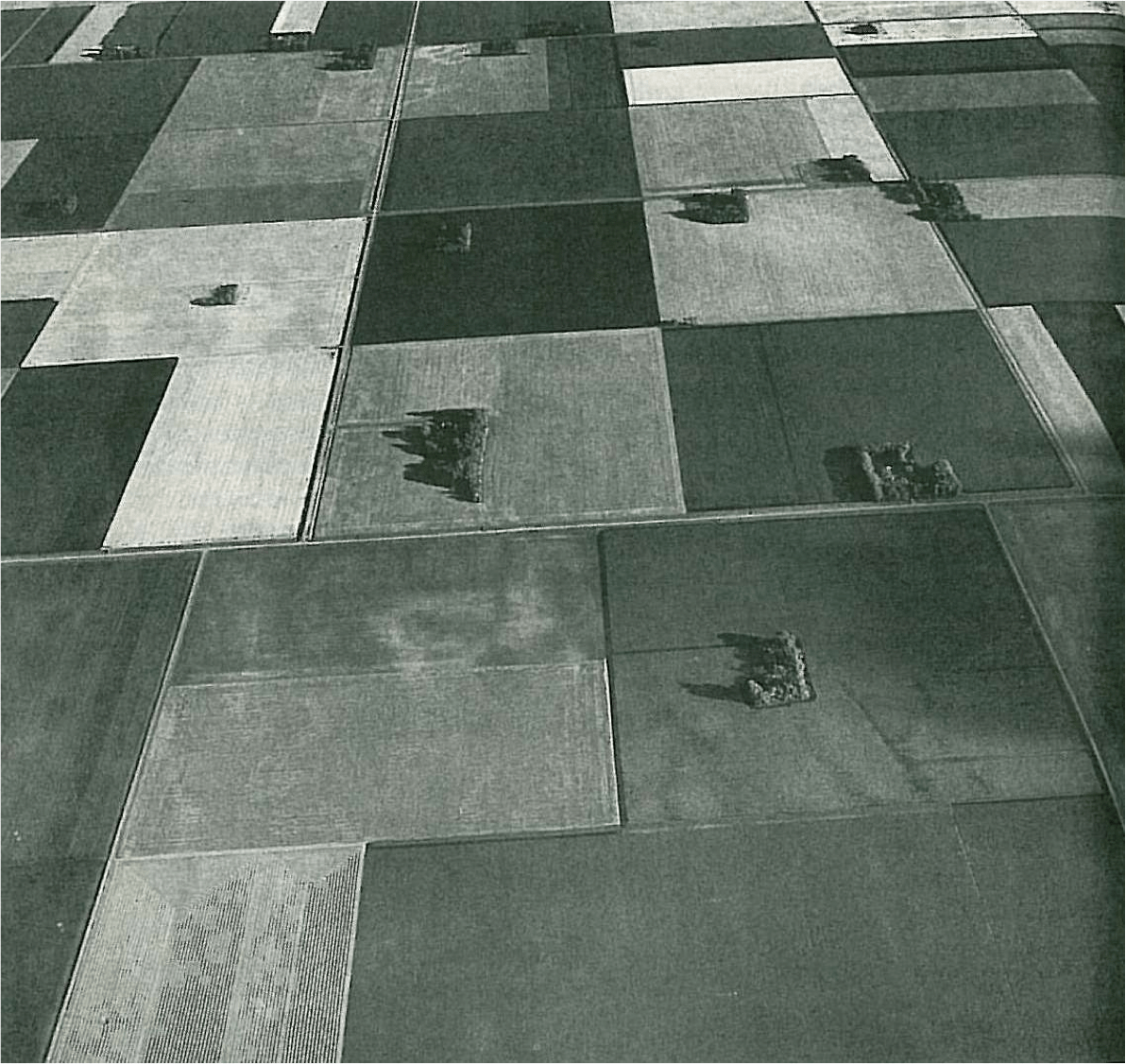
Which relates to what we mean by ‘development’. Development is not about building ‘things’; structural projects. Jane Jacobs, who wrote two excellent books on local economies, said it best: “Development is not about a collection of things but rather a process that creates things.” Those processes feed off each other to create a positive ‘virtuous circle’ (figure 4). What Jacobs was referring to was developing the very opposite of the self-reinforcing ‘vicious’ circle of cheap monocultural commodity (figure 2).

So rather than build a physical monument to someone’s ego sold on a false hope and living within the same cheap commodity theme, the focus shifts to the capacities of economic strategies, land, and people. These are the key ‘sites of action’ that are critical to the shift.

Getting off the emphasis on industrialised cheap commodity and re-focusing on market position and price retention is paramount. Embrace diversity and flexibility. The industrial spin merchants promising a temporary margin increase from some new technology are working in their interests, not ours. We ought to be particularly wary when they promote technologies that actually decrease our market position to the lowest grade of foodstuffs, such as GE.

The second key is to realise the potential within our climatic and landscape systems, both in terms of the land use patterns that create a resilient landscape – economically, environmentally, and socially – and in terms of creating capacities in our soils that lower input requirements and hold water against gravity and drying winds. Given our climate, and the threats of more extreme weather events in the future, then increasing these capacities over the wider Central Hawke’s Bay area is far more important than the 24,000 hectare proposed for irrigation. Water holding increases our resilience to droughts and floods while at the same time creating economic benefits, increasing biodiversity, water quality, economic options, lowering energy needs, and increasing carbon stores.

The research effort on land should be focused on building agro-ecological understanding, not led by production and techno-fixes. We need to work with climate and land, rather than try to force land areas that are uneconomic in pasture away from the woodlands and wetlands to which they are far better suited – economically and environmentally. That potential is also critical to the market position of our production. The mega-trends for discerning consumers are tasting the local difference (Terroir), environmental and food quality, and food safety.

We need to build the capacities of our people as critical to vibrant social systems and economies. Researchers and thinkers like Jacobs, Putnam and Sen emphasise social factors like participation, justice, trust, and the freedom to think, debate and create as essential. Those who emphasise spreadsheets and dollars usually destroy these capacities because they view ‘labour’ as an unconscious ‘factor of production’ without ideas; and people as box-ticking robots rather than having their own values and ideas.

There are other keys. Localising and building on the value off the land is also vital. So we should emphasising local processing, decentralised co-operative systems, and control of the value-chain to the end market. Family farms are far more important to a local economy than large-scale mechanical enterprises owned out of the region and staffed by cheap migrant labour.

All of these are strategic considerations to build the capacities of economy, land and people. These are moral issues as well as strategic issues, neither of which the financial and economic models capture, which is why qualitative strategy should always comes before quantitative finance within any development or investment framework.

The idea of healthy land, food and community and a strong shift away from corporate commodity, has not been seriously considered by the proponents of the dam. A focus on the one (dam) game in town, public relations, and the bamboozlement of sense by finance, has completely trumped strategic thinking. They are still thinking within the commodity trap, and cannot think themselves out of it.

Chris Perley

Posted in Land Use, Thought Pieces | 2 Comments

Edible Landscapes – Away from the Factory Model

There is many an idea presented as new that has its roots in days long past. We too often forget that the way things are done now was not always so.  We too often presume that the ways of today are destined to remain.

Beautiful_Reflections Jacki McCarten.jpg

Jackie McCartin – Beautiful Reflections

Today we are reinventing the old idea that we can make landscapes – farms and forests – yield many things of use to man and nature alike.  That doesn’t just mean looking at a forest or a field as more than a producer of wood fibre or grass and grain; it also means the development of a finer textured landscape where neither forests nor field dominate.  Forests of old were as much about food as they were about wood, and landscapes in older countries than ours reflect the potential of small sites rather than the singular obsessions of a narrow profession.  For those who see landscapes, the focus shifts from a resolution of 100 ha pixels to fractions of a hectare.  You find the potential in the finer resolutions.

In New Zealand we paint our land with a very broad brush – especially in the hill country.  Our legal boundaries reflect not so much the history and potential of land – trees best suited here, crops there, pastures yonder – as the tedious chore of some bored surveyor biting off 1000 acre quadrangles.  And within those borders we have tended to focus on one thing or another – a sea of ryegrass or a sea of radiata pine.  Anything else is treated as incidental to the primary purpose.  So mushroom collecting or deer stalking, for example, are only tolerated so long as they do not compromise the machine that produces the ‘main crop’.

Rectangle land

The last decade has seen both foresters and farmers rethink the idea that we concentrate on one thing over a broad swath of land.  The Perriams of Bendigo Station in Central Otago have turned a rabbit infested run into a mixed landscape of grapes, gold mining history and tourism, wild food, low-micron wool, quality wine, and recreational sport – and we mustn’t forget Shrek.  The Perriams produce pheasant, rabbit and other game for the tourists to eat accompanied by local wines.  They create experiences far richer than just the taste of a thing, and by so doing create value.  That is a far cry from a degraded sheep run.  The Perriams now have a problem.  They don’t have enough rabbits, and are harvesting the neighbours.  So they turn problems into profits, and poorer areas of land into opportunities.

Ernslaw One is doing a similar thing in their forests.  They have interests in forest food; in ginseng and edible fungus, and – now – freshwater crayfish, koura.  Koura indicate clean Freshwater Crayfishwater, and so demand high environmental standards. They therefore represent a delicacy that is more than just a tasty meal; they represent a clean landscape, one that people will pay for.  That is also an *experience*.  This is not a commodity that is forced to take an ever smaller price; the nature of the experience gives the product a premium, and the seller the market position to pick and choose who has the privilege to dine out on the story.
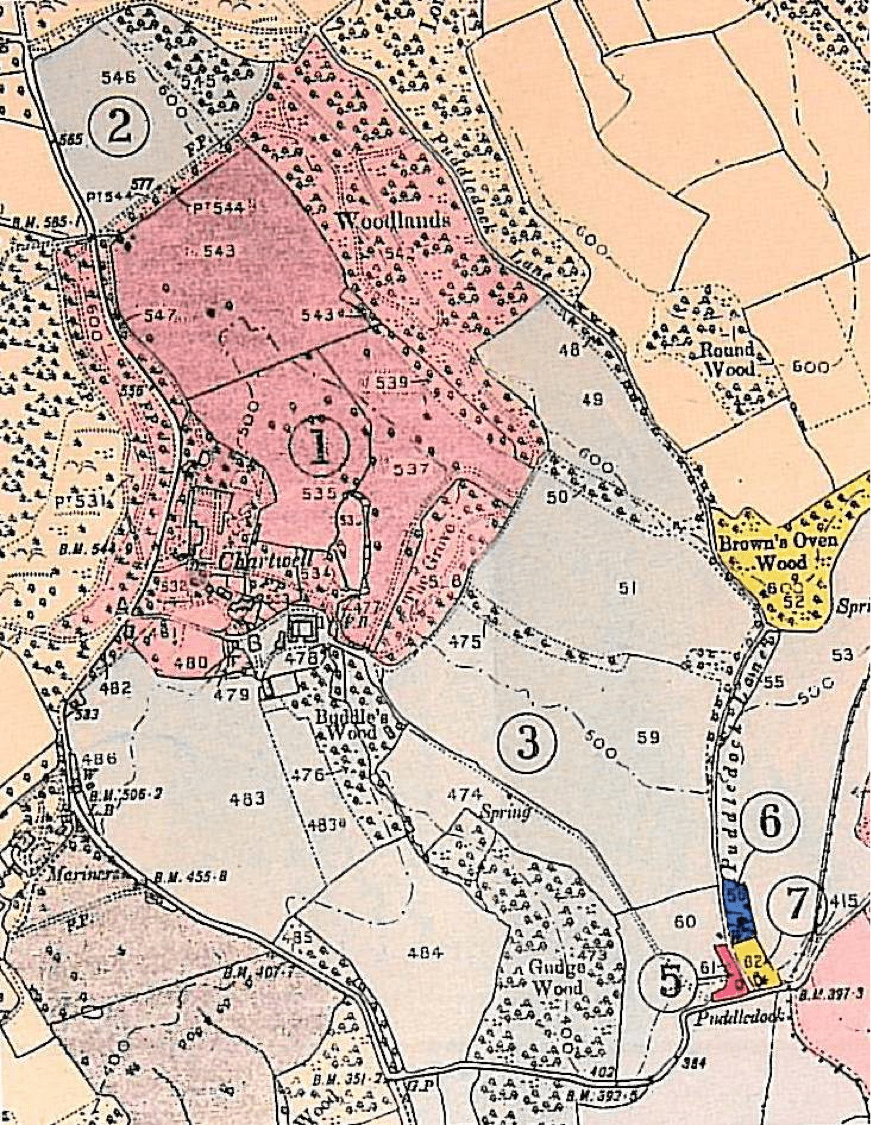
Roydon Downs south of Te Puke is an example of a landscape that combine field, forest, game birds, recreation, wetlands, complementary cashflow, low risk and beauty in one piece of land.  That is a way of doing business from the land that is the opposite of our usual style.

But such thinking is still not the mainstream. Farmers and foresters too often forget that they are land managers first, and farmers and foresters a distant second. History does not give them the luxury of presuming that the future will remain a static and predictable path. It will surprise. It will change. And anyone thinking within the box that says there ought to be one and only one thing in some spurious pursuit of a temporary efficiency – radiata pine or ryegrass – will likely get buried in it; the box that is.

Sissinghurst

History does more than indicate a pattern of change through time. It also demonstrates the potential for change and variety in space. If you look at ordinance maps of the rural landscapes of southern England you realise how young is New Zealand. The Weald of Kent, home of Churchill’s beloved Chartwell and estates like Sissinghurst, are famous – and scenic – because of the patterned landscape of fields and forests.

The arrangement of those patterns is seldom some rich man’s exercise in creating a canvas to please the eye of some Romantic poet. These are in the main functional landscapes, reflecting history, particular land quality, and the dependence of rural communities on both food from the fields and the goods and services provided by the woods. No community could survive in the pre-oil age without a forest.  They provided so much of what is now imported or produced from far away sources of oil and aluminium.  And it could never be a simple forest; it had to be complex to provide all the values demanded – from pig fattening acorns to barrel staves, firewood and herbs.

Chartwell

Rather than creating what they presume to be efficiencies and more profit, that obsession with the one thing has often resulted in the loss of money and opportunity. That is because the pursuit of cost efficiency presumes that nothing will change other than the cost. They do not see what might change to their detriment because specialists don’t like to think that hard. Alongside that obsession with specialisation rides the production of low value commodity, whose prices spiral downwards while we hope for the miracle that will turn that trend around, while doing absolutely nothing about it. Meanwhile, there are high value goods and services neglected or completely ignored because the blinkers of convention don’t allow us to whisper their names.

We don’t think of other things, so waste money forcing land, rather than working with it. For example, we continually develop and redevelop bits of land that is always going to be a cost to keep in grass, and many seldom think whether it is all worth it to every decade spend ten thousand to return seven thousand, before we spend the next ten again. At the opposite end of the scale, we plant radiata pine on hay paddocks, and seldom think twice. We make uniform and homogeneous what would be more profitable and enjoyable as a mixed and patterned arena.

Ernslaw One and Bendigo Station are but two examples of another way, one that we will see more of as the years go by and the more simple-minded men in suits realise that their specialised sophistication is also the reason why history will show them up as naïve and lacking judgment.  They have focus without breadth, and that is the worst of combinations.

Landscapes achieve a greater richness when they are viewed with a broad eye that senses both history and the potential to bring things together to make a delicious cake. It’s a hell of a lot nicer than just producing the single ingredients like flour.  For truly edible landscapes, the magic is in the mix.

Chris Perley

Thoughtscapes

Posted in Land Use, Socio-ecological Systems, Thought Pieces | 4 Comments

Ruataniwha Dam: The Winners and the Losers

The following is an Op-ed published in Hawkes Bay Today, Wednesday 9th April 2014, in response to a column by Federated Farmers Spokesperson Will Foley promoting the dam

Federated Farmer’s Will Foley highlights three conflicting issues in his defense of the Ruataniwha dam (HBT 3rd April 2014).

Firstly, he claims that farmers are keen to invest in the dam because ownership allows “more control over its governance.” An excellent point. This is a corporate model dam, selling to suppliers who are not its cooperative owners.

A strong corporate supplying to or buying off generally weaker individual farmers is a game that goes only one way. Those who control will use their monopoly power to dictate a price to farmers which is affordable, but only affordable using time-honoured methods of thrusting costs elsewhere – over the fence, or into the future, to society and the environment, by scaling up and using currently cheap energy. New Zealand’s successful models of farm processing and supply infrastructure have been co-ops. When Ireland corporatised its dairy processing, farmers were exploited. The road to serfdom, social and environmental decline. So yes, be inside the tent, and be very wary of powerful interests.

However, Mr Foley is dreaming if he thinks farmers will get control of this dam, even if a few do invest. They face competing demands for their capital. They must invest in on-farm infrastructure – irrigation and probably dairy conversion – resulting in an already high overhead of debt servicing. They can only invest in the dam through yet more debt.

Secondly, Mr Foley points out that a major investor has pulled out because the dam is too risky. What does this mean for the citizens of Hawke’s Bay whose risk is arguably greater than Trust Power’s?

Lastly, Mr Foley asserts that farmers won’t ‘get rich quick’ out of land value rises or increased profitability. The claim there will be no land value rise is laughable. Water rights and infrastructure development will capitalise into land. They always have. As to operating profitability, Mr Foley is probably correct.

All these conflicting issues raise questions: who, then, will benefit? The banks inevitably. They will lend on the dam construction. They will also lend on the purchase and development of farms. The owners of the dam might also win. They can always increase the price of water not in contract, or sell it to someone else who’ll pay; a fracking company perhaps. The corporates will probably be alright. They usually are under the current ideology that is power and money-affirming rather than life-affirming.

There is a mirror question: who then will lose? The answer is family farms as they sell out to corporate farms, the local community and economy as corporates centralise their purchases, the environment, and we citizens who have been sold the half-truths and had their perceptions ‘managed’ by this council.

The risk to farmers cannot be over-emphasised. If you face extreme overheads associated with a fixed contract for water from a powerful monopoly corporate supplier, high debt servicing for farm purchase and any development costs for irrigation and conversion, then that is an anvil waiting for a hammer. The hammer is the long-run real price reduction of commodities. They are currently spiking because of China and quantitative easing. Yet production of milk is expanding in the third world with nice cheap cost structure. We are even helping them do it.

The seductive promotion of this dam should be seen for what it is. Like all good propaganda, they play on our fears and claim inevitability. They pluck the heartstrings of our colonial identity in the interests of corporate promoters, not our people or our land. We are taught this identify at the feet of our fathers, at our agricultural colleges, and through the media. Produce more. Feed the world. Hope and hail every promise of a temporary increase in our financial margins. All will trickle down to the local community with jobs and increased spending. Meanwhile, an anticipating Fonterra is expanding its milk drying capacity in Pahiatua.

We can no longer afford to think this way. High energy input, high production, low value, retail-dominant industrial agriculture is destructive to family farms, local communities, local economies and local environments.

There are alternatives. We can shift from narrow production to diverse value. From industrial supply chains with our land supplying cheap commodities, to controlling supply chains from the farm, through the local economy to the consumer. From treating land as a large-scale factory, to treating land as a system with enormous potential for variety and value, critical to which is the management of rain and water-holding within the farm itself.

The world is full of failed dams sold on empty promises and hope. Hope is as blind as love it seems. The real hope is in not getting stuck in the industrial past.

Chris Perley

Posted in Land Use | 1 Comment

The Renaissance of an Ethos of Care

It is now more and more a forgotten fact that much of the effort by the New Zealand state in planting trees in the landscape had as its primary goal the ‘protection’ of some social and environmental value.  These values were non-tradable; they didn’t provide a direct return as ready cash.  That is the way of value.  Much of that past tree establishment was about maintaining some quality, some capacity, some potential that does not sit easily on a balance sheet.  It was much more to do with care and a better New Zealand, then merely dollars in a spreadsheet: An Ethos of Care.

We need it back again.

Often those qualities we cared to protect were of importance to the wider community, or to those downstream, as much or more than they might be to the owner of any land.  It is in the realm of this type of widely connected, networked, non-capital value that the market and dollar-drenched spreadsheets is such a poor arbiter of what we ought to do.  The market is not wise in scope beyond the short term and a traded dollar; and even then is narrow of wit.  Land and community cannot be known merely through columns of figures.

Image  Image

In the past, the landscape value most at issue related to protecting soil and water; soil for its productive and economic potential, and water-borne soil in its potential to create hazard and to lose productive potential somewhere else, usually downstream.  It was recognised as a problem well over a hundred years ago.  Prime Ministers such as Stafford and Vogel from the 1870s were concerned about the role of forests to protect the land, and those new settlements that tended to be located on the plains below.  But that didn’t stop our forefathers clearing the forest and shrubland from much of our hard hill country to put it into the new god, grass.  Much of the cleared land was the sort of country that in Europe and North America would have been kept in forests, or at least allowed to regenerate after overzealous clearing.

In our curiously grass-obsessed culture, many now argue that we went too far.  They look to the efforts to control high country scree slopes using mountain pines such as Pinus contorta as being both of debatable merit, and of literally sowing the seeds for future problems.  Catchment boards were also accused of being overzealous in planting erodible hillsides in now-problem poplars in an attempt to maintain grazing.  These are easy criticisms to make.  We are a young country, and when you are dealing with the time periods associated with trees, the mistakes take a few more years to become obvious.

And we have made mistakes.  The question is whether we are learning, and making things better over time, or whether we have slipped back over the last 30 odd years.

In the past, the intent was right; perhaps not in the high country, but very much so within erodible hard hill country where the loss of woody vegetation creates one problem compounding upon another.  Many of the soils that extend from the Wairarapa hills up to the East Coast, and through the Manawatu and Wanganui hill country are based on sedimentary and highly erodible mudstones and sandstones.  High rainfall combined with steep terrain over sometimes as little as 20 degrees of slope, and soils can slip off slopes like a block of wet soap; a recipe for erosion.

The compounding and cascading domino effects are treated by some – especially those who only know dollars – as surprising outcomes, no matter how predictable they are to those dealing in wider land use policy.  They are not surprising.  The linkages are obvious to those that know land and community.

You lose your hill country soil, and with the soil gone you lose the capacity of the hill country to hold and store water associated with quite significant rain events of 50 mm or so.  With the forests gone, the problem is exacerbated.  The strength of the slope is significantly reduced.

The soils can then no longer store the size of storm events that we periodically get in these hard hill North Island areas, nor can they can buffer the flow into the river system, and extend the run of streams.  You trend to the violent dynamic of a flashflood boom-bust rushing wadi, followed by an empty dry gulch.

In up to moderate storm events, deep, porous soils with high water holding capacity will significantly reduce the quick overland flow that can come from shallow, compacted grassland soils; which is like rain on a concrete face.  That quickflow and loss of woody habitat creates yet more erosion (a classic positive feedback of more creating more creating more …. until collapse) which links through to more social and economic loss to the plains below.  To know, you have to link.  To link, you have to understand the system.  To understand the system, you have to be able to think in a wider space than some silo speciality.  You have to have a sense of the whole, and have the ethos that cares about consequences.

Fast run-off also affects the soil fertility store, the carbon store, and the biotic life on land and in our water systems often buried in silt.  You can end up with a shallow, droughty, structureless soil, with little water retained in the landscape.

The storm events of 1988 (Bola), 2004 (Manawatu-Wanganui) and 2011 (Cape Kidnappers-
Kairakau coast, Hawke’s Bay) have resulted in little that could be considered positive. The East Coast scheme has probably created more animosity toward trees than acceptance of them.  The 2004 Manawatu-Wanganui floods were a classic example of a system without much of a rudder.  During the storm, 200 million tonnes of sediment slipped off farmed hill slopes.

We once had a government knowledge system that linked research, policy, and the facilitation of localised best practice.  imagesNow we have isolated hierarchical rumps, many so specialised into blinkered silos of non-thought and competition that they are incommunicative within themselves let alone with others.  The further up the hierarchies developed by shallow and narrow Treasury minds, the less linkages are understood, and the less they care about consequences beyond the immediate contractual milestones.

What we have lost.  Where wind and localised erosion was a problem, the now defunct catchment boards had excellent professional and practical staff learning from and providing advice to land managers.  They were backed by the also defunct National Water and Soil Conservation Organisation (NWASCO), the Ministry of Works and Development, the old Department of Scientific and Industrial Research (DSIR), the Forest Research Institute.  The relationships between researcher and advisor were personal as well as professional, with a self-supporting ethos of both care and responsibility.  Now the links are ‘contractual’, and crown research ‘business managers’ ensure you leave your ethos at the door.

This policy approach of active local and central government involvement – with a well established network between research, policy, and practice, where each learned off the others, and where the will and capacity to cooperate was strong and continually reinforced – because people cared – is now considerably reduced.  We used to work with people; now we impose a regulation, or assume some market instrument will imagesprovide the answer.  Knowledge is now much more hierarchical than networked, despite the efforts at participation, because the central policy structures are set up that way, with control, direction, and dis (dys?)-integrated isolation the Modus Operandi.
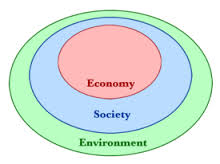
We are no longer as wise because, rather than an integrated, open-discourse on issues and solutions down to the local, we now have empty clichés such as “the market will provide” expressed as some axiomatic religious catechism.  We need to change that before we can hope to change the arrogance of isolated technocrats.  Attempts at collaboration will tend to be token without new thinking being core to the way people and the public sector work.

The old catchment board functions are now nominally provided by the regional council structure, but the capacity to respond to events varies widely between councils.  Some have adequate professional staff, knowledgeable about land management, able to relate to local people, and able to input to local policy.  Other councils have few people with such capacity, and those that do have little influence on policy, all compounded by management structures that emphasis bureaucratic task-orientated box ticking over adaptive, actively thinking, place-based action.

images

Perhaps most reduced of all is the ability to coordinate and cooperate across the many environmental, social and economic issues that relate to land.

The loss of soil through erosion was the big protection issue of the past.  That focus has shifted.  Currently we have many more environmental issues – all linked to the capacities and qualities of our social and economic life – that are raising their heads with no obvious system that can coordinate the whole.  Biodiversity, but only if it’s indigenous, has been the issue of the last 25 years since 1987.  It is almost as though we dropped the soil conservation ball in order to pick up the biodiversity one.  Multitasking is not valued apparently.

Now we have a sharply rising and immediate concern for water quality, and associated recreational values, particularly as affected by intensive land use.  The issue of soil degradation, as distinct from erosion, is related to that same trend.  Over the last 15 years, the links between climate, land use intensification, and stores of carbon have been on the rise.  The prospects of droughts and floods have raised the importance once again, of landscapes that can slow, store and detain water – not in dams, but in the landscape itself.

And now the issue of future energy balances is well above the horizon, though there are still those who live in denial of a constrained future, and seek only to burn the furnace ever brighter on the runaway train without thought of any approaching cliff.

If we look to the coordination of these issues within their own environmental domain, let alone linking them to our social and economic futures, then our government and institutional structures seem woefully inadequate.  DoC have been underfunded, but also have a poor reputation when talking with land owners as fellow colleagues for mutual benefit.  They are too detached from the potential for mutual benefit because single function reserves are aligned against single function production as the only two options.  Where then, do we put the fence.  The conflict occurs because between farmer and preservationist, neither mindset is prepared to shift to one that can encompass part of the other.  Silos and false Treasury assumptions of the ‘efficiency’ of single function myopia creates that impasse.  Neither can accommodate the others’ point of view.  DoC have little incentive to integrate other environmental issue besides indigenous biodiversity managed in preserves – energy, carbon, ecosystem services to land and community, climate change, water detention, soil function.  They also have a reputation of favouring regulation (“thou shalt not ….”) as a policy approach when the real gains come from value change (from both sides) and reinforcement, itself requiring integrative thinking.

images

Integrated systems thinking is perhaps the greatest imperative, destroyed by the mechanical and self-centred world of Treasury economists and their large corporate backers.  Environment, economy, society and culture are all linked, however dys-integrated the ‘reforms’ since 1984 were, premised on a competitive silo model.  And within each domain – environment and society (which includes the economy) – the linkages also flourish.  The environment is a strongly linked system where landscape functions of biodiversity, ecosystem services, water detention, water quality, soil conservation, energy demand and carbon balance are all mutually supporting.  

You can design a landscape that does all of it.  And more.  Realising our economic and cultural potential is strongly – and positively – linked with our environmental capacity.  The silo minds do not realise this, and so destroy that potential to which they are blind.  

Many in the Ministry of Primary Industries (whose name indicates how they see land as an industrial machine) think woody vegetation within farmed landscapes as some sacrifice to their favoured green grass god, and suggest – if anything – yet more separate silos of radiata pine as they lift their eyes from the financial spreadsheet.  The Ministry for the Environment seems to have lost the heart it once had, with the best keeping their heads down, and the management peopled by ex-Treasury economists who are taught to see dollars in models.

The regional councils vary from excellent to awful, some gallantly performing in spite of the lack of integration with research and central government policy. The research structure imposed in 1992 is an expensive, bureaucratic, inflexible, and isolating charade. Getting any coordination and cooperation through to policy and practice is hard enough; let alone getting them to talk together.

Time for a change. But first we have to change the ideas that dominate policy from dis-integrated money-affirming mechanics, to integrated, life-affirming connected systems.  We need some capacity to coordinate the whole that is currently woefully lacking.  Do we need a Land Commission?  Or at least think about it – and by ‘think’ I mean also recognise neo-liberal Treasury economists as expounding a fundamentalist faith that affirms power and money, not long-term life.  Their irrational ideas are very much a part of the problem, not the solution.

Such a rethink represents a Rennaisance of an Ethos of Care; to legacy building, to integrity, to opportunity, to thought, to a resilient and value-based future, to civilisation.


Chris Perley

Thoughtscape


Posted in Land Use, Resilience Thinking, Thought Pieces | Tagged , , , , , | 1 Comment